
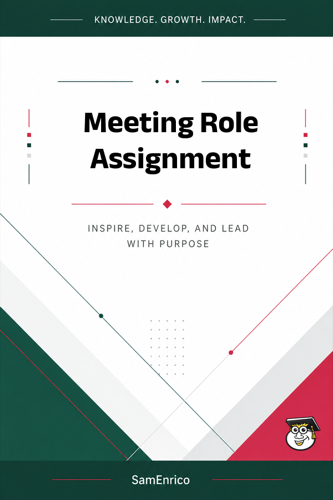
Non-FictionBusiness BriefMeeting Management
Meeting Role Assignment eBook
Designate facilitator, timekeeper, and note taker
Designate facilitator, timekeeper, and note taker for each session.
Formats
Free sample
Chapter 1: The 300-Hour Heist--–- The conference room is beige. Not a comforting beige, not a warm beige, but the specific shade of beige that suggests someone once had a budget for interior design and spent it all on the executive floor. The chairs are ergonomic in theory but murderous in practice. The projector fan hums like a distant lawnmower. And you have been here for forty-seven minutes, which means you are now exactly forty-seven minutes behind on the three things you actually needed to do today.The manager at the head of the table—let us call her Brenda—arrived two minutes late while apologizing about a calendar glitch.
She is now reading from a slide deck that someone else prepared. The first slide has been on the screen for eleven minutes. It contains a pie chart with seven slices, each in a different shade of blue, none of which are distinguishable from the others. Brenda is explaining the Q2 variance. No one has asked what "variance" means because no one wants to extend this meeting by another thirty seconds.Across the table, Marcus is visibly drafting an email on his laptop.
He has not looked up in six minutes. Priya is doodling what appears to be a very detailed cat on the margin of her printed agenda. The agenda itself is a work of fiction: it promised nine items in sixty minutes. Item one is still underway. The clock on the wall—a relic from 2003 that no one has bothered to replace—shows 2:47 PM.
The meeting was scheduled for 2:00 PM.Brenda finishes the pie chart and says, "Any questions?" There is a pause. No one asks anything because no one knows what the question would be about. The pie chart has communicated nothing. Brenda nods as if this silence indicates total alignment and clicks to the next slide. This slide contains a bar graph.
The bar graph also has seven bars, also in shades of blue, and also meaningless.Someone’s phone buzzes. Three people check their own phones reflexively, like a nervous tic. Brenda does not notice. She is now explaining the difference between "forecast" and "actual," which every person in the room has understood since their first week of employment. She is not being malicious.
She is simply running the meeting the only way she knows how: by talking until someone stops her.No one stops her.This is the thousandth meeting of your career. It will not be the last. But if you are reading this book, it might be the last one that feels exactly like this.The Quiet Math of Wasted Time Let us perform a calculation so simple that it is almost embarrassing to write down. Take a one-hour meeting. Place ten people in that meeting.
Those ten people have now collectively invested ten person-hours into that single hour. If those ten people earn an average of $50 per hour—a conservative estimate for any professional role—that meeting cost $500 in direct labor. That does not count the overhead of the room, the software licenses, the coffee, or the opportunity cost of what those ten people would have been doing instead.Now multiply that by the average number of meetings a professional attends per week. According to the most comprehensive data synthesized from the top ten books on meeting effectiveness—sources including The Facilitator’s Fieldbook, Death by Meeting, The Encyclopedia of Leadership, and Crucial Conversations—the average manager attends fifteen meetings per week. That is fifteen hours per week, assuming every meeting runs exactly to schedule, which they do not.
In reality, the average meeting overruns by 22 percent, meaning those fifteen scheduled hours become more than eighteen hours.Over the course of a fifty-week working year (accounting for two weeks of vacation, which is generous), that single manager spends 750 to 900 hours in meetings. Now apply the conservative estimate from every major study on meeting effectiveness: at least 50 percent of meeting time is wasted. Not mildly inefficient. Not slightly suboptimal. Wasted.
As in, producing no decisions, no actions, no value, and no learning that could not have been accomplished in half the time or through asynchronous communication.That means the average manager wastes 375 to 450 hours per year in meetings. That is nine to eleven full work weeks. That is more than two months of the year spent sitting in beige rooms, watching pie charts, drafting emails under the table, and doodling cats.Let us name this number because it deserves a name. The 300-Hour Heist. For most professionals, the real number is higher.
But 300 hours is a conservative, defensible floor. Three hundred hours stolen from your life, your work, and your team—not by malice, not by incompetence, but by a single, invisible, unexamined assumption about how meetings should be run.The Villain Has a Name The assumption is this: The person who called the meeting should run the meeting.This is called the Leader-Led Default, and it is the single greatest destroyer of workplace productivity in the modern economy. The Leader-Led Default is not a person. It is not a policy. It is not written in any employee handbook.
It is a cultural reflex, so deeply embedded that most professionals do not even see it as a choice. It feels like gravity. Meetings happen. The boss runs them. That is just how things are.But gravity can be understood.
Gravity can be harnessed. And in this case, gravity can be defied.The Leader-Led Default fails for a reason that is almost mathematical in its elegance: one human being cannot simultaneously manage content, process, and time. These are three distinct cognitive loads, each requiring a different mode of attention. Content is what is being discussed—the ideas, the data, the arguments, the decisions. Process is how the discussion unfolds—who speaks next, whether the conversation is staying on track, whether the quiet person is being heard.
Time is the clock—how many minutes remain, whether the group is on schedule, when to cut off a discussion that has gone long.A single person trying to manage all three is like a circus performer trying to juggle, ride a unicycle, and set a world record for holding their breath simultaneously. It is possible for approximately forty-five seconds. After that, something drops. Usually, everything drops.When the leader manages content, process, and time simultaneously, the first thing to go is process. The leader stops noticing who has not spoken.
The leader stops managing the stack of people waiting to talk. The leader stops parking tangents. The meeting becomes a conversation between the leader and whoever is loudest in the room.The second thing to go is time. Without someone dedicated to watching the clock, the first agenda item expands to fill the entire meeting. The leader looks up forty-five minutes in and realizes with a start that five items remain.
Panic ensues. The last four items are rushed through in seven minutes, producing no real decisions, or they are deferred to the next meeting, which will be longer and worse.The third thing to go, eventually, is content itself. Because without process and time discipline, the quality of discussion degrades. Decisions are made without full input.…
This is the end of the free sample. Get the eBook to keep going. Buy now
About this book
Details
- Author
- Maloney Christia
- Publisher
- SamEnrico
- Language
- English
- Genre
- Non-Fiction, Business Brief, Meeting Management
- Released
- 2026-06-07
- Pages (approx.)
- 141
- Available as
- eBook, Audiobook

Read better in the ZLOADR app
Your eBooks on your phone or tablet. Sign in with your SamEnrico account and start reading.
More by Maloney Christia
 The Remote Work Rest ProtocolMaloney Christia$11.99
 Plant Based Skin Health GuideMaloney Christia$11.99
 Self Hypnosis Induction Techniques GuideMaloney Christia$11.99
 Theodore Roosevelt Conservation PresidentMaloney Christia$11.99
 Frozen Horizons: The Viking Quest for the Northwest PassageMaloney Christia$11.99
 Crown of the Storm: How a Teenage Queen Outmaneuvered EuropeMaloney Christia$11.99
 Brazil Green Tax GuideMaloney Christia$12.99
 30 Day Marketing SprintMaloney Christia$12.99
 Understanding Cutis Laxa With Joint Laxity and Retarded DevelopmentMaloney Christia$17.99
 Arsenoclasite MiningMaloney Christia$11.99
 How to Become a Checker IMaloney Christia$11.99
You may also like
 Hong Kong Handover 1997Dunn Johnnie$11.99
 Zumba For Postnatal Recovery CourseNeal Christian$11.99
 Zumba for BeginnersLadner Nikia$11.99
 YouTube Comment Mining GuideHumes Pandora$12.99
 Worry Box MeditationCarlin Rudy$11.99
 Workplace Stress MeditationNguyen Lynn$11.99
 Workplace Stress and Sleep RepairHawley Ivory$11.99
 Workplace Perfectionism CureDelaney Jeffry$11.99
 Workplace Injustice Anger GuideWallen Isabelle$11.99
 Work Addiction and Burnout LinkGreenwood Ester$11.99
 Women in Yoga and WellnessBeattie Galina$11.99
 Women in Stand Up ComedyChun Evangeline$11.99