
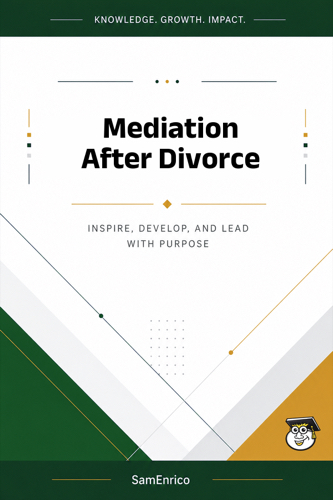
Mediation After Divorce eBook
Resolve disputes without court through collaborati
Resolve disputes without court through collaborative negotiation.
Formats
Free sample
Chapter 1: The $50,000 Mistake--–- The email arrived at 11:47 on a Tuesday night. Sarah had been staring at her ceiling for three hours, replaying every fight, every silence, every moment she wished she could take back. Her lawyer had just sent the latest bill: $14,800. For two months. They hadn't even set a trial date yet.
Her ex-husband's lawyer had filed a motion to compel discovery. Her lawyer had filed a motion for a protective order. The judge had scheduled a hearing to hear arguments about whether they needed a hearing. Sarah was a high school English teacher. She made $62,000 a year.
She had just spent nearly a quarter of her annual salary on absolutely nothing—no agreement, no resolution, no peace. Just two lawyers billing her for the privilege of hating each other.–- This is the divorce economy. And if you are reading this book, you are likely standing at the same crossroads Sarah faced: one path leads to court, where the average contested divorce costs $20,000 to $50,000 per person and takes twelve to eighteen months; the other path leads to mediation, where the average cost is $3,000 to $7,000 total and the timeline is eight to twelve weeks. The difference is not just money. It is the difference between coming out the other side with your retirement account intact or drained.
It is the difference between your children watching you cry in a courthouse hallway or watching you shake hands in a mediator's office. It is the difference between a life defined by revenge and a life defined by simply moving on.–- This chapter is not a gentle introduction. It is a wake-up call. Before we talk about parenting plans, financial disclosure, or how to negotiate with a narcissist, we have to talk about the single most important decision you will make in your entire divorce: whether you choose the adversarial system or the collaborative system. The choice you make in the next thirty days will determine not only how much money you have left when this is over, but who you become on the other side.The Great Divergence: Two Paths, Two Destinies–- Every divorcing couple stands at the same fork in the road.
On one side is the adversarial model—the court system, the lawyers who bill by the hour, the motions, the depositions, the hearings, the trial. This system was designed for strangers who never have to see each other again. It works reasonably well for a business dispute between two companies that will never share another meal, another holiday, another parent-teacher conference. It is a catastrophic failure for parents who will have to coordinate school pickups for the next twelve years.–- On the other side is the collaborative model—mediation, negotiation, interest-based bargaining, and (if necessary) collaborative law with trained attorneys who commit to settling rather than fighting. This system was designed for people who have to maintain a functional relationship after the divorce is final.
It assumes you are not enemies, even if you feel like enemies right now. It assumes you have shared interests, even if you cannot see them through the fog of anger and grief.–- The table below is not theoretical. It is drawn from actual data collected by the American Arbitration Association, the National Association of Divorce Professionals, and court records from across the United States. Read it carefully. Then read it again.Factor Adversarial (Court)Collaborative (Mediation)Average cost per person$20,000 – $50,000$3,000 – $7,000 total (split)Average timeline12 – 18 months8 – 12 weeks Control over outcome Judge decides You decide Emotional toll Very high Moderate Post-divorce relationship Adversarial or broken Functional or cooperative Children's adjustment time2 – 4 years (severe cases)6 – 12 months (typical)Likelihood of returning to court30% – 40% within 3 years5% – 10% within 3 years–- These numbers are averages.
Your specific situation may be better or worse. But the direction is unmistakable. Court is slower, more expensive, more destructive, and more likely to produce a second round of litigation when someone gets remarried, loses a job, or wants to move to another state. Mediation is faster, cheaper, more humane, and far more likely to produce a lasting agreement.–- Here is what the numbers do not capture: the morning Sarah received her $14,800 bill, she called her sister and sobbed for twenty minutes. She had missed her daughter's school play because she was on a conference call with her lawyer.
She had stopped sleeping through the night. She had started drinking a glass of wine (then two, then three) every evening just to take the edge off. Her ex-husband, a decent man she had loved for fifteen years, had become a monster in her mind—not because he was a monster, but because their lawyers had turned every minor disagreement into a battlefield. That is what the adversarial system does. It does not resolve conflict.
It monetizes it.Sunk Costs: Why You Keep Throwing Good Money After Bad–- Economists have a term for what happens when people pour resources into a losing endeavor: sunk cost fallacy. It is the cognitive bias that makes you finish a terrible movie because you already paid for the ticket. It makes you stay in a failing business because you have already invested so much time. And it makes divorcing couples burn through their life savings because they have already spent $10,000 and "cannot afford to lose now."–- Here is how sunk cost fallacy plays out in a typical litigated divorce. Month one: you hire a lawyer and pay a $5,000 retainer.
Month two: your lawyer files a complaint. Your ex's lawyer files an answer. You have spent $8,000 and accomplished nothing. Month three: your ex hides some assets (or you think they did), so your lawyer files a motion to compel discovery. Their lawyer objects.
The judge schedules a hearing. You have spent $12,000 and are no closer to a settlement. Month four: you realize you could have mediated this whole thing for $5,000 total. But you have already spent $12,000. If you stop now, you have "wasted" that money.
So you keep going. Month six: you have spent $18,000. Month nine: $25,000. Month twelve: $35,000. Your retirement account is gone.
Your children's college fund is depleted. And you still do not have a signed agreement.–- This is not hypothetical. I have sat across from dozens of clients who described this exact trajectory. Every single one of them said the same thing: "I wish someone had stopped me at month two."–- The antidote to sunk cost fallacy is a simple mental exercise. Ask yourself: "If I were starting over today, knowing everything I know now, would I choose the path I am on?" If the answer is no, stop.
The money you have already spent is gone. It is not coming back. Continuing to spend more money does not recover the money you lost. It only adds to the loss.BATNA: The Single Most Important Concept You Have Never Heard Of–- In the Harvard Negotiation Project's seminal book Getting to Yes, authors Roger Fisher and William Ury introduced a concept that has saved billions of dollars in litigation costs: BATNA, which stands for Best Alternative to a Negotiated Agreement.–- BATNA sounds academic. It is not.
It is the most practical tool you will ever use in a divorce negotiation. Here is what BATNA means in…
This is the end of the free sample. Get the eBook to keep going. Buy now
About this book
Details
- Author
- Leighton Lenna
- Publisher
- SamEnrico
- Language
- English
- Genre
- Non-Fiction, Self-Help, Mediation
- Released
- 2026-06-12
- Pages (approx.)
- 122
- Available as
- eBook, Audiobook

Read better in the ZLOADR app
Your eBooks on your phone or tablet. Sign in with your SamEnrico account and start reading.
More by Leighton Lenna
 Voice Warmup Before SpeakingLeighton Lenna$11.99
 The Teen Self Esteem Coloring BookLeighton Lenna$11.99
 Workplace Anger When You're RightLeighton Lenna$11.99
 The Calcium Bone Health HandbookLeighton Lenna$11.99
 The Ballad of the Phantom Ballerina: How a Forgotten Dancer Changed the GameLeighton Lenna$11.99
 YouTube Product Launch GuideLeighton Lenna$12.99
 European Travel Spending RecoveryLeighton Lenna$12.99
 How to Become a Color-card MakerLeighton Lenna$11.99
 Calderite MiningLeighton Lenna$11.99
 Understanding Polymorphic Catecholergic Ventricular TachycardiaLeighton Lenna$17.99
You may also like
 Active Listening for Mediation and ArbitrationLadd Lenora$11.99
 NVC Mediation GuideCarmichael Carry$11.99
 Initiating A Mediation SessionSheets Cordell$11.99
 The Third Party Mediation GuideDodge Cathryn$11.99
 NVC For Mediation GuideFraley Georgeanna$11.99
 Mediation With NVC GuideCrider Garret$11.99
 Mediation Techniques GuideAmato Lupe$11.99
 Listening In Mediation GuideCain Thelma$11.99
 Self Doubt In Mediation GuideFrye Clare$11.99
 Listening For MediationMartins Verona$11.99
 Divorce and Mediation GuideCase Paulina$11.99
 Active Listening For MediatorsSheets Trina$11.99