
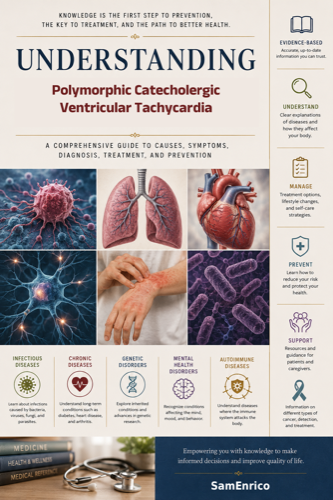
Understanding Polymorphic Catecholergic Ventricular Tachycardia
This disease publication, published by SamEnrico,
This disease publication, published by SamEnrico, covers Understanding Polymorphic Catecholergic Ventricular Tachycardia
Formats
About this book
Free sample
Chapter 1: The Falling Child...--The first time I saw a child collapse from catecholaminergic polymorphic ventricular tachycardia, I almost missed it entirely.She was seven years old, with pigtails and a missing front tooth, and she had been running the bases during a school field day. One moment she was laughing, pumping her small arms as she rounded second base. The next moment she was on the ground. Not sliding—sliding is controlled, intentional, athletic. She simply stopped being upright and became horizontal, as if someone had pulled a plug.
By the time I reached her, she was already waking up, confused, asking why everyone was looking at her. Her pulse was strong. Her color was good. Her heart sounded normal through the stethoscope. Two hours later, the emergency department discharged her with a diagnosis of dehydration and a suggestion to "follow up with her pediatrician."That was the first missed opportunity.It would not be the last.
Not for her, and not for the hundreds of children like her who pass through emergency departments, cardiology clinics, and neurology offices every year, each one carrying the same invisible time bomb inside their chests.The Most Misunderstood Heart Condition You Have Never Heard Of Catecholaminergic polymorphic ventricular tachycardia—CPVT for those who prefer acronyms to tongue twisters—is arguably the most lethal cardiac condition that most physicians will never diagnose correctly on the first try. It is also one of the most treatable, which makes every missed diagnosis a small tragedy and every correct one a potential miracle.Let me be precise about what we are discussing. CPVT is an inherited arrhythmia syndrome characterized by syncope, cardiac arrest, or sudden death during physical exertion or emotional stress in individuals with a structurally normal heart. That last clause is the killer, in both senses of the word. A structurally normal heart means that when you perform an echocardiogram—the gold standard imaging test for heart structure—everything looks perfect.
The chambers are the right size. The walls move appropriately. The valves open and close as they should. There are no clots, no…
This is the end of the free sample. Get the eBook to keep going. Buy now
Contents
- Chapter 1
- Chapter 2
- Chapter 3
- Chapter 4
- Chapter 5
- Chapter 6
- Chapter 7
- Chapter 8
- Chapter 9
- Chapter 10
- Chapter 11
- Chapter 12
Details
- Author
- Leighton Lenna
- Publisher
- SamEnrico
- Language
- English
- Genre
- Non-Fiction, Informative, Educational
- Released
- 2026-05-08
- Pages (approx.)
- 144
- Available as
- eBook, Audiobook

Read better in the ZLOADR app
Your eBooks on your phone or tablet. Sign in with your SamEnrico account and start reading.
More by Leighton Lenna
 Mediation After DivorceLeighton Lenna$11.99
 Voice Warmup Before SpeakingLeighton Lenna$11.99
 The Teen Self Esteem Coloring BookLeighton Lenna$11.99
 Workplace Anger When You're RightLeighton Lenna$11.99
 The Calcium Bone Health HandbookLeighton Lenna$11.99
 The Ballad of the Phantom Ballerina: How a Forgotten Dancer Changed the GameLeighton Lenna$11.99
 YouTube Product Launch GuideLeighton Lenna$12.99
 European Travel Spending RecoveryLeighton Lenna$12.99
 How to Become a Color-card MakerLeighton Lenna$11.99
 Calderite MiningLeighton Lenna$11.99