
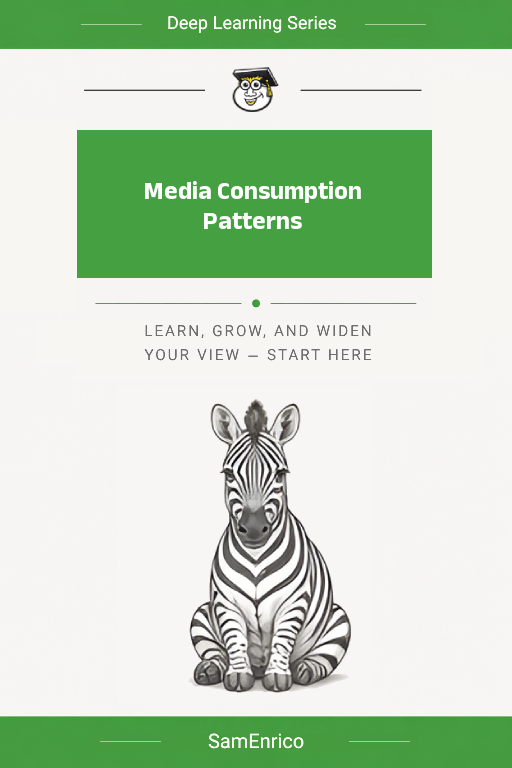
Non-FictionConsumer Mind ReportMedia Strategy
Media Consumption Patterns eBook
Examines TV, streaming, podcast, radio, and news c
by Wills Micah
Examines TV, streaming, podcast, radio, and news consumption differences for media planning strategies.
Formats
Free sample
Chapter 1: The Vanished Audience...–- At exactly 8:47 PM on May 23, 2009, something died. You probably didn't notice. Most people didn't. But if you had been watching the Nielsen ratings scroll across a media executive's screen that night, you would have seen the exact moment when the last truly mass audience blinked out of existence.The show was the American Idol season eight finale. Nearly 29 million Americans watched Adam Lambert lose to Kris Allen.
It was the last time any single broadcast would capture more than 25 million viewers for a non-sports event. Within five years, the Idol finale would drop to 10 million. Within ten, the show would be canceled. And in its place? Not another show.
Not another network. Nothing that could be pointed to as the "replacement."That's the first thing you need to understand about the fragmentation of media: it wasn't a war with a winner. It was an explosion with no single shrapnel piece large enough to matter.The Great Unwinding For most of the twentieth century, media consumption followed a predictable pattern. Three television networks (ABC, CBS, NBC) divided the primetime spoils. A handful of radio formats (Top 40, News/Talk, Country) dominated the airwaves.
Daily newspapers, often one per city, set the morning agenda. The math was simple: limited channels, limited hours, limited choices. Audiences were captive not because they lacked curiosity but because they lacked alternatives.The 1980s brought cable television, and the first cracks appeared. MTV, CNN, ESPN, Nickelodeon—these were not just new channels but new categories of content. You could now watch music videos all day (why wouldn't you?), or news all day (why would you?), or cartoons designed specifically for children rather than repurposed prime-time leftovers.
By 1990, the average American household received 33 channels. By 2000, that number had climbed to 89. By 2010, with the rise of digital streaming, the very concept of "channels" began to dissolve.But here's what the obituaries get wrong: the fragmentation didn't happen because technology forced it upon unwilling consumers. It happened because consumers wanted it. Desperately.
The three-network era was not a golden age of shared cultural experience; it was a monopoly disguised as tradition. When given a choice—any choice—people fled the common ground in search of ground that actually felt like their own.The Myth of the Mass Audience Let me be precise about what we lost, because "mass audience" is one of those phrases that sounds impressive until you examine its guts.A true mass audience requires three conditions. First, limited alternatives—the viewer cannot easily choose something else. Second, shared timing—everyone watches at the same appointed hour. Third, low friction—changing the channel requires getting off the couch, so inertia keeps you locked in.The 2009 American Idol finale satisfied all three conditions.
There were only four other broadcast networks worth flipping to (and most were showing reruns). Everyone who watched watched at 8 PM Eastern, because there was no other option. And changing the channel meant finding the remote, losing your seat warmth, and risking missing something.Every single one of those conditions has been obliterated.Today, the average streaming household has access to over 200,000 unique titles across platforms. Timing is irrelevant—you watch when you want, pausing and resuming at will. And friction?
The remote is in your hand, your phone is in your other hand, and three different recommendation algorithms are whispering suggestions directly into your attention stream.The mass audience didn't gradually decline. It evaporated the moment the conditions that sustained it disappeared. And in its place? Not a smaller audience. Not a more fragmented audience.
Something stranger: micro-audiences that aggregate and disaggregate around content like flocks of birds, swirling together for a moment of shared attention and then scattering just as quickly.Media Gravity: A New Model If the old model was broadcast (one source, many receivers), the new model requires a different metaphor. I call it Media Gravity.Every piece of content—every show, podcast, article, Tik Tok, newsletter, album—exerts a gravitational pull. The strength of that pull depends on three factors:Contextual Fit: Does this content belong in this moment? News has high gravity at 7 AM but low gravity at 10 PM. Horror movies have high gravity on Friday night but low gravity on Tuesday afternoon.
The same content in the wrong context exerts no pull at all.Social Proof: Has someone I trust already consumed this? The recommendation from a friend, a Book Tok influencer, or a podcast host multiplies gravitational force dramatically. Content that arrives without social proof must be exceptionally strong to overcome inertia.Friction Cost: How many clicks, seconds, or cognitive calories are required to access it? A show that requires downloading a new app has near-zero gravity, regardless of quality. A Tik Tok video that auto-plays has extremely high gravity, regardless of depth.Media Gravity explains phenomena that traditional metrics cannot.
Why do Netflix shows that "everyone is talking about" still reach only a fraction of Netflix subscribers? Because contextual fit varies—not everyone is in the mood for a dark Scandinavian drama at the same time. Why do some podcasts with modest download numbers generate passionate, high-value communities? Because their gravity is concentrated in specific contexts (commuting, exercising, cleaning) where listeners have high attention availability.For media planners, Media Gravity is the replacement for reach. You no longer ask "How many people can we hit?" You ask "In what contexts can we maximize our gravitational pull?"The Discovery Revolution Here is where the old models break most dramatically.
In the broadcast era, discovery was passive. You turned on the TV at 8 PM and watched whatever the network scheduled. Discovery was simply whatever came next.Today, discovery has become its own industry, its own economy, its own battleground. The shift from "what's on?" to "what should I watch?" has created an entire layer of intermediaries whose job is to answer that question: algorithms, influencers, newsletters, recommendation engines, social media trends, and now AI agents.And here is the counterintuitive finding that upends most media planning: discovery channels now capture more attention than the content they discover.Consider the math. A user opens Tik Tok.
They spend 45 minutes scrolling. In that time, they might watch parts of 60 different videos. How many of those videos do they watch to completion? Maybe 5. How many do they remember 24 hours later?
Maybe 1. How many lead to a meaningful action (save, share, search, purchase)? A fraction of one.Yet that 45 minutes counts as "media consumption." The discovery layer has become the primary experience; the content is almost incidental.This has profound implications for anyone trying to plan media spend. If discovery dominates attention, then the traditional funnel—awareness, consideration, conversion—is inverted. Discovery is awareness.
Discovery is consideration. The moment someone saves a Tik Tok recommending a book, they have moved from discovery to intent in a single gesture, bypassing the steps that used to require separate exposures across separate channels.The Content Commerce Tipping Point The logical endpoint of discovery-driven consumption is what I call content commerce: the ability to act on discovery without leaving the discovery environment.For decades, media and commerce were separate. You saw an ad for a product, you remembered it, you went to a store (physical…
This is the end of the free sample. Get the eBook to keep going. Buy now
About this book
Details
- Author
- Wills Micah
- Publisher
- SamEnrico
- Language
- English
- Genre
- Non-Fiction, Consumer Mind Report, Media Strategy
- Released
- 2026-06-01
- Pages (approx.)
- 141
- Available as
- eBook, Audiobook

Read better in the ZLOADR app
Your eBooks on your phone or tablet. Sign in with your SamEnrico account and start reading.
More by Wills Micah
 Child Stars Who Killed ThemselvesWills Micah$11.99
 Posture And Breath ConnectionWills Micah$11.99
 Stress and Relationship Apology RepairWills Micah$11.99
 Active Listening for Anger ManagementWills Micah$11.99
 The Still Breath PointWills Micah$11.99
 Barley & Blood: The Viking Brewer Who Conquered RomeWills Micah$11.99
 How to Start a Technical Schools BusinessWills Micah$11.99
 Understanding LoiasisWills Micah$17.99
 Feature LeadWills Micah$11.99
 Real Estate LLC For Foreign InvestorsWills Micah$12.99
You may also like
 Hong Kong Handover 1997Dunn Johnnie$11.99
 Zumba For Postnatal Recovery CourseNeal Christian$11.99
 Zumba for BeginnersLadner Nikia$11.99
 YouTube Comment Mining GuideHumes Pandora$12.99
 Worry Box MeditationCarlin Rudy$11.99
 Workplace Stress MeditationNguyen Lynn$11.99
 Workplace Stress and Sleep RepairHawley Ivory$11.99
 Workplace Perfectionism CureDelaney Jeffry$11.99
 Workplace Injustice Anger GuideWallen Isabelle$11.99
 Work Addiction and Burnout LinkGreenwood Ester$11.99
 Women in Yoga and WellnessBeattie Galina$11.99
 Women in Stand Up ComedyChun Evangeline$11.99