
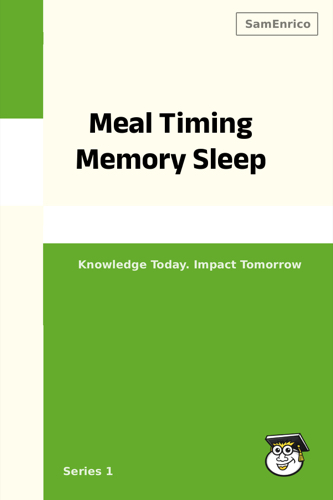
Meal Timing Memory Sleep eBook
Teaches avoiding late meals to prevent sleep disru
by Doan Sarina
Teaches avoiding late meals to prevent sleep disruption and memory loss.
Formats
Free sample
Chapter 1: The Body's Betrayal...--You ate dinner three hours ago. The plates are cleared, the kitchen is dark, and you are settling into bed, scrolling your phone one last time. Your stomach feels fine—not full, not empty, just neutral. In the bathroom mirror, you look like a person who has finished their day. But inside, a war is about to begin.In your gut, that last meal is still there.
Not fully digested. Not yet processed. Your stomach, which should be winding down for the night, is instead working a double shift. Your pancreas, confused by the late arrival of food, is releasing insulin when it should be conserving energy. And upstairs, in the control tower of your skull, your brain is receiving two entirely contradictory sets of instructions.One signal says: Melatonin rising.
Darkness detected. Prepare for deep sleep. Initiate repair protocols. Clear metabolic waste. Consolidate memories.The other signal says: Insulin spiking.
Food detected. Divert blood flow to the gut. Activate digestive enzymes. Stay alert enough to manage this metabolic load.Your brain cannot do both. It has to choose.
And every time you eat late, it makes the wrong choice.This is not about willpower. This is not about being "good" or "bad" with food. This is about biology that predates the invention of the refrigerator by about two hundred million years. Your body evolved in a world without grocery stores, without electric lights, and without leftover pizza at midnight. For the vast majority of human history, eating after dark was impossible, unnecessary, or actively dangerous—because predators also hunt at night, and a sleeping human with a full stomach is a slow human.Your stomach, it turns out, has a bedtime.
And you have been ignoring it.The Master Clock You Never Knew You Had Every living organism on Earth, from bacteria to blue whales, operates on a roughly 24-hour cycle. This is not a habit. It is not a cultural preference. It is a biological fact written into the very structure of our DNA. The scientific term is circadian rhythm—from the Latin circa diem, meaning "around a day." And for most of human history, this rhythm was as reliable and unchangeable as the rising sun.Deep inside your brain, buried in a region called the suprachiasmatic nucleus—a cluster of about 20,000 neurons no larger than a grain of rice—sits your master clock.
This tiny structure receives direct input from your eyes and uses that information to synchronize every other clock in your body. When light hits your retina in the morning, your master clock says, "Daytime. Wake up. Be alert. Move." When darkness falls, it says, "Nighttime.
Sleep. Repair. Conserve."But here is what most people do not understand: your master clock is not the only clock. It is the conductor of an orchestra, but every instrument—every organ, every tissue, every cell—has its own rhythm. Your liver has a clock.
Your pancreas has a clock. Your stomach lining has a clock. Your heart, your kidneys, even the bacteria living in your gut—they all keep time.And they all expect to eat during the day.The evolutionary logic is simple. For millions of years, humans were daytime creatures. We hunted, gathered, and ate when the sun was up.
At night, we slept in darkness, our digestive systems idle, our bodies focused on repair rather than processing. This pattern was so consistent, so unbroken, that our biology came to depend on it. Our digestive enzymes are most active in the morning and early afternoon. Our insulin sensitivity peaks before noon. Our stomach empties fastest in the first half of the day.By 8 PM, your digestive system is supposed to be powering down.
By 10 PM, it should be nearly silent. By midnight, it should be asleep—just like the rest of you.But for millions of people, the opposite is true. According to the most recent National Health and Nutrition Examination Survey, the average American consumes nearly 25% of their daily calories after 6 PM. One in four adults reports eating their largest meal of the day after 8 PM. And nearly 40% of all calories consumed by shift workers—who make up 15% of the workforce—are eaten after 9 PM.We have become a species that eats in the dark.
And our bodies have no idea how to handle it.The Gut-Brain Superhighway To understand why late-night eating is so dangerous, you need to understand the conversation happening constantly between your gut and your brain. This conversation takes place along what scientists call the gut-brain axis—a two-way communication network that includes nerves, hormones, and immune signals.The most famous component of this axis is the vagus nerve, a thick cable of nerve fibers that runs from your brainstem all the way down to your abdomen. Think of it as a superhighway with traffic flowing in both directions. About 80% of the traffic goes from the gut to the brain—meaning your digestive system is constantly telling your brain what is happening down there. Are you hungry?
Are you full? Did you just eat sugar? Fat? Protein? Is there inflammation?
Are there pathogens?Your brain listens to every single message.Now imagine what happens when you eat a late-night meal. Your stomach stretches. Your intestines start churning. Your pancreas releases insulin. Your gut bacteria begin fermenting whatever you just ate.
All of these events generate signals that travel up the vagus nerve to your brain.And your brain, which should be preparing for sleep, instead has to stay awake and process this information.But the traffic goes both ways. Your brain also sends signals down to your gut. When your master clock decides it is time to sleep, it sends inhibitory signals that slow digestion, reduce stomach acid production, and quiet intestinal contractions. This is a feature, not a bug. Your body is supposed to conserve energy during sleep, not waste it on digesting a midnight snack.Here is the problem: a late-night meal overrides those inhibitory signals.
The presence of food in your stomach forces your digestive system to stay active, even when your brain is trying to shut it down. This creates a state of physiological conflict—what scientists call circadian misalignment. Your brain says "sleep," but your gut says "digest." Neither wins. Both lose.The result is fragmented sleep, impaired digestion, and a brain that never gets the full restoration it needs.The Melatonin-Insulin Tango Two hormones are at the center of this conflict: melatonin and insulin. They are supposed to be enemies—not in a destructive way, but in a choreographed dance where one rises while the other falls.Melatonin is your brain's darkness signal.
When light levels drop, your pineal gland begins producing melatonin, and levels continue to rise throughout the evening, peaking in the middle of the night. Melatonin does not just make you sleepy. It also lowers your core body temperature, reduces inflammation, and—critically—suppresses insulin secretion from your pancreas.That last point is essential. Your body does not want high insulin levels at night. Insulin is a storage hormone; it tells your cells to take up glucose from the blood and store it as fat or glycogen.
During the day, this is exactly what you need. At night, it is unnecessary and disruptive. Elevated insulin at night…
This is the end of the free sample. Get the eBook to keep going. Buy now
About this book
Details
- Author
- Doan Sarina
- Publisher
- SamEnrico
- Language
- English
- Genre
- Non-Fiction, Self-Help, Nutrition
- Released
- 2026-06-09
- Pages (approx.)
- 140
- Available as
- eBook, Audiobook

Read better in the ZLOADR app
Your eBooks on your phone or tablet. Sign in with your SamEnrico account and start reading.
More by Doan Sarina
 Empowerment Success StoriesDoan Sarina$11.99
 Cocaine Induced DepressionDoan Sarina$11.99
 Cognitive Reframing Road RageDoan Sarina$11.99
 Conquering Imposter Syndrome WorkbookDoan Sarina$11.99
 Chunking MistakesDoan Sarina$11.99
 Workplace Rejection SensitivityDoan Sarina$11.99
 The Sobriety Affirmations GuideDoan Sarina$11.99
 TM For TinnitusDoan Sarina$11.99
 The Enigma of the Sydney Cipher: How a Mathematician Cracked the Code of the PacificDoan Sarina$11.99
 Shadows of the Yurei SpyDoan Sarina$11.99
 Ghosts of the Greenbrier: The Lost Children of the Underground RailroadDoan Sarina$11.99
 Growing PteropogonDoan Sarina$11.99
You may also like
 Hong Kong Handover 1997Dunn Johnnie$11.99
 Zumba For Postnatal Recovery CourseNeal Christian$11.99
 Zumba for BeginnersLadner Nikia$11.99
 YouTube Comment Mining GuideHumes Pandora$12.99
 Worry Box MeditationCarlin Rudy$11.99
 Workplace Stress MeditationNguyen Lynn$11.99
 Workplace Stress and Sleep RepairHawley Ivory$11.99
 Workplace Perfectionism CureDelaney Jeffry$11.99
 Workplace Injustice Anger GuideWallen Isabelle$11.99
 Work Addiction and Burnout LinkGreenwood Ester$11.99
 Women in Yoga and WellnessBeattie Galina$11.99
 Women in Stand Up ComedyChun Evangeline$11.99