
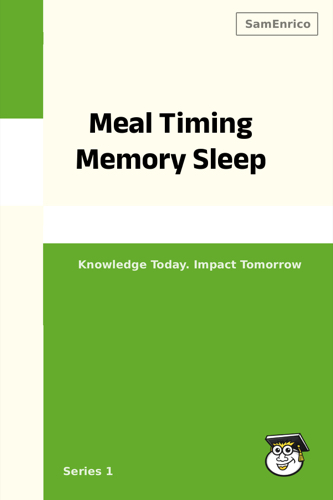
Meal Timing Memory Sleep
Teaches avoiding late meals to prevent sleep disru
by Doan Sarina
Teaches avoiding late meals to prevent sleep disruption and memory loss.
Formats
About this book
Free sample
Chapter 1: The Body's Betrayal...--You ate dinner three hours ago. The plates are cleared, the kitchen is dark, and you are settling into bed, scrolling your phone one last time. Your stomach feels fine—not full, not empty, just neutral. In the bathroom mirror, you look like a person who has finished their day. But inside, a war is about to begin.In your gut, that last meal is still there.
Not fully digested. Not yet processed. Your stomach, which should be winding down for the night, is instead working a double shift. Your pancreas, confused by the late arrival of food, is releasing insulin when it should be conserving energy. And upstairs, in the control tower of your skull, your brain is receiving two entirely contradictory sets of instructions.One signal says: Melatonin rising.
Darkness detected. Prepare for deep sleep. Initiate repair protocols. Clear metabolic waste. Consolidate memories.The other signal says: Insulin spiking.
Food detected. Divert blood flow to the gut. Activate digestive enzymes. Stay alert enough to manage this metabolic load.Your brain cannot do both. It has to choose.
And every time you eat late, it makes the wrong choice.This is not about willpower. This is not about being "good" or "bad" with food. This is about biology that predates the invention of the refrigerator by about two hundred million years. Your body evolved in a world without grocery stores, without electric lights, and without leftover pizza at midnight. For the vast majority of human history, eating after dark was impossible, unnecessary, or actively dangerous—because predators also hunt at night, and a sleeping human with a full stomach is a slow human.Your stomach, it turns out, has a bedtime.
And you have been ignoring it.The Master Clock You Never Knew You Had Every living organism on Earth, from bacteria to blue whales, operates on a roughly 24-hour cycle. This is not a habit. It is not a cultural preference. It is a biological fact written into the very structure of our DNA. The scientific term is circadian rhythm—from the Latin circa diem, meaning…
This is the end of the free sample. Get the eBook to keep going. Buy now
Contents
- Chapter 1
- Chapter 2
- Chapter 3
- Chapter 4
- Chapter 5
- Chapter 6
- Chapter 7
- Chapter 8
- Chapter 9
- Chapter 10
- Chapter 11
- Chapter 12
Details
- Author
- Doan Sarina
- Publisher
- SamEnrico
- Language
- English
- Genre
- Non-Fiction, Self-Help, Nutrition
- Released
- 2026-06-09
- Pages (approx.)
- 140
- Available as
- eBook, Audiobook

Read better in the ZLOADR app
Your eBooks on your phone or tablet. Sign in with your SamEnrico account and start reading.
More by Doan Sarina
 Empowerment Success StoriesDoan Sarina$11.99
 Cocaine Induced DepressionDoan Sarina$11.99
 Cognitive Reframing Road RageDoan Sarina$11.99
 Conquering Imposter Syndrome WorkbookDoan Sarina$11.99
 Chunking MistakesDoan Sarina$11.99
 Workplace Rejection SensitivityDoan Sarina$11.99
 The Sobriety Affirmations GuideDoan Sarina$11.99
 TM For TinnitusDoan Sarina$11.99
 The Enigma of the Sydney Cipher: How a Mathematician Cracked the Code of the PacificDoan Sarina$11.99
 Shadows of the Yurei SpyDoan Sarina$11.99
 Ghosts of the Greenbrier: The Lost Children of the Underground RailroadDoan Sarina$11.99
 Growing PteropogonDoan Sarina$11.99
You may also like
 The Nicotine Detox Diet PlanClemens Marivel$11.99
 The Remote Work Lunch HourBerg Justin$11.99
 The Nutrition and Emotion LinkBorrego Shantel$11.99
 The Meal Prep Scheduling BlockCohen Leah$11.99
 Student Nutrition for StressDugger Elvina$11.99
 Spouse Loss Appetite GuideRosenthal Logan$11.99
 Snack Based Mood RegulationGivens Sherrill$11.99
 Parental Nutrition Self CareAhern Rubi$11.99
 Appetite and DivorcePutman Samara$11.99
 Anticipatory Grief Appetite LossBarnette Rufina$11.99
 The Workaholic's Nutrition GuideJordan Ken$11.99
 The Food Comparison GuideNoonan Ta$11.99