
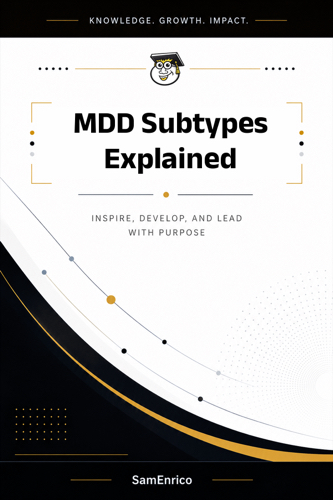
MDD Subtypes Explained eBook
Differentiate melancholic, atypical, catatonic, an
Differentiate melancholic, atypical, catatonic, and seasonal patterns of depression.
Formats
Free sample
Chapter 1: The Broken Map...--–- Sarah had tried everything. By the time she walked into a psychiatrist’s office at age thirty-four, she had accumulated seventeen different medication bottles in her bathroom drawer. Zoloft made her feel flat but not better. Prozac lifted her mood slightly but left her sleeping twelve hours a day and craving bread like an addiction. Wellbutrin gave her energy but also a terrifying rage that surfaced over minor inconveniences.
Each failure was recorded in her chart as “treatment-resistant depression,” a label that felt like a life sentence. Her primary care doctor had shrugged and referred her to a specialist. Her specialist had shrugged and suggested another SSRI. Her family had stopped asking how she was doing.What no one had ever done was ask her the right questions. Not “On a scale of one to ten, how sad are you?” but rather: “When something good happens, do you feel better for a while?” Yes, she said.
Absolutely. “Do you sleep more than ten hours a night and still wake up exhausted?” Yes. “Do you feel like your limbs are made of concrete, making even getting a glass of water feel like climbing a mountain?” She burst into tears. Yes. That was exactly it.
“And do you find yourself obsessing over whether people are criticizing you, to the point that you avoid social situations altogether?” She had never told anyone that before, but yes, every single day.Sarah did not have treatment-resistant depression. She had never had treatment-resistant depression. She had atypical depression, a subtype that affects an estimated fifteen to forty percent of all depressives but is routinely misdiagnosed because its symptoms look like the opposite of what most doctors expect. The SSRIs she had been prescribed for years were never going to work well for her. What she needed was a dopamine-targeting agent like bupropion or, in more resistant cases, an MAOI.
Within six weeks of the correct diagnosis and the correct medication, Sarah was functioning better than she had in a decade. She was not cured—depression rarely offers clean endings—but she was no longer drowning.Sarah’s story is not unusual. It is the rule.The One-Size-Fits-All Disaster For nearly half a century, the public and far too many clinicians have operated under a simple, comforting model of depression. The “chemical imbalance” theory, popularized in the 1990s by direct-to-consumer advertising and simplified by well-meaning educators, held that depression was caused by low serotonin. Fix the serotonin with an SSRI, and you fix the depression.
This narrative was never scientifically accurate—serotonin is involved in mood regulation, but no study has ever demonstrated that depression is fundamentally a deficiency of serotonin—but it had the virtue of being easy to understand. It also had the catastrophic side effect of encouraging clinicians to treat all depressions as if they were the same disease.They are not.Major Depressive Disorder (MDD) is not a single illness with varying degrees of severity. It is a diagnostic umbrella that covers at least four distinct biological subtypes, each with its own pathophysiology, symptom profile, genetic markers, neuroimaging findings, and—most critically—its own treatment hierarchy. Treating melancholic depression the same way you treat atypical depression is like treating a bacterial infection with antifungal medication. You might get lucky.
You will usually fail. And in the process, you will convince the patient that they are somehow broken in a way that medicine cannot fix.The Diagnostic and Statistical Manual of Mental Disorders, Fifth Edition, Text Revision (DSM-5-TR) acknowledges this reality through a system of “specifiers.” These are not separate diagnoses but rather additional labels that describe the specific pattern of a patient’s depression. The four major specifiers that demand different treatment approaches are:Melancholic depression, characterized by complete anhedonia (the inability to feel pleasure, not just low mood), psychomotor disturbance (either profound slowing or agitated pacing), early-morning awakening with diurnal variation (worst in the morning), and a near-total lack of mood reactivity (nothing makes you feel better, even temporarily).Atypical depression, defined by mood reactivity (the paradoxical ability to feel better when good things happen), reversed vegetative symptoms (hypersomnia and hyperphagia rather than insomnia and weight loss), leaden paralysis (a heavy, weighted-down feeling in the limbs), and a lifelong pattern of rejection sensitivity.Catatonic depression, a medical emergency characterized by psychomotor disturbances ranging from stupor (mute, staring, immobile) to excitement (agitated, violent thrashing), often with waxy flexibility, echolalia, negativism, and—critically—no requirement that the patient report feeling “sad.”Seasonal pattern (SAD) , defined by a regular temporal relationship between depressive episodes and the time of year (typically fall/winter), with full remission in spring/summer, often presenting with atypical features like hypersomnia and carbohydrate craving.Each of these subtypes responds differently to every class of antidepressant, to psychotherapy, to somatic treatments like ECT and light therapy, and to lifestyle interventions. A clinician who does not know which subtype they are treating is flying blind. A patient who does not know which subtype they have will spend years—sometimes decades—on the wrong medications, accumulating side effects without benefits, internalizing the belief that their suffering is somehow their fault.The Dangerous Consequences of Misdiagnosis The stakes of getting this wrong are not theoretical.
They are measured in suicide rates, in lost careers, in marriages destroyed by the slow erosion of hope, in children who grow up believing their depressed parent simply did not love them enough to try harder.Consider the case of melancholic depression. Patients with this subtype show a characteristic pattern of hypercortisolism—chronically elevated cortisol levels, particularly in the morning. Their HPA axis (hypothalamic-pituitary-adrenal axis) is stuck in the “on” position. They wake at three or four in the morning not because they are anxious about the day ahead but because their biology forces them awake, and when they wake, the despair is so overwhelming that getting out of bed feels physically impossible. They do not respond well to SSRIs.
Multiple meta-analyses have shown that tricyclic antidepressants (TCAs) and serotonin-norepinephrine reuptake inhibitors (SNRIs) are significantly more effective for melancholic depression. Yet SSRIs remain the most commonly prescribed first-line treatment for all depressions, including melancholic. This is not a minor discrepancy. It is a systematic failure.Now consider atypical depression, Sarah’s subtype. The prevalence of atypical features in community samples ranges from fifteen to forty percent, making it arguably the most common specifier.
Yet it remains the most misdiagnosed. Why? Because the symptoms look like laziness or character pathology rather than depression. Hypersomnia—sleeping ten, twelve, even fourteen hours a day—is easily dismissed as poor sleep hygiene. Hyperphagia—increased appetite with weight gain—is blamed on lack of willpower.
Leaden paralysis is called “being out of shape.” Rejection sensitivity is called “being too sensitive.” The patient hears these judgments, internalizes them, and concludes that they are not sick but weak.Worse, atypical depression has a distinctive treatment response. SSRIs are less effective for atypical features than they are for non-atypical depression. What works better? Dopamine-targeting agents like bupropion and, for treatment-resistant cases, monoamine oxidase inhibitors (MAOIs). Yet MAOIs have fallen out of favor due to dietary restrictions and perceived risk, and bupropion is…
This is the end of the free sample. Get the eBook to keep going. Buy now
About this book
Details
- Author
- Seward Laronda
- Publisher
- SamEnrico
- Language
- English
- Genre
- Non-Fiction, Health & Wellness, Subtypes, Specifiers
- Released
- 2026-06-09
- Pages (approx.)
- 158
- Available as
- eBook, Audiobook

Read better in the ZLOADR app
Your eBooks on your phone or tablet. Sign in with your SamEnrico account and start reading.
More by Seward Laronda
 The Expectation Reset GuideSeward Laronda$11.99
 Smoking and ED GuideSeward Laronda$11.99
 The Working Memory for Chess GuideSeward Laronda$11.99
 Emergency Placement NightsSeward Laronda$11.99
 The Lost Tapes of the Apollo 11 Mission: Unearthed Secrets from the MoonSeward Laronda$11.99
 The Breeder's Guide to Randall Lineback CattleSeward Laronda$11.99
 .eu vs .com ComparisonSeward Laronda$12.99
 CTO Interview Questions GuideSeward Laronda$12.99
 Opseu CourierSeward Laronda$11.99
 How to Become a Log PeelerSeward Laronda$11.99