
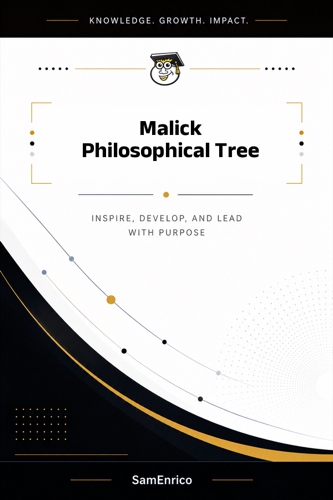
Malick Philosophical Tree eBook
Analyze the voiceover, nature footage, and spiritu
Analyze the voiceover, nature footage, and spiritual drift of the recluse.
Formats
Free sample
Chapter 1: The Man Who Disappeared--–- In 1978, Terrence Malick was one of the most promising directors in Hollywood. He had made two films—Badlands (1973) and Days of Heaven (1978)—that had won the Palme d'Or at Cannes, earned an Academy Award for cinematography, and drawn comparisons to Stanley Kubrick and Orson Welles. He was thirty-five years old. He had money, fame, and the full attention of a studio system that wanted to know: what next? The answer came as a shock to everyone.
Malick sold his house in Los Angeles, packed a suitcase, and moved to Paris. He did not announce a new project. He did not give interviews. He simply vanished. For the next twenty years, he would release exactly one film—The Thin Red Line (1998)—and even that appeared only after a decade of rumors, false starts, and near-mythological silence.
In an industry built on publicity, branding, and the relentless production of content, Malick became the anti-Hollywood figure: the recluse who refused to play the game.This chapter dismantles the popular myth that Malick’s withdrawal was merely eccentricity or shyness. It argues, instead, that his disappearance was a philosophical method—a deliberate strategy for stripping away the noise of authorship so that the work could speak for itself. To understand this method, we must first understand the intellectual journey that preceded it. Malick was not a filmmaker who happened to read philosophy. He was a philosopher who became a filmmaker.
His undergraduate degree from Harvard was in philosophy. He studied under Stanley Cavell, one of the most important American philosophers of the twentieth century. He won a Rhodes Scholarship to Oxford, then transferred to the American Film Institute Conservatory after a dispute with his advisor. Between Oxford and the AFI, he translated Martin Heidegger’s Vom Wesen des Grundes (On the Essence of Ground)—a dense, untranslated text that most professional philosophers avoid. By the time he made Badlands, Malick had spent nearly a decade immersed in phenomenology, existentialism, and the question that would define his cinema: how can we attend to the world without distorting it with our concepts, our desires, or our egos?The Philosopher’s Formation To understand Malick’s silence, we must first understand his education.
Harvard in the 1960s was a crucible of philosophical debate. The analytic tradition, imported from Cambridge and Oxford, dominated the department: logical positivism, ordinary language philosophy, and the relentless parsing of propositions. But Malick was drawn to a different stream. He read Heidegger, who argued that Western philosophy had forgotten the most basic question: what does it mean to be? He read Wittgenstein, who argued that philosophical problems arise when language goes on holiday—when words become detached from the lived contexts that give them meaning.
He read Kierkegaard, who argued that truth is subjectivity, that the most important knowledge cannot be spoken but must be lived. These thinkers shared a conviction that philosophy had become too abstract, too concerned with logical puzzles and too little concerned with the texture of existing.Malick took this critique seriously. After Harvard, he went to Oxford to study with Gilbert Ryle, the author of The Concept of Mind and a leading figure in ordinary language philosophy. The fit was poor. Ryle’s Oxford was dry, analytical, and suspicious of continental mysticism.
Malick wanted to ask Heideggerian questions about being, death, and the meaning of existence. Ryle wanted to clarify the logical grammar of psychological terms. The tension came to a head when Malick submitted a thesis chapter on “the concept of world” that his advisor rejected as insufficiently rigorous. Malick left Oxford without finishing his degree—a rare failure for a Rhodes Scholar. But the failure was productive.
It pushed him toward the American Film Institute, where he discovered that cinema could do what philosophy could not: show being without describing it, present the world without reducing it to propositions.This biographical detail is not mere background. It is the key to understanding Malick’s entire career. He did not abandon philosophy for film. He translated philosophy into film. His camera does not argue; it shows.
His voiceover does not explain; it confesses. His nature footage does not symbolize; it presents. Every decision Malick makes as a director—the roaming camera, the whispered monologues, the long takes of grass and water—is a philosophical decision about how to be in relation to the world without dominating it. And the most radical of these decisions was the decision to disappear.Silence as Phenomenological Reduction The term “phenomenological reduction” comes from Edmund Husserl, the founder of phenomenology and Heidegger’s teacher. It refers to a methodological procedure: the philosopher brackets (suspends) all assumptions about the external world, about causality, about the self, and about the history of philosophy, in order to attend to things as they appear.
Husserl called this the epoché—the act of “holding back” judgment so that phenomena can show themselves on their own terms. The goal is not to deny reality but to clear away the interpretive sediment that prevents us from seeing what is actually there.Malick’s withdrawal from Hollywood is a cinematic version of the phenomenological reduction. When a director gives interviews, records commentary tracks, and appears at press junkets, he performs a particular function: he tells the audience what the film means. He fixes interpretation. He closes down the possibility of the viewer encountering the work directly.
Malick refuses this role. By refusing interviews, he refuses to be the authoritative voice that explains his films. By avoiding commentary tracks, he refuses to substitute his intentions for the viewer’s experience. By disappearing from public life, he performs a kind of epoché on himself: he brackets his own authorship so that the films can stand alone.This is not modesty. It is a philosophical stance with profound implications.
When you watch a Malick film, you are not being guided by a director who wants you to feel a specific emotion or understand a specific theme. You are being left alone with the image, the sound, and the whisper. The silence of the director creates a clearing—what Heidegger called the Lichtung—in which meaning becomes possible precisely because it is not imposed. The viewer becomes an active seeker rather than a passive receiver. You are not told what to think.
You are told to look.The Early Films: Nature as Character Malick’s first two films, Badlands and Days of Heaven, established the template that his later work would refine. Both films are ostensibly narratives: Badlands follows a young couple (Martin Sheen and Sissy Spacek) on a murder spree across the American Midwest; Days of Heaven follows a love triangle (Richard Gere, Brooke Adams, Sam Shepard) on a Texas wheat farm in 1916. But in both films, the human story is interrupted—constantly, insistently—by images of the natural world that have no obvious narrative function. Grass sways in slow motion. Locusts swarm across a field.
Fire consumes a harvest. A dead fish floats in a river. The camera lingers on these images long after the plot has moved on, and sometimes it abandons the plot entirely just to watch the light change on a leaf.Viewers accustomed…
This is the end of the free sample. Get the eBook to keep going. Buy now
About this book
Details
- Author
- Kinsey Charles
- Publisher
- SamEnrico
- Language
- English
- Genre
- Non-Fiction, Biography, Art House
- Released
- 2026-06-10
- Pages (approx.)
- 103
- Available as
- eBook, Audiobook

Read better in the ZLOADR app
Your eBooks on your phone or tablet. Sign in with your SamEnrico account and start reading.
More by Kinsey Charles
 The Ageist Stereotype Shield GuideKinsey Charles$11.99
 Real Estate Networking GuideKinsey Charles$11.99
 Parent Chronically Ill Child GuideKinsey Charles$11.99
 Cuphead Rage Cycle GuideKinsey Charles$11.99
 Understanding Mental Retardation Microcephaly Unusual FaciesKinsey Charles$17.99
 Promotion Business Case ChecklistKinsey Charles$12.99
 UN Statistics and Data Science JobsKinsey Charles$12.99
 How to Start a Municipal Bus Service Business (Beginners Guide)Kinsey Charles$11.99
 Security Operations EngineerKinsey Charles$11.99
You may also like
 Hong Kong Handover 1997Dunn Johnnie$11.99
 Zumba For Postnatal Recovery CourseNeal Christian$11.99
 Zumba for BeginnersLadner Nikia$11.99
 YouTube Comment Mining GuideHumes Pandora$12.99
 Worry Box MeditationCarlin Rudy$11.99
 Workplace Stress MeditationNguyen Lynn$11.99
 Workplace Stress and Sleep RepairHawley Ivory$11.99
 Workplace Perfectionism CureDelaney Jeffry$11.99
 Workplace Injustice Anger GuideWallen Isabelle$11.99
 Work Addiction and Burnout LinkGreenwood Ester$11.99
 Women in Yoga and WellnessBeattie Galina$11.99
 Women in Stand Up ComedyChun Evangeline$11.99