
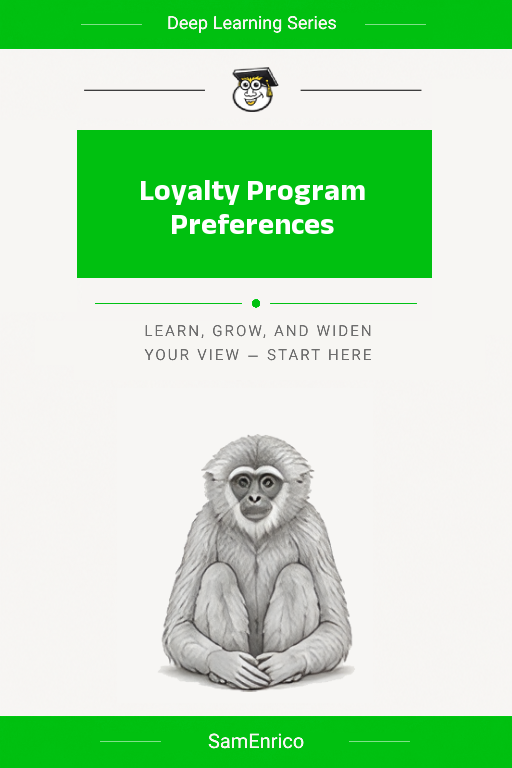
Non-FictionConsumer Mind ReportLoyalty Marketing
Loyalty Program Preferences eBook
Examines points vs cash back vs tiered rewards and
Examines points vs cash back vs tiered rewards and redemption behavior for CRM strategy.
Formats
Free sample
Chapter 1: The Irrational Asset--–- Every morning at 7:43 AM, without exception, a man named David Chen in Chicago, Illinois, opens his Starbucks app to check his star balance. He does not need coffee at 7:43. He does not leave for work until 8:15. He has no practical reason to open the app. Yet he does it, compulsively, because he is currently at 147 stars and needs 150 for a free drink.
The gap of three stars gnaws at him. Three stars represent approximately six dollars in spending, or roughly two medium drip coffees, or one overpriced muffin that he does not actually want. But the number 147 feels incomplete. It feels like almost. And almost, for the human brain, is a torture device disguised as a motivational tool.David Chen is not unusual.
He is not particularly loyal to Starbucks as a brand. He will buy coffee at Dunkin' if he is running late and it is closer. He has no emotional attachment to the green siren logo. What he has is an attachment to the number 150. That number has become a cognitive anchor around which his morning behavior now orbits.
He will choose the Starbucks that is three blocks out of his way because it closes the gap faster. He will buy the muffin he does not want because it yields more stars per dollar than coffee alone. He has been manipulated, exquisitely and precisely, by one of the most powerful psychological forces in consumer behavior: the endowed progress effect.This chapter reveals the hidden architecture of irrational loyalty. We will dismantle the myth that loyalty programs work because they reward customers for their business. They do not.
They work because they exploit predictable cognitive biases that evolution left in the human brain like open backdoors. Once you understand these biases—the endowment effect, the goal gradient, loss aversion, status signaling, and the sunk cost fallacy—you will see loyalty programs not as marketing tools but as behavioral engineering platforms. And you will never look at your own points balance the same way again.The Velvet Rope: Why Status Costs Nothing and Changes Everything Of the three reward pillars introduced in this book's foreword—points, cash, and status—the most powerful is also the most misunderstood. Status costs the company almost nothing to grant. A digital badge, a colored tier label (Silver, Gold, Platinum), a customer service phone number with a shorter wait time: these have near-zero marginal cost.
Yet their psychological value to customers can exceed that of hundreds of dollars in cash rewards.This is the Velvet Rope Effect. Exclusivity creates value not because of what it provides but because of who it excludes. A Gold tier that includes 40 percent of your customers is worthless. A Gold tier that includes 5 percent of your customers is aspirational. The velvet rope matters only when most people cannot get past it.Consider the airline industry, which perfected tiered status decades ago.
A top-tier elite member receives essentially the same seat, the same peanuts, the same oxygen as a general member. The difference is psychological: priority boarding, lounge access, and the implicit acknowledgment that they matter more. These perks cost the airline pennies per passenger. Yet customers will spend an additional $3,000 per year to maintain them.Why? Because status satisfies two fundamental human drives that points and cash cannot touch.
First, status provides social proof of success. A Platinum card in the wallet signals to the world (and to the self) that the holder is a person of means and importance. Second, status provides intrinsic motivation—the pleasure of the activity itself, separate from any external reward. Achieving Platinum status feels good not because of the lounge access but because of the achievement.Points and cash provide extrinsic motivation. You earn them as a means to an end.
Status provides intrinsic motivation. You earn it as an end in itself. And intrinsic motivation, as decades of behavioral psychology have demonstrated, is far more durable than extrinsic motivation.The Endowed Progress Effect: Why Almost is More Powerful Than Done Return to David Chen and his 147 stars. Why does three stars away feel so different from zero stars away? The answer lies in the Endowed Progress Effect, a phenomenon first documented by researchers Joseph Nunes and Xavier Drèze in a landmark 2006 study.In their experiment, customers at a car wash were given loyalty cards.
One group received a card with eight blanks and was told that after eight car washes, they would receive a free wash. The second group received a card with ten blanks, but two of the blanks were already stamped as a "bonus." Both groups needed eight additional washes to earn the reward. The only difference was the psychological starting point.The results were dramatic. Customers who started with two bonus stamps completed their cards at a significantly higher rate than those who started from zero. The same number of required washes, the same reward, the same economics.
The only difference was the perception of progress. Having two stamps already made customers feel that they were already on the path, that they had already invested effort, that giving up would mean losing progress they had already made.This is the endowed progress effect in its purest form: people are more motivated to complete a goal when they believe they have already made progress toward it, even if the progress is illusory. The two bonus stamps were not earned. They were gifted. Yet the brain processed them as owned, and loss aversion did the rest.
To abandon the card would be to lose the two stamps, and loss is twice as painful as equivalent gain.Starbucks exploits this effect brilliantly by showing customers not just their current star total but their progress toward the next reward. The app does not simply say "147 stars." It says "3 stars to your next reward." That framing activates the goal gradient—the tendency for effort to accelerate as the finish line approaches. And the finish line is always approaching. There is always a next reward. The loop never closes.Loss Aversion: The Engine of Irrational Retention To understand why customers stay in bad loyalty programs, you must first understand loss aversion.
Loss aversion is the cognitive bias that losses loom larger than gains. The pain of losing fifty dollars is approximately twice as intense as the pleasure of gaining fifty dollars. This asymmetry, first documented by Kahneman and Tversky in their prospect theory, is one of the most robust findings in all of behavioral economics.Loss aversion explains why points create switching costs that cash cannot match. A customer with ten thousand dollars in cash back can switch banks without losing a cent. The cash is in their account, fungible and portable.
A customer with ten thousand points faces a different calculation. Those points have value only within the originating program. To switch is to lose them. And the pain of that loss is twice as powerful as the pleasure of any sign-up bonus a competitor might offer.This is not a minor effect. It is structural.
Airlines and hotels have built billion-dollar businesses on the back of loss aversion. Their customers do not stay because they love the service.…
This is the end of the free sample. Get the eBook to keep going. Buy now
About this book
Details
- Author
- Ladner Eneida
- Publisher
- SamEnrico
- Language
- English
- Genre
- Non-Fiction, Consumer Mind Report, Loyalty Marketing
- Released
- 2026-05-29
- Pages (approx.)
- 141
- Available as
- eBook, Audiobook

Read better in the ZLOADR app
Your eBooks on your phone or tablet. Sign in with your SamEnrico account and start reading.
More by Ladner Eneida
 Forgiveness Breath PracticeLadner Eneida$11.99
 DoorDash Dasher RatingsLadner Eneida$11.99
 The Breath Anchor for PanicLadner Eneida$11.99
 Non threatening Posture GuideLadner Eneida$11.99
 The Remote Work Health Insurance GuideLadner Eneida$11.99
 The Gold Rush Heist: How a Gang Outwitted the Wild WestLadner Eneida$11.99
 Genetic EngineeringLadner Eneida$11.99
 Non Resident LLC Formation AgentsLadner Eneida$12.99
 Understanding LsaLadner Eneida$17.99
 How to Become a Draw-bench-operator HelperLadner Eneida$11.99
You may also like
 Hong Kong Handover 1997Dunn Johnnie$11.99
 Zumba For Postnatal Recovery CourseNeal Christian$11.99
 Zumba for BeginnersLadner Nikia$11.99
 YouTube Comment Mining GuideHumes Pandora$12.99
 Worry Box MeditationCarlin Rudy$11.99
 Workplace Stress MeditationNguyen Lynn$11.99
 Workplace Stress and Sleep RepairHawley Ivory$11.99
 Workplace Perfectionism CureDelaney Jeffry$11.99
 Workplace Injustice Anger GuideWallen Isabelle$11.99
 Work Addiction and Burnout LinkGreenwood Ester$11.99
 Women in Yoga and WellnessBeattie Galina$11.99
 Women in Stand Up ComedyChun Evangeline$11.99