
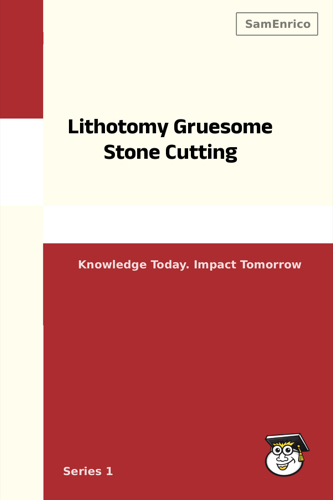
Lithotomy Gruesome Stone Cutting eBook
Experience the horrific medieval surgery to remove
by Dupre Sean
Experience the horrific medieval surgery to remove bladder stones without anesthesia in this history.
Formats
Free sample
Chapter 1: The Devil’s Pebble...--The first sign was not pain. It was silence.For three days in the autumn of 1348, a peasant named Edmund of Wymondham—a man whose name appears in no history book and whose bones now lie in an unmarked Norfolk grave—had not urinated. Not a drop. His belly, once flat from a lifetime of弯腰 over plows, had begun to swell like a bladder stretched to bursting. Which, of course, it was.His wife, Aelis, brought him warm ale.
She tried the old remedies: a poultice of crushed nettle leaves pressed to his groin, a tea brewed from the bark of the wild cherry tree, even a whispered prayer to Saint Cosmas, the patron of physicians. Nothing moved. Edmund lay on their straw pallet, knees drawn to his chest, sweating despite the cold. When Aelis pressed her hand to his lower belly, he screamed—a short, sharp sound like a rabbit caught in a trap.Inside Edmund, something the size of a pigeon’s egg was blocking the flow of his life. It had been growing for years, layer by mineral layer, invisible and silent until the day it simply stopped everything.
That thing was a bladder stone. And in 14th-century England, it was a curse that afflicted the poor with a ferocity the rich would never understand.The Geography of Suffering Bladder stones were not a universal plague. They were, like many horrors of the medieval world, intensely local. In the flat, marshy farmlands of Norfolk, where the water ran hard with calcium and the diet consisted almost entirely of coarse rye bread, salted fish in winter, and legumes grown in chalky soil, the condition reached what medical historian David E. Allen has called "endemic crisis levels." One in ten adult men in certain Norfolk villages between 1300 and 1500 likely suffered from bladder calculi.
Among boys under the age of ten, the rate was even higher.The cause was a perfect storm of poverty and geology. Chronic dehydration—peasants could not afford to drink ale or wine the way the wealthy did, and well water was often unsafe—meant that urine became concentrated, allowing minerals to crystallize. A diet heavy in oxalates (found in rye, beans, and dark leafy greens) provided the raw material for stones. And recurrent urinary tract infections, untreated and unremarked, created the protein matrix upon which those crystals could grow. A stone the size of a grain of sand could become a stone the size of a hen's egg within two years.Edmund had probably carried his stone for at least five years before it finally betrayed him.
There had been signs, of course. Blood in his urine after a long day of plowing. A dull ache in his lower back that he blamed on the plow. The occasional stoppage—a few hours of straining to piss, then a sudden, painful release. But a man who works from dawn to dusk does not have the luxury of listening to his body.
He listened only when the body stopped working entirely.The Geography of Privilege In the same year that Edmund lay groaning on his pallet, a very different scene was unfolding in the manor house of Sir Richard de la Pole, a wealthy landowner in Suffolk. Sir Richard had also been suffering from what he called "the stone"—but his stone was smaller, and his treatment was something Edmund could not have imagined.Sir Richard’s physician, Master John of Gaddesden (a real historical figure, author of the Rosa Anglica, a popular medical text), did not recommend the knife. Instead, he prescribed a regimen of birch sap (a mild diuretic), madder root (believed to dissolve stones), and something called "the king's cure": a diet of white bread, fresh game, and wine mixed with rosewater. When Sir Richard’s symptoms worsened, Master John inserted a silver catheter—a hollow tube lubricated with oil—through the urethra and into the bladder, bypassing the stone entirely. The procedure was uncomfortable but not agonizing.
Sir Richard complained about the indignity. He did not scream.This class divide—catheters and herbs for the rich, the knife or death for the poor—is one of the most consistent patterns in the history of lithotomy. Wealth did not prevent stones (gout, often called the "rich man's affliction," was a different disease entirely), but it did buy time, comfort, and alternatives. The poor had only two choices: live with the stone, or die trying to be rid of it.The Anatomy of a Stone To understand what Edmund was experiencing, one must understand what a bladder stone actually is. It is not a single substance.
The vast majority of bladder calculi—then as now—are composed of calcium oxalate, a crystalline compound that forms when oxalic acid (found in plants) binds with calcium in the urine. But medieval stones were often mixed: layers of calcium phosphate, uric acid, and even struvite (a magnesium ammonium phosphate that forms in the presence of infection). Each layer represented a different phase of the patient's suffering.A stone grows slowly, like a pearl. It begins as a microscopic nidus—a speck of protein, a dead cell, a tiny crystal. Over months and years, new minerals precipitate out of the urine and coat the nidus, building concentric layers.
A stone the size of a pea takes about a year. A stone the size of a walnut takes five to ten years. The largest stones recorded in medieval surgical texts—some the size of a man's fist—represented decades of growth.But size was not the only determinant of suffering. Shape mattered even more. A smooth stone might roll around inside the bladder for years, causing only intermittent obstruction.
A jagged stone—one with spikes of calcium oxalate sticking out like a medieval mace—could embed itself in the bladder wall, causing chronic inflammation, bleeding, and the constant sensation of needing to urinate. These were the stones that drove men to the knife.Edmund's stone, as we will learn later, was of the jagged variety. It had been tearing at his bladder wall for at least two years before it finally lodged itself in his urethra. The internal bleeding had turned his urine the color of rust. The inflammation had scarred the neck of his bladder, making it harder and harder to empty.
And then, one morning in October, he rose from his pallet, walked to the corner of the cottage, and stood for a long time. Nothing came out. He returned to bed, and he did not rise again for three days.The Calculus of Desperation Why would any sane person consent to surgery without anesthesia? This is the question that haunts every history of pre-anesthetic medicine. The answer is simple, brutal, and universal: because the agony of the stone eventually exceeds the terror of the cut.Edmund had reached that threshold by the fourth day of his obstruction.
His bladder had become a fist-sized balloon of urine pressing against his abdominal wall. The pain was not localized; it radiated down his legs, up his spine, and into his chest. He could not eat. He could not sleep. He could not think.
Aelis sent their son to fetch the barber-surgeon who served the village—a man named Wat, whose qualifications consisted of having…
This is the end of the free sample. Get the eBook to keep going. Buy now
About this book
Details
- Author
- Dupre Sean
- Publisher
- SamEnrico
- Language
- English
- Genre
- Non-Fiction, History, Urological History
- Released
- 2026-06-12
- Pages (approx.)
- 149
- Available as
- eBook, Audiobook

Read better in the ZLOADR app
Your eBooks on your phone or tablet. Sign in with your SamEnrico account and start reading.
More by Dupre Sean
 Memory and Sleep JournalDupre Sean$11.99
 Navigating Breakup TalksDupre Sean$11.99
 Competitive Lifecycle Mapping CourseDupre Sean$11.99
 Etsy Digital Planner Seasonal StrategyDupre Sean$11.99
 Operation Red Hat: The Spy Who Vanished in ViennaDupre Sean$11.99
 The Lost Ship of the Sultan: A 17th-Century Treasure of Science and SurvivalDupre Sean$11.99
 Psychiatrist Board PartnershipDupre Sean$12.99
 Employee Persona CommunicationDupre Sean$12.99
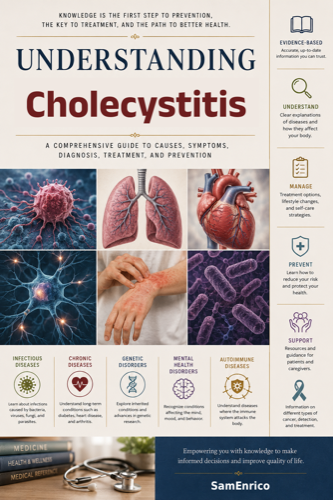 Understanding CholecystitisDupre Sean$17.99
 Lead Experience DesignerDupre Sean$11.99
 Ultimate Handbook Guide to Phoenix : (United States) Travel GuideDupre Sean$11.99