
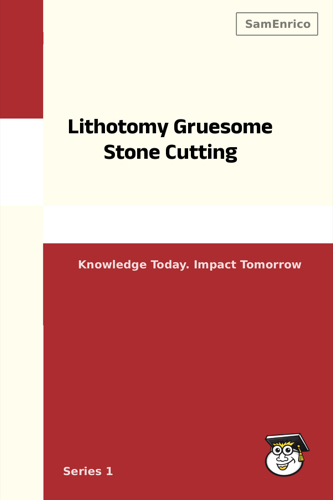
Lithotomy Gruesome Stone Cutting Audiobook
Experience the horrific medieval surgery to remove
by Dupre Sean
Experience the horrific medieval surgery to remove bladder stones without anesthesia in this history.
Formats
Free sample
Chapter 1: The Devil’s Pebble...--The first sign was not pain. It was silence.For three days in the autumn of 1348, a peasant named Edmund of Wymondham—a man whose name appears in no history book and whose bones now lie in an unmarked Norfolk grave—had not urinated. Not a drop. His belly, once flat from a lifetime of弯腰 over plows, had begun to swell like a bladder stretched to bursting. Which, of course, it was.His wife, Aelis, brought him warm ale.
She tried the old remedies: a poultice of crushed nettle leaves pressed to his groin, a tea brewed from the bark of the wild cherry tree, even a whispered prayer to Saint Cosmas, the patron of physicians. Nothing moved. Edmund lay on their straw pallet, knees drawn to his chest, sweating despite the cold. When Aelis pressed her hand to his lower belly, he screamed—a short, sharp sound like a rabbit caught in a trap.Inside Edmund, something the size of a pigeon’s egg was blocking the flow of his life. It had been growing for years, layer by mineral layer, invisible and silent until the day it simply stopped everything.
That thing was a bladder stone. And in 14th-century England, it was a curse that afflicted the poor with a ferocity the rich would never understand.The Geography of Suffering Bladder stones were not a universal plague. They were, like many horrors of the medieval world, intensely local. In the flat, marshy farmlands of Norfolk, where the water ran hard with calcium and the diet consisted almost entirely of coarse rye bread, salted fish in winter, and legumes grown in chalky soil, the condition reached what medical historian David E. Allen has called "endemic crisis levels." One in ten adult men in certain Norfolk villages between 1300 and 1500 likely suffered from bladder calculi.
Among boys under the age of ten, the rate was even higher.The cause was a perfect storm of poverty and geology. Chronic dehydration—peasants could not afford to drink ale or wine the way the wealthy did, and well water was often unsafe—meant that urine became concentrated, allowing minerals to crystallize. A diet heavy in oxalates (found in rye, beans, and dark leafy greens) provided the raw material for stones. And recurrent urinary tract infections, untreated and unremarked, created the protein matrix upon which those crystals could grow. A stone the size…
This is the end of the free sample. Get the Audiobook to keep going. Buy now
About this book
Details
- Author
- Dupre Sean
- Publisher
- SamEnrico
- Language
- English
- Genre
- Non-Fiction, History, Urological History
- Released
- 2026-06-12
- Pages (approx.)
- 149
- Available as
- eBook, Audiobook

Listen in the VoxFlicks app
Audiobooks and audio dramas wherever you go. Sign in with your SamEnrico account and press play.
More by Dupre Sean
 Memory and Sleep JournalDupre Sean$11.99
 Navigating Breakup TalksDupre Sean$11.99
 Competitive Lifecycle Mapping CourseDupre Sean$11.99
 Etsy Digital Planner Seasonal StrategyDupre Sean$11.99
 Operation Red Hat: The Spy Who Vanished in ViennaDupre Sean$11.99
 The Lost Ship of the Sultan: A 17th-Century Treasure of Science and SurvivalDupre Sean$11.99
 Psychiatrist Board PartnershipDupre Sean$12.99
 Employee Persona CommunicationDupre Sean$12.99
 Understanding CholecystitisDupre Sean$17.99
 Lead Experience DesignerDupre Sean$11.99
 Ultimate Handbook Guide to Phoenix : (United States) Travel GuideDupre Sean$11.99