
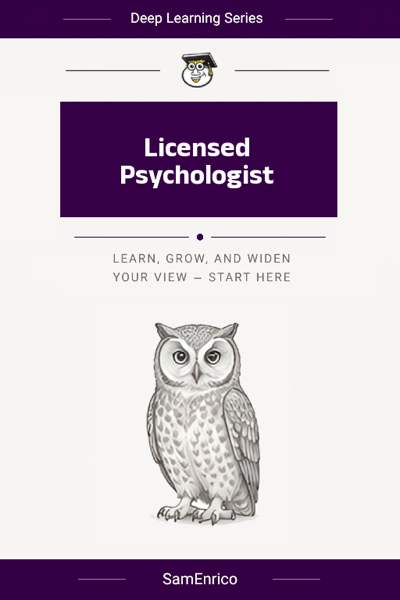
Non-FictionInformativeEducational
Licensed Psychologist eBook
A Coursebook on Licensed Psychologist
A Coursebook on Licensed Psychologist
Formats
Free sample
Chapter 1: The Mirror Test...--– You have probably imagined this moment more times than you can count.You are sitting in your first therapy session. Across from you is a real human being—not a textbook case, not a role-play partner from your practicum, not a character in a vignette. They are nervous. You are nervous. Their palms are sweating.
Your palms are also sweating. They are looking at you with an expression that contains equal parts hope and terror, and somewhere in the space between your exhale and their inhale, you realize: they believe you know what you are doing.Do you?This is the question that haunts every aspiring psychologist long before they ever sit in that chair. It haunts you in the library at 2 AM when you cannot memorize one more defense mechanism. It haunts you in supervision when your supervisor gently asks, “What were you thinking when you said that?” and you were not thinking anything at all. It haunts you when you calculate your student loan balance for the first time.
It haunts you when you explain to your parents—again—that no, you are not going to medical school, and yes, this is a real doctorate.The mirror test is simple: look at yourself honestly and ask, “Do I belong here? Do I have what it takes? Am I willing to do what this actually requires?”Most people who start down the path to becoming a licensed psychologist never finish. That is not cruelty; it is data. According to the American Psychological Association’s Center for Workforce Studies, approximately 50 percent of students who begin doctoral study in psychology do not complete their degree.
Among those who complete, a significant minority never obtain licensure. They pass their dissertation defense, frame their diploma, and then... stop. They become “ABD” (All But Dissertation) or “Dr. Smith” who works in administration or research or something entirely unrelated.
They are intelligent, compassionate, and capable. They just ran out of something. Stamina. Money. Belief.
Clarity about what they were actually signing up for.This chapter exists to prevent that outcome for you.We are going to do something unusual before you invest another dollar, another year, or another ounce of hope into this journey. We are going to examine the psychology of becoming a psychologist. We are going to look at the four doctoral pathways and ask not just “which one fits my interests” but “which one fits my actual life.” We are going to weigh the Ph.D. against the Psy.D. with numbers, not nostalgia.
We are going to assess your fitness for this profession with the same rigor you will one day apply to your clients. And we are going to build a decision matrix that forces you to be honest about what you want, what you need, and what you are willing to sacrifice.By the end of this chapter, you will either have a clear, evidence-backed plan for moving forward—or you will have the relief of knowing, with equal clarity, that you should not. Both outcomes are wins. The only loss is staying stuck in the limbo of “maybe” while time, money, and energy drain away.The Four Doors: Choosing Your Doctoral Pathway Psychology is not one profession wearing different hats. It is four related professions that share academic departments and a licensing exam but diverge dramatically in daily practice, income potential, work settings, and the kind of person who thrives in each.Let us walk through each door.Clinical Psychology This is what most people picture when they hear “psychologist.” Clinical psychologists assess, diagnose, and treat mental, emotional, and behavioral disorders across the lifespan.
They work with severe psychopathology—schizophrenia, bipolar disorder, major depression, personality disorders, post-traumatic stress—as well as more common concerns like anxiety, relationship difficulties, and life transitions.Typical work settings: Private practice (solo or group), community mental health centers, hospitals (psychiatric units, general medical floors), Veterans Administration medical centers, academic medical centers, correctional facilities, and forensic settings (court evaluations, expert testimony).Training emphasis: Psychopathology, assessment (particularly cognitive and personality testing), evidence-based interventions for moderate to severe disorders, and often research (depending on program orientation). Clinical programs are the most likely to require a stand-alone dissertation and statistical training.Who thrives here: People who are comfortable with sustained exposure to human suffering. People who can hold hope and horror in the same hand. People who are not easily shocked, who have good boundaries, and who find fascination rather than repulsion in the complexity of severe mental illness.Who struggles here: People who need clear, unambiguous outcomes. People who become overly identified with their clients’ pain.
People who cannot tolerate the slow, non-linear pace of recovery in serious mental illness.Counseling Psychology Counseling psychologists work with essentially the same range of concerns as clinical psychologists, but with a different philosophical emphasis. Where clinical psychology grew out of the medical model (diagnose and treat disease), counseling psychology grew out of the humanistic and vocational guidance traditions. Counseling psychologists tend to focus more on normative life transitions, developmental challenges, vocational development, and strengths-based approaches.Typical work settings: University counseling centers, community mental health (often but not exclusively with less severe populations), private practice, VA medical centers (particularly in rehabilitation and PTSD services), and college student affairs.Training emphasis: Humanistic and person-centered approaches, career assessment and counseling, multicultural competence, supervision, and prevention. Counseling programs typically require less emphasis on severe psychopathology and more on resilience and optimal functioning.Who thrives here: People who love the developmental perspective—watching young adults become themselves, midlife people pivot, older adults integrate. People who value the therapeutic relationship as the primary vehicle of change.
People who enjoy working in educational or community settings.Who struggles here: People who prefer the medical model. People who find “normal problems” boring or insufficiently weighty. People who want to specialize in neuropsychology or forensic assessment (those are clinical domains).School Psychology School psychologists work within educational systems to support students’ learning, behavior, and mental health. Their primary clients are children and adolescents, and their primary settings are schools. They conduct psychoeducational assessments to determine eligibility for special education services, consult with teachers and parents, provide direct interventions (counseling, behavior plans), and contribute to crisis response teams.Typical work settings: Public and private K-12 schools (often covering multiple buildings), school district administrative offices, pediatric hospitals (consultation-liaison), and academic research settings.Training emphasis: Assessment (particularly cognitive, academic achievement, and behavior rating scales), consultation models, intervention design for academic and behavioral problems, special education law, and child development.
School psychologists are the most likely to use single-case design and progress monitoring in daily practice.Who thrives here: People who love children and can tolerate the systemic frustrations of schools. People who enjoy assessment and problem-solving. People who want predictable hours, summers off (often), and union-like job protections.Who struggles here: People who want long-term therapeutic relationships (school-based work is often brief and solution-focused). People who cannot navigate bureaucracy. People who want to work primarily with adults.Organizational (Industrial-Organizational) Psychology I-O psychologists apply psychological principles to workplaces.
They focus on employee selection, training, performance management, leadership development, team effectiveness, job satisfaction, and organizational change. They typically do…
This is the end of the free sample. Get the eBook to keep going. Buy now
About this book
Details
- Author
- Numbers Hiedi
- Publisher
- SamEnrico
- Language
- English
- Genre
- Non-Fiction, Informative, Educational
- Released
- 2026-05-06
- Pages (approx.)
- 157
- Available as
- eBook, Audiobook

Read better in the ZLOADR app
Your eBooks on your phone or tablet. Sign in with your SamEnrico account and start reading.
More by Numbers Hiedi
 Burnout Prevention Accountability GuideNumbers Hiedi$11.99
 Parent Dementia Death GuideNumbers Hiedi$11.99
 The Observatory Dome GuideNumbers Hiedi$11.99
 Mindfulness for Nighttime WorryNumbers Hiedi$11.99
 Binge Eating After Weight LossNumbers Hiedi$11.99
 Nefertiti's Lost Charm: The Pharaoh's Forgotten SorceressNumbers Hiedi$11.99
 The Ballad of the Iron Horse: The Transcontinental Railroad’s Untold CowboysNumbers Hiedi$11.99
 How to Start a Cellular Rubber Products Business (Beginners Guide)Numbers Hiedi$11.99
 Event Study Excel GuideNumbers Hiedi$12.99
 Employment Arbitration Trap WorkbookNumbers Hiedi$12.99
 Understanding Glucose-galactose MalabsorptionNumbers Hiedi$17.99
You may also like
 Hong Kong Handover 1997Dunn Johnnie$11.99
 Zumba For Postnatal Recovery CourseNeal Christian$11.99
 Zumba for BeginnersLadner Nikia$11.99
 YouTube Comment Mining GuideHumes Pandora$12.99
 Worry Box MeditationCarlin Rudy$11.99
 Workplace Stress MeditationNguyen Lynn$11.99
 Workplace Stress and Sleep RepairHawley Ivory$11.99
 Workplace Perfectionism CureDelaney Jeffry$11.99
 Workplace Injustice Anger GuideWallen Isabelle$11.99
 Work Addiction and Burnout LinkGreenwood Ester$11.99
 Women in Yoga and WellnessBeattie Galina$11.99
 Women in Stand Up ComedyChun Evangeline$11.99