
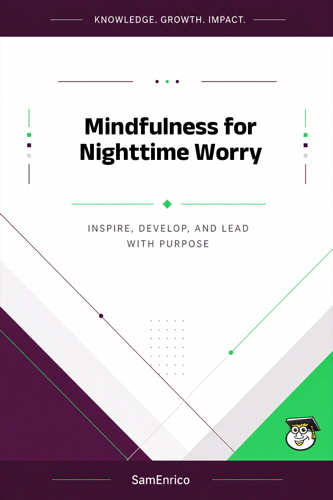
Mindfulness for Nighttime Worry
Observe anxious thoughts without engaging, letting
Observe anxious thoughts without engaging, letting them drift away at bedtime.
Formats
About this book
Free sample
Chapter 1: The 3 AM Theater--–- You are lying in the dark. The clock reads 3:14 AM. Your chest feels tight, though you cannot remember exactly when that started. A thought arrives, seemingly from nowhere: What if I said the wrong thing in that meeting yesterday? Then another: What if they noticed?
What if I get fired? Within ninety seconds, you have lost your job, missed a mortgage payment, and disappointed everyone you love – all while staring at a ceiling crack you never noticed before. Your heart is now racing. You check the clock again: 3:17 AM. Three minutes have passed, but it feels like an hour.
You try the usual remedies: “Just relax,” you tell yourself. “Think of something pleasant. Count backwards from one hundred.” Nothing works. The thoughts only get louder. You are now angry at yourself for being awake, which adds shame to the original worry.
This is the 3 AM theater, and you have a front-row seat.If this scene feels familiar, you are not broken. You are not weak-willed, spiritually undisciplined, or secretly wanting to suffer. You are experiencing a predictable biological and psychological event that has a name, a cause, and – as this book will show – a solution. The solution is not what you think. It is not positive thinking, not forced relaxation, not “just letting go” in the vague way people suggest.
The solution is a specific, trainable skill called non-engagement. And it begins with understanding why your brain turns against you precisely when you most need rest.The Perfect Storm of Nocturnal Anxiety To understand why nighttime worry is different from daytime worry, we must look under the hood. Your body runs on a circadian rhythm, a roughly twenty-four-hour internal clock that regulates when you feel alert and when you feel sleepy. As part of this cycle, your adrenal glands produce cortisol – the primary stress hormone – in a daily wave. Cortisol peaks in the early morning (around 8 AM) to help you wake up and face the day.
It then gradually declines, reaching its lowest point around midnight. This is why you can usually fall asleep without catastrophic…
This is the end of the free sample. Get the eBook to keep going. Buy now
Contents
- Chapter 1
- Chapter 2
- Chapter 3
- Chapter 4
- Chapter 5
- Chapter 6
- Chapter 7
- Chapter 8
- Chapter 9
- Chapter 10
- Chapter 11
- Chapter 12
Details
- Author
- Numbers Hiedi
- Publisher
- SamEnrico
- Language
- English
- Genre
- Non-Fiction, Self-Help, Anxiety
- Released
- 2026-06-08
- Pages (approx.)
- 134
- Available as
- eBook, Audiobook

Read better in the ZLOADR app
Your eBooks on your phone or tablet. Sign in with your SamEnrico account and start reading.
More by Numbers Hiedi
 Burnout Prevention Accountability GuideNumbers Hiedi$11.99
 Parent Dementia Death GuideNumbers Hiedi$11.99
 The Observatory Dome GuideNumbers Hiedi$11.99
 Binge Eating After Weight LossNumbers Hiedi$11.99
 Nefertiti's Lost Charm: The Pharaoh's Forgotten SorceressNumbers Hiedi$11.99
 The Ballad of the Iron Horse: The Transcontinental Railroad’s Untold CowboysNumbers Hiedi$11.99
 How to Start a Cellular Rubber Products Business (Beginners Guide)Numbers Hiedi$11.99
 Event Study Excel GuideNumbers Hiedi$12.99
 Employment Arbitration Trap WorkbookNumbers Hiedi$12.99
 Understanding Glucose-galactose MalabsorptionNumbers Hiedi$17.99
 Licensed PsychologistNumbers Hiedi$11.99
You may also like
 Hong Kong Handover 1997Dunn Johnnie$11.99
 Zumba For Postnatal Recovery CourseNeal Christian$11.99
 Zumba for BeginnersLadner Nikia$11.99
 YouTube Comment Mining GuideHumes Pandora$12.99
 Worry Box MeditationCarlin Rudy$11.99
 Workplace Stress MeditationNguyen Lynn$11.99
 Workplace Stress and Sleep RepairHawley Ivory$11.99
 Workplace Perfectionism CureDelaney Jeffry$11.99
 Workplace Injustice Anger GuideWallen Isabelle$11.99
 Work Addiction and Burnout LinkGreenwood Ester$11.99
 Women in Yoga and WellnessBeattie Galina$11.99
 Women in Stand Up ComedyChun Evangeline$11.99