
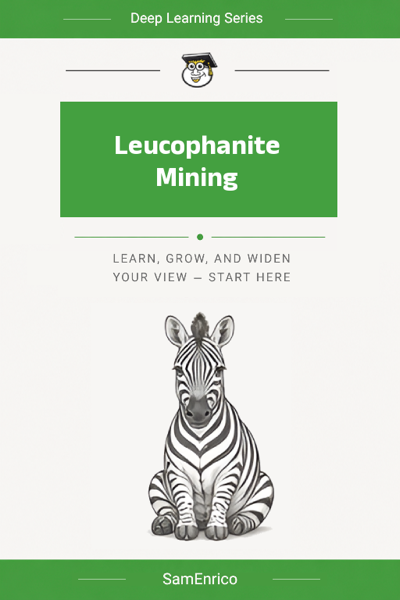
Non-FictionInformativeEducational
Leucophanite Mining Audiobook
A Coursebook on Leucophanite Mining
A Coursebook on Leucophanite Mining
Formats
Free sample
Chapter 1: The Forgotten Metal--In the annals of mineralogy, certain elements and their host minerals have shaped empires, fueled wars, and enabled technologies that define modern civilization. Beryllium—light, stiff, and remarkably thermally conductive—is one such element, yet its primary ore minerals remain largely unknown outside specialized circles. Among these, leucophanite stands as one of the most fascinating and least understood. Discovered in the fjords of Norway in the mid-nineteenth century, this rare beryllium silicate languished for generations as little more than a collector's curiosity. Today, as the world scrambles for secure supplies of critical minerals, leucophanite is emerging from obscurity.
This chapter introduces the mineral, its properties, its strategic importance, and its place in the broader context of beryllium extraction—setting the stage for a comprehensive journey through the geology, mining, metallurgy, and sustainable development of this remarkable resource.The Discovery of Leucophanite The year 1840 marked a significant moment in Scandinavian mineralogy. Peter Christian Weibye, a Norwegian mineralogist and customs inspector with a passion for collecting, was exploring the Langesundsfjord region—a coastal area south of Oslo renowned for its alkaline intrusions and rare minerals. Among the specimens he gathered was an unusual pale crystal that did not match any known mineral. Weibye submitted the samples to the Swedish chemist and mineralogist Jöns Jacob Berzelius, one of the fathers of modern chemistry, who confirmed it as a new species. The mineral was named leucophanite, from the Greek words leukos (white) and phainein (to appear)—a reference to its typical whitish or pale coloration, though subsequent discoveries would reveal a much wider color palette.The type locality, Langesundsfjord, remains a classic site for agpaitic minerals.
Here, in nepheline syenite pegmatites, leucophanite occurs alongside eudialyte, sodalite, aegirine, and an array of rare earth element (REE) minerals. The original specimens, now housed in the Natural History Museum in Oslo and the Swedish Museum of Natural History in Stockholm, display the characteristic penetration twinning that would later become a diagnostic feature for the species.Crystal Chemistry and Formula Leucophanite belongs to the group of beryllium silicates, a small family that includes the more famous beryl (Be₃Al₂Si₆O₁₈) and bertrandite (Be₄Si₂O₇(OH)₂). Its chemical formula is written as Na Ca Be Si₂O₆F, though natural specimens exhibit considerable variation. The structure is a framework of silicon-oxygen tetrahedra—the fundamental building blocks of silicate minerals—arranged in chains linked by beryllium in tetrahedral coordination. Calcium and sodium occupy larger sites…
This is the end of the free sample. Get the Audiobook to keep going. Buy now
About this book
Details
- Author
- Ewing Jacquiline
- Publisher
- SamEnrico
- Language
- English
- Genre
- Non-Fiction, Informative, Educational
- Released
- 2026-05-04
- Pages (approx.)
- 132
- Available as
- eBook, Audiobook

Listen in the VoxFlicks app
Audiobooks and audio dramas wherever you go. Sign in with your SamEnrico account and press play.
More by Ewing Jacquiline
 Teresa Way of PerfectionEwing Jacquiline$11.99
 Nonverbal Customer ServiceEwing Jacquiline$11.99
 Drug Addiction Support GroupsEwing Jacquiline$11.99
 Tai Chi For SeniorsEwing Jacquiline$11.99
 The Bloodied Silk: The Fall of the Ming and the Rise of the Qing (1644)Ewing Jacquiline$11.99
 How to Produce Car Window NetsEwing Jacquiline$11.99
 Members Only Pricing StrategyEwing Jacquiline$12.99
 How to Start a Provident Fund (non-life) Business (Beginners Guide)Ewing Jacquiline$11.99
You may also like
 Hong Kong Handover 1997Dunn Johnnie$11.99
 Zumba For Postnatal Recovery CourseNeal Christian$11.99
 Zumba for BeginnersLadner Nikia$11.99
 YouTube Comment Mining GuideHumes Pandora$12.99
 Worry Box MeditationCarlin Rudy$11.99
 Workplace Stress MeditationNguyen Lynn$11.99
 Workplace Stress and Sleep RepairHawley Ivory$11.99
 Workplace Perfectionism CureDelaney Jeffry$11.99
 Workplace Injustice Anger GuideWallen Isabelle$11.99
 Work Addiction and Burnout LinkGreenwood Ester$11.99
 Women in Yoga and WellnessBeattie Galina$11.99
 Women in Stand Up ComedyChun Evangeline$11.99