
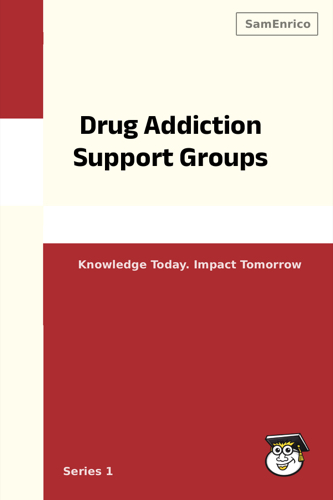
Drug Addiction Support Groups
Find online and in person peer help.
Find online and in person peer help.
Formats
About this book
Free sample
Chapter 1: The Connection Prescription--–- Imagine two people trying to climb out of a deep hole. The first person has a rope, a ladder, and a pair of climbing boots. They are well-equipped, determined, and they have read every book on hole-escaping. But they are alone. The second person has nothing but their bare hands.
They are scared, underprepared, and they have no idea what they are doing. But there is someone at the top of the hole reaching down, offering a hand. Which person is more likely to get out? The research is unequivocal: the person with connection beats the person with all the tools and none of the support, every single time.This is not a metaphor for the power of positive thinking. It is a statement of empirical fact, backed by decades of peer-reviewed research.
The single most powerful predictor of long-term recovery from drug addiction is not willpower. It is not expensive therapy. It is not medication, although medication can help. The single most powerful predictor of long-term recovery is connection to a community of people who understand what you are going through because they have been there themselves. Peer support groups work.
They work better than almost anything else we have. And this chapter is going to explain why, from the neuroscience of mirror neurons to the psychology of shame resilience to the practical reality of what happens when one addict helps another.The startling statistic that changes everything Let us start with the numbers. The National Institute on Alcohol Abuse and Alcoholism conducted a landmark study following patients after treatment. They compared people who actively participated in peer support groups—AA, NA, SMART Recovery, or others—with people who attempted recovery on their own. The results were dramatic.
People who attended peer support groups were twice as likely to maintain long-term recovery compared to those who did not. Twice. Not ten percent. Not twenty percent. One hundred percent more likely.Another study from the Journal of Substance Abuse Treatment followed over two thousand individuals for five years.
Those who attended at least one peer support meeting per week had relapse rates nearly sixty percent lower than those…
This is the end of the free sample. Get the eBook to keep going. Buy now
Contents
- Chapter 1
- Chapter 2
- Chapter 3
- Chapter 4
- Chapter 5
- Chapter 6
- Chapter 7
- Chapter 8
- Chapter 9
- Chapter 10
- Chapter 11
- Chapter 12
Details
- Author
- Ewing Jacquiline
- Publisher
- SamEnrico
- Language
- English
- Genre
- Non-Fiction, Self-Help, Support
- Released
- 2026-06-07
- Pages (approx.)
- 123
- Available as
- eBook, Audiobook

Read better in the ZLOADR app
Your eBooks on your phone or tablet. Sign in with your SamEnrico account and start reading.
More by Ewing Jacquiline
 Teresa Way of PerfectionEwing Jacquiline$11.99
 Nonverbal Customer ServiceEwing Jacquiline$11.99
 Tai Chi For SeniorsEwing Jacquiline$11.99
 The Bloodied Silk: The Fall of the Ming and the Rise of the Qing (1644)Ewing Jacquiline$11.99
 How to Produce Car Window NetsEwing Jacquiline$11.99
 Members Only Pricing StrategyEwing Jacquiline$12.99
 Leucophanite MiningEwing Jacquiline$11.99
 How to Start a Provident Fund (non-life) Business (Beginners Guide)Ewing Jacquiline$11.99
You may also like
 Hong Kong Handover 1997Dunn Johnnie$11.99
 Zumba For Postnatal Recovery CourseNeal Christian$11.99
 Zumba for BeginnersLadner Nikia$11.99
 YouTube Comment Mining GuideHumes Pandora$12.99
 Worry Box MeditationCarlin Rudy$11.99
 Workplace Stress MeditationNguyen Lynn$11.99
 Workplace Stress and Sleep RepairHawley Ivory$11.99
 Workplace Perfectionism CureDelaney Jeffry$11.99
 Workplace Injustice Anger GuideWallen Isabelle$11.99
 Work Addiction and Burnout LinkGreenwood Ester$11.99
 Women in Yoga and WellnessBeattie Galina$11.99
 Women in Stand Up ComedyChun Evangeline$11.99