
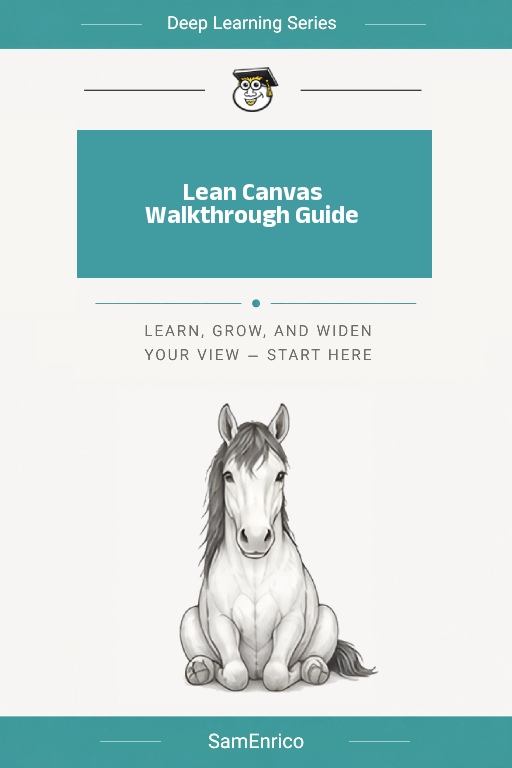
Lean Canvas Walkthrough Guide eBook
Complete Ash Maurya's Lean Canvas in one hour. Ada
by Marin Lesha
Complete Ash Maurya's Lean Canvas in one hour. Adapt Business Model Canvas for startups and scaleups.
Formats
Free sample
Chapter 1: Burn Your Plan--–- The first time Maya raised her voice in a boardroom, she was holding a forty-slide deck she had spent three months perfecting. The room smelled of stale coffee and desperation. Across the table sat three angel investors who had already committed $500,000 based on that deck. Maya was twenty-eight years old, twenty pounds lighter than when she started, and completely convinced that her business plan was a masterpiece. Six months later, she would watch that same plan kill her company.The funeral for Maya’s first startup happened on a Tuesday.
There was no ceremony, no cake, no bittersweet toasts. There was only an email to her thirty-seven employees announcing that payroll would stop at the end of the week. The investors had already walked away. The product—a beautifully designed, impeccably coded platform for “small business management”—had exactly fourteen active users. Fourteen.
After eighteen months of work and nearly $800,000 in burn. Fourteen people who had tried the product and not immediately abandoned it.Maya sat in her empty office, the forty-slide deck still open on her laptop, and realized something that would change the rest of her life. The plan was not wrong because she had made a mistake. The plan was wrong because planning itself was the mistake.The Prediction Trap Here is a truth that business schools will never teach you: a business plan is not a tool for success. It is a tool for feeling safe.
When you write a forty-page document projecting revenue for five years into the future, you are not preparing for reality. You are building a fortress against uncertainty. And uncertainty, as every startup founder eventually discovers, is the only certainty you have.Startups are not smaller versions of Google or General Motors. That seems obvious when stated plainly, but watch how founders behave. They write business plans.
They build detailed financial models. They hire functional leads for marketing, sales, and product before they have a single paying customer. They treat the unknown as if it were merely the known with a few missing data points. This is the Prediction Trap, and it has destroyed more startups than competition, funding shortages, and bad hires combined.The Prediction Trap operates through a simple psychological mechanism: planning feels like progress. When you spend three weeks perfecting a revenue forecast, your brain releases the same dopamine as when you actually acquire a customer.
The act of writing down a plan triggers the same reward circuitry as executing on that plan. This is not a character flaw; it is how human brains are wired. And it is deadly.Eric Ries, in his foundational work The Lean Startup, documented this phenomenon across hundreds of failed companies. The common pattern was always the same: a team would spend months building a detailed plan, raise money based on that plan, hire aggressively to execute the plan, and only then discover that the plan’s core assumptions were wrong. By that point, the company was out of time and out of money.
The plan had become a suicide pact.Why Startups Are Not Small Big Companies The distinction between a startup and an established company is not about size. It is about uncertainty. An established company operates in known territory. It knows who its customers are. It knows what problem it solves.
It knows its channels, its pricing, its cost structure. For an established company, execution is the challenge. Execution can be planned.A startup operates in unknown territory. It does not know who its customers are—not really. It does not know what problem it solves—not definitively.
Every single box on its business model is a hypothesis, not a fact. For a startup, learning is the challenge. Learning cannot be planned. Learning can only be discovered through experimentation.This distinction has profound implications. When a startup uses a business plan designed for an established company, it is committing what Steve Blank calls the “startup error” : applying execution thinking to a learning problem.
The result is catastrophic. The startup builds a product based on untested assumptions, launches it with great fanfare, and then stares in confusion at the silence.Maya’s first startup was a textbook case of the startup error. She had assumed that “small businesses” needed an all-in-one management platform. Which small businesses? Any small businesses.
What specific problem were they solving? The problem of “not having a management platform.” She had never interviewed a single small business owner before writing the plan. She had never tested the assumption that a unified platform was preferable to the half-dozen specialized tools small businesses already used. She had simply planned. And then she had built.
And then she had failed.The $500,000 Lesson Let us be specific about Maya’s failure, because specificity is the entire point of this book. Her forty-slide deck contained the following forecasts:Month 6: 500 paying customers Month 12: 2,500 paying customers Month 18: 10,000 paying customers Month 24: Acquisition by Salesforce for $40 million These numbers did not come from customer conversations. They came from a spreadsheet model that extrapolated from “comparable companies.” Maya had spent two weeks researching the growth trajectories of similar startups, averaged their metrics, and projected that average onto her own company. This is like predicting your child’s height by averaging the height of every adult in your city. The average tells you nothing about the specific individual.The actual results were brutally different.
Maya’s team spent six months building the platform. When they launched, they acquired fourteen customers in the first month. Not five hundred. Fourteen. Most of those fourteen churned within ninety days.
By month twelve, the company had thirty-seven active users. Not 2,500. Thirty-seven.Maya had raised $500,000 based on a plan that assumed 500 customers by month six. She had hired a team of twelve based on a plan that assumed 2,500 customers by month twelve. She had signed a two-year lease for office space based on a plan that assumed acquisition by month twenty-four.
Every single decision was based on assumptions that turned out to be false. And because she had treated those assumptions as facts, she had no room to pivot when the facts revealed themselves to be fantasies.This is the hidden cost of business plans. It is not the time spent writing them. It is not the paper wasted printing them. It is the commitment to assumptions that are made before any real evidence exists.
A business plan locks you into a path. When that path leads off a cliff, the plan does not save you. The plan is the reason you did not see the cliff in the first place.The 60-Minute Pact This book is built on a single promise: you can complete a Lean Canvas for your startup or scaleup in sixty minutes. Not six months. Not six weeks.
Not even six days. Sixty minutes.This is not a marketing gimmick. The Lean Canvas is designed to be fast. It has only nine boxes. Each box requires a sentence, not a paragraph.
The entire canvas fits on a single page. If it takes you longer than sixty minutes to fill out, you are doing something wrong. You are adding detail that belongs in execution…
This is the end of the free sample. Get the eBook to keep going. Buy now
About this book
Details
- Author
- Marin Lesha
- Publisher
- SamEnrico
- Language
- English
- Genre
- Non-Fiction, First 30 Days, Lean Planning
- Released
- 2026-06-01
- Pages (approx.)
- 140
- Available as
- eBook, Audiobook

Read better in the ZLOADR app
Your eBooks on your phone or tablet. Sign in with your SamEnrico account and start reading.
More by Marin Lesha
 Creative Bootstrapping BootcampMarin Lesha$11.99
 TM Expectations ManagementMarin Lesha$11.99
 Parking Tech Capital GuideMarin Lesha$11.99
 The Mattress Selection Back GuideMarin Lesha$11.99
 Sendy Logistics Exit GuideMarin Lesha$11.99
 The Papyrus Thieves: Stealing Stories from Ancient EgyptMarin Lesha$11.99
 Understanding Pfeiffer–palm–teller SyndromeMarin Lesha$17.99
 How to Start a Cabinets for Sewing Machines Business (Beginners Guide)Marin Lesha$11.99
 Streaming Services PositioningMarin Lesha$12.99
 Bob Marley: Reggae RevolutionMarin Lesha$11.99
You may also like
 SWOT Analysis on One PageHaag Kirstin$12.99
 Team Section in Lean PlanSeward Rocky$12.99
 Startup Hypothesis Testing PlanBynum Ashleigh$12.99
 Social Impact on One PageLindsay Helena$12.99
 Single Page Business Model GuideAdams Dominic$12.99
 Revenue Streams for One Page PlanKimmel Britta$12.99
 One Page Plan for Side HustleCombs Oralee$12.99
 One Page Plan for Pop Up ShopsMccool Penni$12.99
 One Page Plan for Family BusinessOtto Celsa$12.99
 One Page Plan for CreativesBartels Trish$12.99
 One Page Business Plan BlueprintEarle Bettina$12.99
 Milestone Planning on One PageDennison Charmain$12.99