
Non-FictionDocumentaryMusicCultural Studies
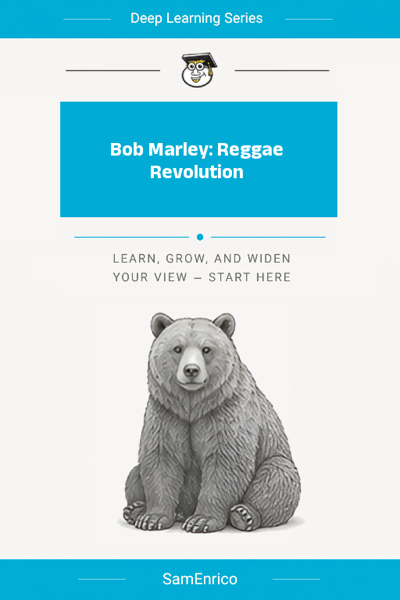
Bob Marley: Reggae Revolution
A Coursebook on Bob Marley: Reggae Revolution
by Marin Lesha
A Coursebook on Bob Marley: Reggae Revolution
Formats
About this book
Free sample
Chapter 1: The Boy From Nowhere...--The fifteen-year-old slept on a wooden crate that night.Not because he had to prove anything. Not because he was running toward a dream. Simply because there was no other place to lie down in the Trenchtown slum of Kingston, Jamaica, and the crate was dry while the dirt outside was wet. The year was 1960. The boy’s name was Robert Nesta Marley, though no one called him Bob yet.
He had walked thirty miles from the rural village of Nine Mile, traveling alone, with nothing but a change of clothes wrapped in a cloth bag and a confusion in his chest that he could not yet name. His mother, Cedella Booker, had sent him to Kingston to live with a family friend, hoping the city might offer opportunities that the countryside could not. What the city offered instead was a crash course in survival.The wooden crate became his bed. The open sewer that ran past the front door became his lullaby. The sound of gunfire in the distance became his alarm clock.This is not the beginning of a fairy tale.
It is the beginning of a forging. And before we can understand the Reggae Revolution—before we can hear the basslines that shook the world or feel the spiritual force of Rastafari that powered an entire movement—we must first understand the furnace in which Bob Marley was made. That furnace was not a recording studio. It was not a political rally. It was the muddy, violent, beautiful, desperate lane called Trenchtown.The Geography of Sorrow To understand Marley, one must first understand Jamaica in the mid-twentieth century—a nation caught between the collapse of colonial rule and the chaos of self-determination.
Jamaica had been a British colony since 1655, its economy built on the backs of enslaved Africans who worked sugar plantations under a system so brutal that rebellion was not a choice but a reflex. The slave trade was abolished in 1807, but the damage was done. The island’s social structure was a pyramid with a white minority at the…
This is the end of the free sample. Get the eBook to keep going. Buy now
Contents
- Chapter 1
- Chapter 2
- Chapter 3
- Chapter 4
- Chapter 5
- Chapter 6
- Chapter 7
- Chapter 8
- Chapter 9
- Chapter 10
- Chapter 11
- Chapter 12
Details
- Author
- Marin Lesha
- Publisher
- SamEnrico
- Language
- English
- Genre
- Non-Fiction, Documentary, Music, Cultural Studies, Informative, Educational
- Released
- 2026-05-04
- Pages (approx.)
- 140
- Available as
- eBook, Audiobook

Read better in the ZLOADR app
Your eBooks on your phone or tablet. Sign in with your SamEnrico account and start reading.
More by Marin Lesha
 Creative Bootstrapping BootcampMarin Lesha$11.99
 TM Expectations ManagementMarin Lesha$11.99
 Parking Tech Capital GuideMarin Lesha$11.99
 The Mattress Selection Back GuideMarin Lesha$11.99
 Sendy Logistics Exit GuideMarin Lesha$11.99
 The Papyrus Thieves: Stealing Stories from Ancient EgyptMarin Lesha$11.99
 Understanding Pfeiffer–palm–teller SyndromeMarin Lesha$17.99
 How to Start a Cabinets for Sewing Machines Business (Beginners Guide)Marin Lesha$11.99
 Lean Canvas Walkthrough GuideMarin Lesha$12.99
 Streaming Services PositioningMarin Lesha$12.99
You may also like
 Hong Kong Handover 1997Dunn Johnnie$11.99
 Zumba For Postnatal Recovery CourseNeal Christian$11.99
 Zumba for BeginnersLadner Nikia$11.99
 YouTube Comment Mining GuideHumes Pandora$12.99
 Worry Box MeditationCarlin Rudy$11.99
 Workplace Stress MeditationNguyen Lynn$11.99
 Workplace Stress and Sleep RepairHawley Ivory$11.99
 Workplace Perfectionism CureDelaney Jeffry$11.99
 Workplace Injustice Anger GuideWallen Isabelle$11.99
 Work Addiction and Burnout LinkGreenwood Ester$11.99
 Women in Yoga and WellnessBeattie Galina$11.99
 Women in Stand Up ComedyChun Evangeline$11.99