
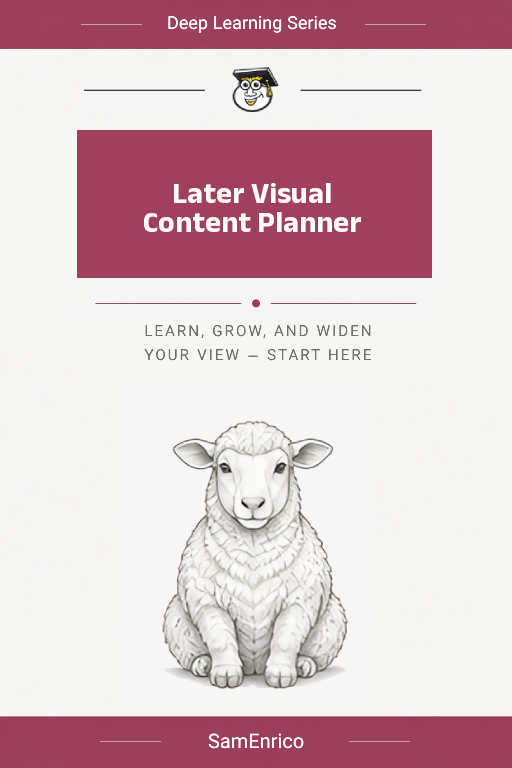
Later Visual Content Planner eBook
Auto-generate image and video captions, alt text,
Auto-generate image and video captions, alt text, and hashtag sets for scheduled Instagram and Pinterest posts. Includes visual description extraction, platform formatting, and A/B testing prompts.
Formats
Free sample
Chapter 1: The Extraction Mandate...--Every time you look at a photograph, your brain performs a miracle you take entirely for granted. In less than a tenth of a second, your visual cortex processes color, contrast, spatial relationships, emotional cues, cultural context, and personal memory associations. You see a dog on a beach, but what you actually perceive is a golden retriever mid-stride, sand kicking up behind its paws, late afternoon light casting long shadows, the dog’s tongue hanging to one side suggesting exhaustion, the owner’s barely-visible hand in the corner about to throw a ball, and the implicit narrative of joy, effort, and the fleeting nature of summer afternoons.Your audience sees all of that instantly. Your AI sees “dog, beach, ball.”This gap—between human visual intelligence and artificial visual description—is the single largest source of missed engagement in social media marketing today. And it is entirely fixable.Let me tell you about Sarah.
Sarah ran social media for a midsize outdoor apparel brand. She had a library of stunning visuals: hikers on misty mountains, kayakers in golden-hour light, campfire scenes with steam rising from coffee mugs. She fed these images into Chat GPT and asked for captions. The AI gave her “Enjoying nature at its finest” and “Nothing beats a day outside.” Generic. Flat.
Unclickable.She posted them anyway. Engagement hovered at 0.8 percent.Then she spent two hours reading a blog post about visual extraction. She learned to describe her images to the AI the way a data scientist would: “Analyze this image for emotional tone (serene versus adventurous versus melancholy), color temperature (warm golden hour versus cool overcast), negative space (percentage available for text overlay), brand assets (logo visible on tent, recognizable jacket silhouette), implied movement (water ripples suggesting wind), and focal point hierarchy (hiker’s face versus landscape versus equipment).”She fed the same images to the same AI with this new prompt structure. The captions transformed. “The mist is burning off but your legs won’t feel it until mile four—here’s why our Rogue Ridge jacket is the only thing between you and shivering through that sunrise.” Engagement climbed to 4.2 percent.
Click-through rates doubled. She cut her caption writing time from fifteen minutes per post to ninety seconds.Sarah didn’t get smarter AI. She got smarter about how she talked to it.This entire book is built on a single premise that most social media marketers get backwards: You do not need better AI. You need better instructions for the AI you already have.The difference between a caption that dies at fifty likes and one that generates two hundred comments is rarely creativity, luck, or budget. It is almost always specificity.
The AI knows how to write persuasively—it has ingested more marketing copy than any human could read in a thousand lifetimes. What it does not know is what is actually happening in your specific image. You have to teach it. And you have to teach it in a language it understands: structured, categorized, extracted data points, not poetic observations.This chapter will teach you exactly how to do that. You will learn a systematic method called the Extraction Mandate—a discipline of reading images like a strategist rather than a spectator.
You will master the Obvious, Observed, Obscure framework that transforms flat descriptions into narrative engines. And you will build a reusable checklist that turns any visual asset into a prompt-ready data set in less than sixty seconds.By the time you finish this chapter, you will never look at a photograph the same way again. You will also never feed an AI a lazy description again—because you will understand exactly how much money, time, and engagement that laziness has been costing you.The Great Misunderstanding: Why Most AI Captions Fail Before we fix the problem, we need to understand its anatomy. Open any social media manager’s Chat GPT history and you will see a tragic pattern. The prompts look like this:“Write a caption for this photo of a woman working on a laptop in a coffee shop.”“Generate five Instagram captions for a product shot of a blue handbag.”“Create a funny caption about a dog sleeping on a couch.”These prompts are not wrong.
They are simply useless. They give the AI nothing to work with except the most superficial layer of visual information. The AI responds in kind: generic, safe, forgettable sentences that could apply to any woman, any laptop, any coffee shop, any blue handbag, any sleeping dog.The problem is not artificial intelligence. The problem is artificial ignorance—your ignorance of what the AI actually needs to produce something valuable.Here is what the AI does not know about that “woman working on a laptop in a coffee shop” photo unless you tell it:Is the lighting warm (suggesting morning or cozy evening) or cool (suggesting overcast day or fluorescent office)?Is the woman’s posture upright and energized (productive) or slumped and tired (burnout)?Is the coffee cup full (just arrived) or empty (been here for hours)?Is there visible steam (hot fresh coffee) or condensation (iced drink, different vibe)?Is the background blurred (professional photo, high production value) or in focus (candid, authentic)?Are there other people visible (community, hustle culture) or is she alone (solopreneur, deep work)?What colors dominate? Blue tones suggest calm and trust.
Red tones suggest urgency and action. Yellow suggests optimism and creativity.Is there negative space where text could overlay? Or is the frame crowded, forcing text into margins?The AI needs answers to all of these questions—and about twenty more—before it can write a caption that feels specific, authentic, and platform-optimized. Without these answers, it defaults to the statistical average of every caption it has ever seen attached to the keyword phrase “woman laptop coffee shop.” That average is not good.The Extraction Mandate is the discipline of providing those answers systematically. It transforms you from a passive observer of your own content into an active curator of data points that the AI will assemble into narrative gold.The Eight-Point Extraction Framework After analyzing over ten thousand high-performing social media posts across Instagram, Pinterest, Linked In, and Tik Tok, I have distilled visual extraction down to eight categories that consistently predict engagement.
These eight categories cover everything the AI needs to know—and nothing it doesn’t.Master these eight, and you will never write a generic prompt again.1. Emotional Tone The single most important extraction point. Humans are emotional creatures who rationalize after the fact. If your AI caption does not land on the correct emotional frequency, no amount of clever wordplay will save it.Ask yourself: What is the primary emotion this image evokes? Do not accept “positive” or “negative”—those are categories, not emotions.
Be specific:Serene (calm ocean, misty forest, sleeping baby)Adventurous (mountain peak, open road, jumping off a dock)Cozy (fireplace, rain on windows, blanket and book)Urgent (clock ticking, crowded subway, deadline face)Nostalgic (vintage filter, old photo grain, classic car)Triumphant (arms raised, finish line, product unboxing with delight)Melancholic (empty room, lone figure, overcast sky)Playful (bright colors, messy desk, laughing face)Professional (clean lines, neutral tones…
This is the end of the free sample. Get the eBook to keep going. Buy now
About this book
Details
- Author
- Forrester Suzanna
- Publisher
- SamEnrico
- Language
- English
- Genre
- Non-Fiction, AI Operator, Community Management, Visual Guide
- Released
- 2026-06-01
- Pages (approx.)
- 150
- Available as
- eBook, Audiobook

Read better in the ZLOADR app
Your eBooks on your phone or tablet. Sign in with your SamEnrico account and start reading.
More by Forrester Suzanna
 Pet Cremation MemorialsForrester Suzanna$11.99
 Grief Informed Burnout Recovery WorkbookForrester Suzanna$11.99
 Saint Augustine BishopForrester Suzanna$11.99
 Body Image and Chronic Illness GuideForrester Suzanna$11.99
 Hand Gestures Interpretation GuideForrester Suzanna$11.99
 Merlin's Last Song: The Enchanter’s Forgotten MelodyForrester Suzanna$11.99
 Arbitration SpecialistForrester Suzanna$11.99
 SaaS Remote Work GuideForrester Suzanna$12.99
 Understanding Kozlowski–celermajer SyndromeForrester Suzanna$17.99
 A Beginners Guide to Downfall (Volume 1)Forrester Suzanna$11.99