
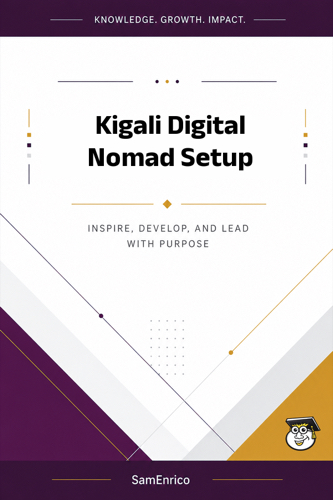
Non-FictionStartup GuideDigital Nomad
Kigali Digital Nomad Setup eBook
Base your remote startup from Rwanda's fast intern
Base your remote startup from Rwanda's fast internet hub.
Formats
Free sample
Chapter 1: The $10,000 Desk--–- The email arrived at 11:47 PM on a Tuesday. I was staring at my bank balance, which had just been reduced by $4,200 for rent on a one-bedroom apartment in San Francisco that had a broken dishwasher, a landlord who didn't believe in heat, and a neighbor who practiced drums at 7 AM. The email was from a founder I had met at a conference six months earlier. Subject line: "We moved to Kigali. Best decision we ever made."I ignored it.
I was busy. I had a startup to build.Three weeks later, I calculated something I had been avoiding. The spreadsheet was brutal. My monthly burn rate, just for me to exist and work in San Francisco, was $10,300. Rent: $4,200.
Co-working desk: $650. Coffee shop Wi Fi "productivity tax": $300. Food delivery because I was too tired to cook: $1,200. Health insurance: $550. Uber rides to meetings: $400.
The rest was software subscriptions, laundry, and the occasional attempt at a social life.And what did I get for $10,300 per month? I got a city where raising a seed round meant 47 coffee meetings. I got a talent market where a junior developer demanded $150,000 and equity. I got a culture where "working hard" meant staying at your desk until 9 PM to impress your manager. I was the manager.
I was impressing no one.I was paying $10,000 per month for the privilege of being stressed, alone, and completely undistinguished.That founder's email sat in my inbox for two weeks. Then I opened it. Then I read it three times. Then I booked a one-way ticket to Kigali, Rwanda.This chapter is about why I never looked back. And why, if you are currently paying for a $10,000 desk in a city that doesn't care if you succeed or fail, you might want to read this with a highlighter.The Geography of Desperation Every digital nomad guide you have ever read is a lie.
Not maliciously. But functionally. They are written by people who spent six weeks in Chiang Mai, wrote a blog post about "how to live like a king for $20 a day," and then moved back to London when their remote contract ended. They are tourists, not builders. They optimize for cheap massages and Instagram sunsets.
They do not optimize for building a company that outlives them.I know because I was almost one of them. I had done the Bali circuit. I had done the Lisbon experiment. I had spent a month in Medellín pretending that working from a hostel pool was a personality. And every time, I came back to the same realization: I was not building anything.
I was drifting. The low cost of living was a trap. It let me pretend that low productivity was acceptable because my expenses were low. I was paying $2,000 a month in Bali and producing $2,000 worth of work. In San Francisco, I was paying $10,000 and producing maybe $8,000 worth of work.
The math was better in Bali, but the trajectory was zero.What I needed was not cheap. What I needed was efficient.Kigali is not cheap. Let me say that again because every other guide will try to sell you on $5 hostels and $1 street food. Kigali is not cheap. It is reasonably priced for what you get.
A nice one-bedroom apartment in a good neighborhood costs $800-$1,200 per month. A latte at a decent cafe costs $3. A moto-taxi across town costs $2. A dinner out with drinks costs $20. You can live well on $2,500 per month.
You can live very well on $4,000. You are not coming here to save money. You are coming here to buy focus.And focus, it turns out, is the only thing that matters.The Clean Slate Advantage Here is something that every history book will tell you and every travel guide will omit: Rwanda rebuilt itself from absolute zero after 1994. The genocide did not just kill a million people. It destroyed every institution, every piece of infrastructure, every assumption about how a country should work.
The government that took over in the aftermath had no legacy systems to protect. No entrenched bureaucrats. No century-old regulations written for a different era. They had nothing. So they built everything from scratch.That is the Clean Slate Advantage.
And it is the single most important fact about doing business in Kigali.When you register a company in France, you are interacting with a bureaucracy designed in the Napoleonic era, updated piecemeal by a thousand different governments, and operated by civil servants who have spent thirty years learning how to say "non" in seventeen different ways. When you register a company in Kigali, you are interacting with a digital platform built in 2015 by a team of young engineers who were told to make it work like Amazon. It takes six hours. I am not exaggerating. Six hours from starting the online form to receiving your registration certificate.
I did it while eating breakfast.The platform is called Irembo. It is the single digital gateway for every government service in Rwanda. Business registration. Tax filing. Visa applications.
Property transfer. Birth certificates. Drivers licenses. Everything. You log in, you fill out forms that are actually clear, you pay with a credit card, and you wait.
Usually less than 24 hours. Sometimes less than 4.I had a conversation with a fintech founder who chose Kigali over Nairobi for this exact reason. He said, "In Nairobi, I spent three months trying to get a data protection license. I had to hire a lawyer. I had to bribe someone.
I still don't know if I did it right. In Kigali, I applied online, got approved in five days, and the approval letter included a link to the exact regulations I needed to follow. It was like dealing with a tech company, not a government."That is the Clean Slate Advantage. No legacy. No corruption.
No "that's just how we do things here." Just efficiency.The Governance APII am a technical founder. I think in systems. And the way I came to understand the Rwandan government was as an API. A well-designed one. With documentation, rate limits, and predictable response times.Let me explain.An API, for the non-technical readers, is a set of rules that allows one piece of software to talk to another.
A good API is consistent. It returns the same data format every time. It has clear error messages. It tells you exactly what you did wrong. A bad API is unpredictable.
Sometimes it works. Sometimes it doesn't. Sometimes it returns data in JSON. Sometimes in XML. Sometimes it just crashes and you have to guess why.The Rwandan government behaves like a good API.
The rules are published online. The forms are standardized. The processing times are published and generally accurate. When something goes wrong, you get a clear explanation and a path to fix it. When you need help, there is a phone number that someone actually answers.This is not an accident.
The current government came to power promising to eliminate the culture of impunity and inefficiency that had plagued the region. They built systems, not relationships. They digitized, not delegated. They created a bureaucracy that is actually bureaucratic—in the Weberian sense of rule-based, impersonal, and predictable.For…
This is the end of the free sample. Get the eBook to keep going. Buy now
About this book
Details
- Author
- Maclean Cinda
- Publisher
- SamEnrico
- Language
- English
- Genre
- Non-Fiction, Startup Guide, Digital Nomad
- Released
- 2026-06-06
- Pages (approx.)
- 129
- Available as
- eBook, Audiobook

Read better in the ZLOADR app
Your eBooks on your phone or tablet. Sign in with your SamEnrico account and start reading.
More by Maclean Cinda
 Nightmare Rescripting For Social Anxiety GuideMaclean Cinda$11.99
 Household Toxin Identification GuideMaclean Cinda$11.99
 Board Game Anger TriggersMaclean Cinda$11.99
 The Exercise Calorie Adjustment GuideMaclean Cinda$11.99
 Monte Cassino: The Mountain That Would Not FallMaclean Cinda$11.99
 Digital Art and NFT Creation BusinessMaclean Cinda$11.99
 Overtime Rules First EmployeeMaclean Cinda$12.99
 Labor Economics Excel GuideMaclean Cinda$12.99
 Understanding Proteus SyndromeMaclean Cinda$17.99
 How to Start a Trauma Center BusinessMaclean Cinda$11.99
You may also like
 Hong Kong Handover 1997Dunn Johnnie$11.99
 Zumba For Postnatal Recovery CourseNeal Christian$11.99
 Zumba for BeginnersLadner Nikia$11.99
 YouTube Comment Mining GuideHumes Pandora$12.99
 Worry Box MeditationCarlin Rudy$11.99
 Workplace Stress MeditationNguyen Lynn$11.99
 Workplace Stress and Sleep RepairHawley Ivory$11.99
 Workplace Perfectionism CureDelaney Jeffry$11.99
 Workplace Injustice Anger GuideWallen Isabelle$11.99
 Work Addiction and Burnout LinkGreenwood Ester$11.99
 Women in Yoga and WellnessBeattie Galina$11.99
 Women in Stand Up ComedyChun Evangeline$11.99