
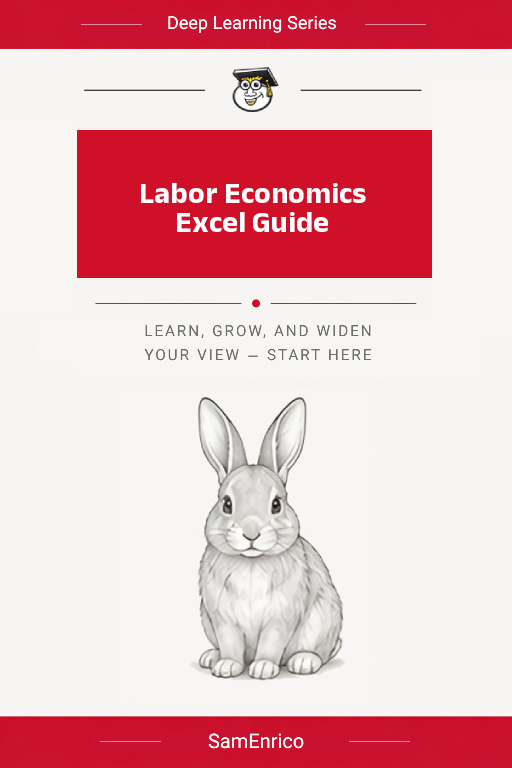
Non-FictionStudent's ShortcutLabor Economics
Labor Economics Excel Guide
Models labor supply, demand, wage determination, a
Models labor supply, demand, wage determination, and human capital using Excel for labor economics exam data analysis.
Formats
About this book
Free sample
Chapter 1: The Data Detective--–- Every labor economist eventually confronts the same cold realization: theory without data is just storytelling. You can memorize indifference curves, recite Mincer equations in your sleep, and draw supply-and-demand diagrams with artistic flair, but when an exam places a messy CSV file in front of you—rows spilling into the hundreds of thousands, missing values scattered like landmines, variable names that look like alphabet soup—the elegant theories suddenly feel like distant memories. This book exists because that gap between theory and exam performance is where most students stumble. And Excel, the software already sitting on your laptop, is the bridge.Labor economics exams are not testing whether you can recite Borjas verbatim. They are testing whether you can take a dataset of real (or realistic) workers, firms, wages, and hours, and answer policy-relevant questions under time pressure.
What is the labor supply elasticity for single mothers? Does a minimum wage hike reduce employment in this panel of fast-food restaurants? What is the return to an additional year of schooling, controlling for experience? These questions require three skills working in concert: theoretical understanding, data manipulation, and quantitative execution. Excel is the only tool that combines all three on virtually every exam computer.
This chapter transforms you from a passive reader of labor economics into an active data detective. You will learn what makes labor economics data unique, how to bring messy exam files into Excel without panic, and how to structure your workbook so that every subsequent chapter becomes a matter of clicking and interpreting rather than wrestling with error messages.By the end of this chapter, you will have a clean, analysis-ready dataset named the Examville Labor Market Survey—a fictional but realistic panel of 500 workers observed annually from 2018 to 2023. This dataset will reappear in Chapters 2, 4, 9, 11, and 12, creating a cumulative learning arc. You will also learn a critical decision that most textbooks ignore: when to use Excel’s built-in native functions (like LINEST) versus the point-and-click Regression Tool Pak. That choice alone can save you ten minutes on an…
This is the end of the free sample. Get the eBook to keep going. Buy now
Contents
- Chapter 1
- Chapter 2
- Chapter 3
- Chapter 4
- Chapter 5
- Chapter 6
- Chapter 7
- Chapter 8
- Chapter 9
- Chapter 10
- Chapter 11
- Chapter 12
Details
- Author
- Maclean Cinda
- Publisher
- SamEnrico
- Language
- English
- Genre
- Non-Fiction, Student's Shortcut, Labor Economics
- Released
- 2026-06-01
- Pages (approx.)
- 147
- Available as
- eBook, Audiobook

Read better in the ZLOADR app
Your eBooks on your phone or tablet. Sign in with your SamEnrico account and start reading.
More by Maclean Cinda
 Nightmare Rescripting For Social Anxiety GuideMaclean Cinda$11.99
 Household Toxin Identification GuideMaclean Cinda$11.99
 Board Game Anger TriggersMaclean Cinda$11.99
 Kigali Digital Nomad SetupMaclean Cinda$11.99
 The Exercise Calorie Adjustment GuideMaclean Cinda$11.99
 Monte Cassino: The Mountain That Would Not FallMaclean Cinda$11.99
 Digital Art and NFT Creation BusinessMaclean Cinda$11.99
 Overtime Rules First EmployeeMaclean Cinda$12.99
 Understanding Proteus SyndromeMaclean Cinda$17.99
 How to Start a Trauma Center BusinessMaclean Cinda$11.99
You may also like
 Hong Kong Handover 1997Dunn Johnnie$11.99
 Zumba For Postnatal Recovery CourseNeal Christian$11.99
 Zumba for BeginnersLadner Nikia$11.99
 YouTube Comment Mining GuideHumes Pandora$12.99
 Worry Box MeditationCarlin Rudy$11.99
 Workplace Stress MeditationNguyen Lynn$11.99
 Workplace Stress and Sleep RepairHawley Ivory$11.99
 Workplace Perfectionism CureDelaney Jeffry$11.99
 Workplace Injustice Anger GuideWallen Isabelle$11.99
 Work Addiction and Burnout LinkGreenwood Ester$11.99
 Women in Yoga and WellnessBeattie Galina$11.99
 Women in Stand Up ComedyChun Evangeline$11.99