
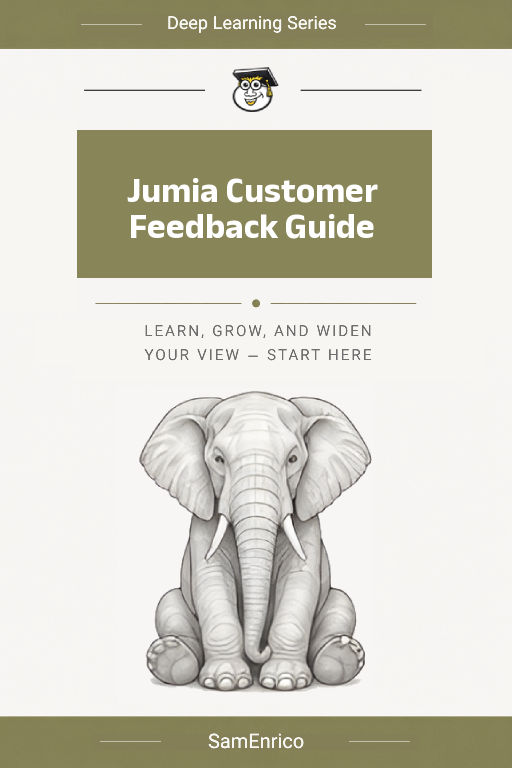
Non-FictionBusiness BriefFeedback
Jumia Customer Feedback Guide eBook
Manage Jumia seller feedback and ratings versus Am
Manage Jumia seller feedback and ratings versus Amazon's detailed product reviews.
Formats
Free sample
Chapter 1: The Handshake Principle--–- The smartphone looked identical. Same brand, same specs, same packaging, same price. On Amazon, the seller with five hundred reviews at 3.8 stars outsold the seller with five reviews at 5 stars. On Jumia, the seller with a 4.8 rating at a higher price outsold the competitor with a 4.2 rating at a lower price. Same product.
Different outcomes. This is not a coincidence. This is the fundamental difference between two e-commerce philosophies, and misunderstanding it has cost thousands of sellers their livelihoods.If you are reading this book, you have likely already discovered that the advice from Amazon seller forums, You Tube gurus, and Western e-commerce blogs does not work on Jumia. You have tried the tactics: stuffing packages with review request cards, running email follow-up sequences, optimizing product pages with endless keywords. And yet, your seller rating remains stuck, your returns are climbing, and you cannot understand why customers leave one-star ratings for reasons that have nothing to do with your product.The answer is simple, but not easy.
You have been playing the wrong game.Welcome to the Handshake Principle.The Two Engines of E-Commerce Every marketplace operates on a foundational currency. On Amazon, that currency is convenience. On Jumia, that currency is trust. These are not marketing slogans. They are algorithmic realities baked into how each platform ranks sellers, distributes traffic, and defines success.Amazon was built for a world of credit cards, predictable postal addresses, and consumers with disposable income.
An Amazon customer has already paid for their product before it ships. Their risk is minimal. Their primary question is not "Will this arrive?" but "Is this the best product for my money?" Consequently, Amazon's algorithm rewards product reviews—volume, velocity, and recency of customer feedback about the item. A smartphone with ten thousand reviews at 4.2 stars will almost always rank above a smartphone with ten reviews at 5 stars. Why?
Because Amazon's machine learning models have determined that large sample sizes are more reliable indicators of product quality than small, potentially biased samples.Jumia was built for a different reality. The majority of Jumia's customers pay with cash on delivery. They do not have credit cards. They may not have a formal street address. They are spending money that they earned through physical labor, saved over weeks, and are now handing over to a stranger at their doorstep.
The risk is entirely on the customer. Their primary question is not "Is this product the best?" but "Will this seller actually send me what I ordered, on time, without drama?" Consequently, Jumia's algorithm rewards seller ratings—the customer's assessment of the transaction rather than the product. A seller with a 4.8 rating at a higher price will almost always rank above a seller with a 4.2 rating at a lower price. Why? Because Jumia's machine learning models have determined that a trustworthy seller is more valuable than a cheap product when the customer is handing over cash.This difference is not subtle.
It is structural. It is encoded in the code that determines whether your products appear on page one or page twenty. And yet, the vast majority of Jumia sellers continue to optimize for the wrong metric.The Cost of Copying Amazon Let me share a story that illustrates the cost of this mistake.In 2021, a seller we will call Tunde launched an electronics store on Jumia Nigeria. He had previously sold on Amazon US, where he had achieved moderate success. He brought his Amazon playbook to Jumia: professional product photography, lengthy keyword-stuffed descriptions, automated email follow-ups, and a pricing strategy designed to undercut competitors.Within three months, Tunde had achieved impressive sales volume.
His products were appearing in search results. His prices were competitive. But his seller rating had dropped to 4.1 stars. He was excluded from Flash Sales, his Gold Seller status was revoked, and his organic traffic began to decline. He could not understand why.
His products were genuine. His delivery times were average. His customer service responses were prompt.The answer lay in the feedback. Tunde's customers were not leaving reviews about the products. They were leaving reviews about Tunde.
"The delivery driver was rude." "The package arrived late." "The phone case was the wrong shade of blue." These were not product issues. They were trust issues. And Tunde had no system for managing trust because his Amazon playbook had no chapter on trust.By contrast, a competitor we will call Amara sold the exact same electronics. Her product photos were taken with a mid-range smartphone. Her descriptions were brief.
Her prices were higher. But her seller rating was 4.8 stars. She was featured in Flash Sales, she held Gold Seller status, and her organic traffic was increasing month over month.Amara's secret was not complicated. She called every customer after delivery to confirm satisfaction. She sent pre-delivery SMS messages to reduce failed deliveries.
She trained her logistics partners to smile and apologize for delays. She treated every transaction as a relationship, not a conversion. In short, she understood that on Jumia, the seller is the product.Tunde eventually recovered, but only after six months of rebuilding his reputation and discarding his Amazon playbook. This book is written to save you those six months.The Anatomy of a Jumia Transaction To understand why seller ratings matter more than product reviews, you must understand the anatomy of a Jumia transaction. Every order follows a specific sequence, and each step presents an opportunity to build or erode trust.Step One: Discovery.
The customer searches for a product. Jumia's algorithm returns results based on relevance, price, and seller rating. A seller below 4.5 stars is demoted. A seller above 4.8 stars is promoted. This is not a suggestion.
It is the algorithm.Step Two: Consideration. The customer clicks on your product page. They examine your photos, read your description, and check your seller rating. If your rating is below 4.5, they may click away. If your rating is above 4.8, they may buy without reading the description.
This is the power of trust.Step Three: Purchase. The customer places the order. Because they are paying with cash on delivery, they have not yet spent any money. They are committing to a handshake, not a transaction. This is the moment of maximum uncertainty for the seller, because the customer can still walk away.Step Four: Fulfillment.
You pick, pack, and ship the product. Jumia's logistics network handles the delivery. But any delay, any damaged box, any rude driver is attributed to you. The customer does not distinguish between your mistake and Jumia's mistake. In their mind, you are responsible for the entire experience.Step Five: Delivery.
The driver arrives at the customer's door. The customer inspects the package. If the product matches their expectations, they hand over cash. If not, they refuse delivery. A refusal triggers an automatic negative rating, regardless of fault.Step Six: Rating.
The customer receives a push notification asking them to rate the seller. Most happy customers ignore this notification. Most unhappy customers click through immediately. This creates the feedback asymmetry that plagues every Jumia seller.Step Seven: Reputation. Your seller rating is updated.
If it drops below 4.5, your future discovery is reduced. If it stays above 4.8, your future discovery is increased.…
This is the end of the free sample. Get the eBook to keep going. Buy now
About this book
Details
- Author
- Mcgowan Melani
- Publisher
- SamEnrico
- Language
- English
- Genre
- Non-Fiction, Business Brief, Feedback
- Released
- 2026-05-30
- Pages (approx.)
- 130
- Available as
- eBook, Audiobook

Read better in the ZLOADR app
Your eBooks on your phone or tablet. Sign in with your SamEnrico account and start reading.
More by Mcgowan Melani
 Child Overdose Death HealingMcgowan Melani$11.99
 Window Glass ForensicsMcgowan Melani$11.99
 Cognitive Restructuring for BurnoutMcgowan Melani$11.99
 The Hair Loss MicronutrientMcgowan Melani$11.99
 EQ Failure LessonsMcgowan Melani$11.99
 Deck Organization SystemsMcgowan Melani$11.99
 Post Injury Return HypnosisMcgowan Melani$11.99
 Sibling Grief After Baby LossMcgowan Melani$11.99
 Love in the Margins: The Secret Correspondence of the First A&R LegendMcgowan Melani$11.99
 The Golden Quill of the Persian Court: The Black Poets Who Shaped an EmpireMcgowan Melani$11.99
 A Collector's Handbook to the Austin A70 HampshireMcgowan Melani$11.99
 Building a Private Tutoring Client BaseMcgowan Melani$12.99
You may also like
 Hong Kong Handover 1997Dunn Johnnie$11.99
 Zumba For Postnatal Recovery CourseNeal Christian$11.99
 Zumba for BeginnersLadner Nikia$11.99
 YouTube Comment Mining GuideHumes Pandora$12.99
 Worry Box MeditationCarlin Rudy$11.99
 Workplace Stress MeditationNguyen Lynn$11.99
 Workplace Stress and Sleep RepairHawley Ivory$11.99
 Workplace Perfectionism CureDelaney Jeffry$11.99
 Workplace Injustice Anger GuideWallen Isabelle$11.99
 Work Addiction and Burnout LinkGreenwood Ester$11.99
 Women in Yoga and WellnessBeattie Galina$11.99
 Women in Stand Up ComedyChun Evangeline$11.99