
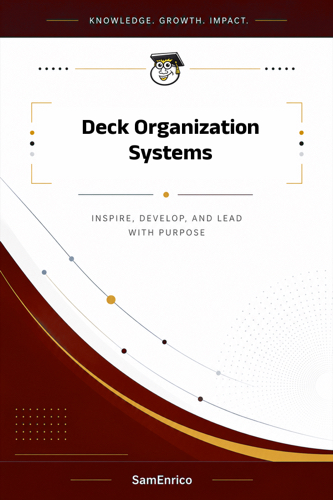
Deck Organization Systems
Teaches hierarchical tags, sub decks, and filtered
Teaches hierarchical tags, sub decks, and filtered decks for review.
Formats
About this book
Free sample
Chapter 1: The Home Deck Lie--You have been lied to about where your memories live.Not by any person, but by the interface itself. Every time you click "Create Deck" and type a new name—"Physics Chapter 4," "French Irregular Verbs," "Memory Palace Kitchen"—the software smiles and obeys. It gives you exactly what you asked for. And that is precisely the problem.The lie is subtle but devastating: the belief that creating more decks creates more order. In reality, it creates fragmentation.
Each new deck is not a folder in a filing cabinet. It is a separate scheduling universe with its own rules, its own due dates, and its own isolated rhythm. When you spread your cards across fifty decks, you are not organizing knowledge. You are building fifty small prisons, each one keeping its prisoners from ever meeting the others.This chapter is not about tags. It is not about filtered decks.
It is about the single most misunderstood concept in spaced repetition software: the home deck. Understanding where a card permanently lives—and why it can only live in one place—is the foundation upon which every other organizational strategy in this book is built. Get this wrong, and nothing else will work. Get this right, and you unlock the ability to study less while remembering more.The Architecture You Never Asked to Understand Every digital tool has a hidden architecture. With word processors, you do not need to understand how the software saves your document to write a sentence.
With email, you do not need to understand SMTP protocols to send a message. But spaced repetition software is different. Its architecture is not an implementation detail. It is the pedagogy. The way the software stores and retrieves your cards directly determines how effectively you learn.Anki, the most powerful spaced repetition system available to general users, is built on a deceptively simple database model.
Every piece of information you study exists as a note. That note contains fields—question, answer, extra context, maybe an image. From that note, the software generates one or more cards. A basic note creates…
This is the end of the free sample. Get the eBook to keep going. Buy now
Contents
- Chapter 1
- Chapter 2
- Chapter 3
- Chapter 4
- Chapter 5
- Chapter 6
- Chapter 7
- Chapter 8
- Chapter 9
- Chapter 10
- Chapter 11
- Chapter 12
Details
- Author
- Mcgowan Melani
- Publisher
- SamEnrico
- Language
- English
- Genre
- Non-Fiction, Self-Help, Organization
- Released
- 2026-06-07
- Pages (approx.)
- 145
- Available as
- eBook, Audiobook

Read better in the ZLOADR app
Your eBooks on your phone or tablet. Sign in with your SamEnrico account and start reading.
More by Mcgowan Melani
 Child Overdose Death HealingMcgowan Melani$11.99
 Window Glass ForensicsMcgowan Melani$11.99
 Cognitive Restructuring for BurnoutMcgowan Melani$11.99
 The Hair Loss MicronutrientMcgowan Melani$11.99
 EQ Failure LessonsMcgowan Melani$11.99
 Post Injury Return HypnosisMcgowan Melani$11.99
 Sibling Grief After Baby LossMcgowan Melani$11.99
 Love in the Margins: The Secret Correspondence of the First A&R LegendMcgowan Melani$11.99
 The Golden Quill of the Persian Court: The Black Poets Who Shaped an EmpireMcgowan Melani$11.99
 A Collector's Handbook to the Austin A70 HampshireMcgowan Melani$11.99
 Building a Private Tutoring Client BaseMcgowan Melani$12.99
 Jumia Customer Feedback GuideMcgowan Melani$12.99
You may also like
 Chunking for Daily Life UseGorman Malik$11.99
 Remote Work Desk Reset MethodPainter Stefanie$11.99
 Dream Theme Index MethodHornsby Bernarda$11.99
 Closet Declutter Spending CureGodfrey Retta$11.99
 Playlist Organization for HypnosisCordero Dusty$11.99
 Personal Palace PortfolioAvery Oma$11.99
 Home Organization MemoryLevy Madison$11.99
 The Name Vault Recall SystemBenitez Candance$11.99
 School Morning Prep StationChun Sang$11.99
 Messy Spaces Anger TriggerMalcolm Bret$11.99
 Remote Workspace OrganizationPrather Candy$11.99
 Desk Workspace ReviewLassiter Sherlene$11.99