
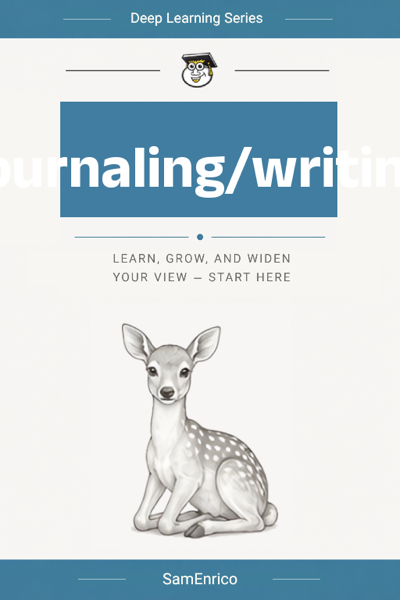
Non-FictionInformativeEducational
Journaling/writing eBook
A Coursebook on Journaling/writing
A Coursebook on Journaling/writing
Formats
Free sample
Chapter 1: The Graveyard of Notebooks...--I want you to look to your left. Or to your right. Or in that drawer you never open. Somewhere within ten feet of where you are sitting right now, there is a good chance you will find one. A notebook.
Probably beautiful. Probably with an untouched first page. Probably purchased with a surge of hope on a Tuesday afternoon after watching a You Tube video about productivity, or after a particularly hard day when you thought, I need to get my life together. And then you wrote in it for three days. Maybe four.
And then something happened. You missed a day. Then another. And now that notebook sits there, spine uncracked beyond page seven, silently judging you every time you walk past.You are not alone. This is not a character flaw.
This is not evidence that you lack discipline or follow-through or the mystical quality that "successful people" possess. This is a design flaw in how we think about journaling.I have a confession. I have owned seventeen of those notebooks. Seventeen. I have bought Moleskines with leather covers and Leuchtturm1917s with numbered pages and gorgeous hand-bound journals from Etsy that cost more than a nice dinner.
I have filled approximately 2.4 of them. The rest sit in a box in my closet, a graveyard of abandoned intentions. For years, I told myself I was the problem. I was lazy. I was scattered.
I was not a "real writer." And then I started studying what actually makes a journaling practice stick, and I discovered something that changed everything.The problem was never you. The problem was never your willpower. The problem is that almost everything you have been told about journaling is wrong.The Three False Starts Let me name the three ways almost everyone fails at journaling. See if any of these sound familiar.False Start #1: The Perfectionism Trap.You sit down to write. You open your beautiful notebook.
You take out your nice pen. And then you freeze. What should you write about? Should it be profound? Should you capture the day's events?
Should you process your feelings? What if you write something stupid? What if someone reads it after you die and thinks you were shallow? The blank page stares back like a mirror, and you see not possibility but judgment. So you write one careful sentence.
Cross it out. Write another. Decide it is not good enough. Close the notebook. Tell yourself you will try again tomorrow when you have something meaningful to say.False Start #2: The Inconsistency Spiral.You start strong.
Monday, you write a page. Tuesday, you write two pages. Wednesday, you are on fire — three pages of raw, honest, beautiful reflection. You feel like a person who journals. You are a person who journals.
Thursday happens. Work explodes. Your kid gets sick. You forget. Friday comes, and you feel a small twinge of guilt.
Saturday, the guilt grows. Sunday, you open the notebook, see the last entry from Wednesday, and think, I already broke the streak. What is the point? And just like that, three weeks pass. The notebook becomes an accusation.False Start #3: The Relevance Gap.You have heard that journaling is good for you.
Everyone says so. It reduces stress. It boosts creativity. It helps you process emotions. But you sit down to write and you think, What am I actually supposed to do with this?
You write about your day. It feels boring. You write about your feelings. It feels whiny. You write about your goals.
It feels like homework. You are going through the motions because someone told you it was good for you, like eating kale or flossing. And because you do not understand why this particular exercise should matter to you, you quit.I have good news. Each of these false starts has a cure. And the cure is not more discipline.
The cure is a different relationship with the page.What Journaling Actually Is (And What It Absolutely Is Not)Before we go any further, we need to destroy a dangerous myth.Journaling is not a product. It is a process.Let me say that again. Journaling is not a thing you make. It is a thing you do. This is the single most important distinction in this entire book, and if you remember nothing else, remember this.A product-oriented activity has a finished result.
Baking a cake produces a cake. Building a chair produces a chair. Writing a novel produces a manuscript. These activities have质量标准. You can judge the cake as too dry, the chair as wobbly, the novel as poorly plotted.
There is a right way and a wrong way.A process-oriented activity has no finished result. Stretching your body in the morning produces nothing you can put on a shelf. Meditating produces nothing you can show to a friend. Taking a walk produces no product. These activities are valuable not because of what they make, but because of what they do to you while you are doing them.Journaling is a process, not a product.This means your journal entry cannot be "bad." It cannot be "wrong." It cannot be "not good enough." The quality of the entry is not the point.
The point is that you showed up. The point is that you moved your hand across the page. The point is that you gave your brain a container to think in.You are not writing a memoir. You are not drafting a novel. You are not composing a letter that will ever be read by anyone but you.
You are simply journaling. And journaling, by definition, cannot be done incorrectly.I want you to say that out loud. Actually. Right now. Say: Journaling cannot be done incorrectly.Feel how strange that sounds.
Feel how much resistance comes up. That resistance is the voice we are going to work with throughout this book. I call it the Inner Critic.Meeting Your Inner Critic The Inner Critic is the voice in your head that says things like:"That is stupid.""You already wrote that yesterday.""Who do you think you are?""This is boring.""You are just complaining.""What would people think if they read this?""You should be doing something more productive."The Inner Critic is not your enemy. I want to be very clear about this. The Inner Critic is a part of you that learned, probably a long time ago, that mistakes are dangerous.
Maybe you had a teacher who circled your spelling errors in red ink. Maybe you had a parent who corrected your grammar. Maybe you were told that your feelings were too much, or not enough, or just wrong. The Inner Critic developed as a protection system. Its job is to keep you safe by keeping you small.
If you never write anything embarrassing, you will never be embarrassed. If you never write anything messy, you will never be judged for being messy. If you never write anything at all, you will never fail.The problem is that the Inner Critic does not know the difference between a journal and a courtroom. It applies the same standards to your private…
This is the end of the free sample. Get the eBook to keep going. Buy now
About this book
Details
- Author
- Hummel Kenisha
- Publisher
- SamEnrico
- Language
- English
- Genre
- Non-Fiction, Informative, Educational
- Released
- 2026-05-09
- Pages (approx.)
- 132
- Available as
- eBook, Audiobook

Read better in the ZLOADR app
Your eBooks on your phone or tablet. Sign in with your SamEnrico account and start reading.
More by Hummel Kenisha
 The Step Parent Stress GuideHummel Kenisha$11.99
 House Of Wisdom Abbasid GuideHummel Kenisha$11.99
 Evening HGH Optimization GuideHummel Kenisha$11.99
 Self Hypnosis LogbookHummel Kenisha$11.99
 AI Object Removal from VideoHummel Kenisha$11.99
 Love, Lies, and Liquor: The Untold Split of Elizabeth Taylor and Richard BurtonHummel Kenisha$11.99
 Frozen Frontiers: The Race to Eradicate Smallpox in AntarcticaHummel Kenisha$11.99
 How to Become a Scalp-treatment OperatorHummel Kenisha$11.99
 Understanding Brief Psychotic DisorderHummel Kenisha$17.99
 Blockchain Bootcamp OptionsHummel Kenisha$12.99
 Ecommerce Subscription Retention OutlookHummel Kenisha$12.99
You may also like
 Hong Kong Handover 1997Dunn Johnnie$11.99
 Zumba For Postnatal Recovery CourseNeal Christian$11.99
 Zumba for BeginnersLadner Nikia$11.99
 YouTube Comment Mining GuideHumes Pandora$12.99
 Worry Box MeditationCarlin Rudy$11.99
 Workplace Stress MeditationNguyen Lynn$11.99
 Workplace Stress and Sleep RepairHawley Ivory$11.99
 Workplace Perfectionism CureDelaney Jeffry$11.99
 Workplace Injustice Anger GuideWallen Isabelle$11.99
 Work Addiction and Burnout LinkGreenwood Ester$11.99
 Women in Yoga and WellnessBeattie Galina$11.99
 Women in Stand Up ComedyChun Evangeline$11.99