
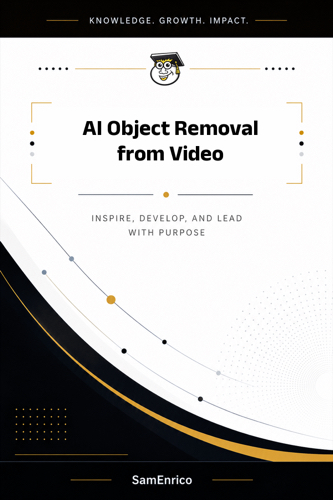
Non-FictionAI OperatorVideo Cleanup
AI Object Removal from Video
Erase unwanted objects, logos, or people by fillin
Erase unwanted objects, logos, or people by filling gaps with context-aware neural inpainting across frames.
Formats
About this book
Free sample
Chapter 1: The Frame Fallacy--–- Open any video editing software. Pause on a single frame. Zoom in until you see the pixels. What you are looking at appears to be a photograph—a perfectly still, self-contained rectangle of color and light. That appearance is a lie.
It is the most dangerous lie in all of post-production, and believing it will guarantee that every AI object removal you attempt ends in failure.The truth is that a video frame has no independent existence. A pixel at coordinates (1920, 1080) in frame 47 does not have its own identity. Its red, green, and blue values are not facts about the world. They are debts owed to the frames that came before and the frames that come after. When you edit that pixel in isolation, you are not fixing a single image.
You are breaking a contract written across time.This chapter dismantles the video file. By the end, you will understand why removing a coffee cup from a locked-off interview shot is trivial, why removing a pedestrian from drone footage is a research-level problem, and why the most expensive AI tools in the world will fail if you feed them the wrong kind of footage. You will learn the hidden architecture of compression, the invisible map of motion called optical flow, the precision trap of bit depth, the silent saboteur called grain, and the one hard rule that will save you more hours than any other piece of advice in this book.Consider this your anatomy lesson. We are about to cut open the patient.The Photograph Lie When you take a photograph with a modern camera, the sensor records light for a fraction of a second. Each photosite measures the intensity of red, green, and blue light at that precise location.
The result is a grid of independent samples. Pixel (0,0) has no relationship to pixel (0,1) except proximity. You can edit one pixel without affecting any other.Video does not work this way. A video file is not a sequence of photographs. It is a sequence of instructions for reconstructing photographs from a compressed representation.
The difference is not academic. It is the difference between a shelf of individual books and a mathematical formula that…
This is the end of the free sample. Get the eBook to keep going. Buy now
Contents
- Chapter 1
- Chapter 2
- Chapter 3
- Chapter 4
- Chapter 5
- Chapter 6
- Chapter 7
- Chapter 8
- Chapter 9
- Chapter 10
- Chapter 11
- Chapter 12
Details
- Author
- Hummel Kenisha
- Publisher
- SamEnrico
- Language
- English
- Genre
- Non-Fiction, AI Operator, Video Cleanup
- Released
- 2026-06-06
- Pages (approx.)
- 140
- Available as
- eBook, Audiobook

Read better in the ZLOADR app
Your eBooks on your phone or tablet. Sign in with your SamEnrico account and start reading.
More by Hummel Kenisha
 The Step Parent Stress GuideHummel Kenisha$11.99
 House Of Wisdom Abbasid GuideHummel Kenisha$11.99
 Evening HGH Optimization GuideHummel Kenisha$11.99
 Self Hypnosis LogbookHummel Kenisha$11.99
 Love, Lies, and Liquor: The Untold Split of Elizabeth Taylor and Richard BurtonHummel Kenisha$11.99
 Frozen Frontiers: The Race to Eradicate Smallpox in AntarcticaHummel Kenisha$11.99
 How to Become a Scalp-treatment OperatorHummel Kenisha$11.99
 Understanding Brief Psychotic DisorderHummel Kenisha$17.99
 Blockchain Bootcamp OptionsHummel Kenisha$12.99
 Ecommerce Subscription Retention OutlookHummel Kenisha$12.99
 Journaling/writingHummel Kenisha$11.99
You may also like
 Hong Kong Handover 1997Dunn Johnnie$11.99
 Zumba For Postnatal Recovery CourseNeal Christian$11.99
 Zumba for BeginnersLadner Nikia$11.99
 YouTube Comment Mining GuideHumes Pandora$12.99
 Worry Box MeditationCarlin Rudy$11.99
 Workplace Stress MeditationNguyen Lynn$11.99
 Workplace Stress and Sleep RepairHawley Ivory$11.99
 Workplace Perfectionism CureDelaney Jeffry$11.99
 Workplace Injustice Anger GuideWallen Isabelle$11.99
 Work Addiction and Burnout LinkGreenwood Ester$11.99
 Women in Yoga and WellnessBeattie Galina$11.99
 Women in Stand Up ComedyChun Evangeline$11.99