
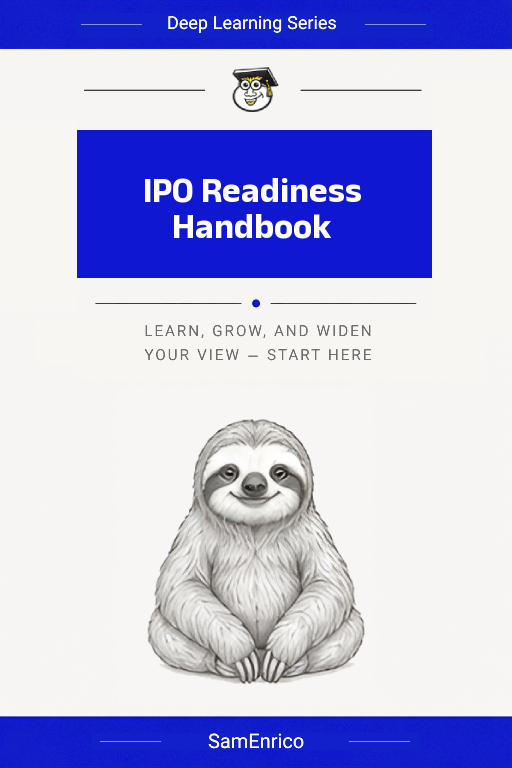
Non-FictionStartup GuidePublic Offering
IPO Readiness Handbook eBook
Prepare your startup for public markets within two
by Buss Winford
Prepare your startup for public markets within two years. This brief covers financial reporting and governance requirements for successful Nasdaq listings.
Formats
Free sample
Chapter 1: The Two-Year Window...--The IPO process, from the organizational meeting to the closing of the offering, typically takes five to six months. That is what the investment banks will tell you. That is what you will read in countless articles and blog posts. And it is true—if you ignore the eighteen to twenty-four months of rigorous preparatory work that must happen before that meeting even appears on your calendar.Here is the reality that separates successful public companies from the also-rans: the companies that most successfully transition to life as a public company do not start preparing when they hire underwriters. They start preparing when they still have two years of runway, when their last funding round is still fresh, when the idea of ringing the Nasdaq bell feels like a distant dream.
They start acting like a public company before they are one.This chapter is your roadmap for that two-year journey. You will learn why the timeline exists, what you must accomplish in each phase, and—most importantly—how to avoid the mistakes that have derailed hundreds of otherwise promising IPOs. By the end of this chapter, you will know exactly where you stand and what you need to do next.The Five-to-Six-Month Myth Let me be blunt: the five-to-six-month timeline for an IPO is a lie. Not a malicious lie, but a convenient omission. It describes only the active period from the organizational meeting (when you formally hire underwriters and counsel) to the closing.
It ignores everything that must happen before that meeting.Here is what actually takes time:Audited Financial Statements. To complete an IPO, you will need either two or three years of financial statements audited at the Public Company Accounting Oversight Board (PCAOB) level by an independent registered public accounting firm. The completion of these audits is often the biggest gating item for an IPO. Many companies are surprised to discover that even if they completed audits as a private company, a public company audit by a "Big 4" accounting firm (and review by the auditor's "national office") often results in significant and time-consuming accounting issues that need to be resolved prior to submitting a registration statement to the SEC. We will cover the PCAOB-level audit difference in detail in Chapter 4.Internal Control Development.
Building the internal financial reporting staff necessary to prepare financial statements, as well as closing the company's books each quarter and preparing the quarterly and annual reports to be filed with the SEC, takes significant time. Beginning the process of designing, documenting, and testing the company's internal control over financial reporting cannot be rushed.Team Building. Recruiting a public company quality management team and board of directors—including a chief financial officer with public company experience, independent directors, and audit committee financial experts—takes time to identify, recruit, and onboard. The best candidates are often employed elsewhere and have notice periods. The search process alone can take six to nine months for a CFO.Equity Compensation Clean-Up.
The SEC will scrutinize your prior equity award grants as part of the IPO process. Ensuring that all equity awards were granted pursuant to appropriate securities law exemptions and that valuations complied with Section 409A of the Internal Revenue Code requires retrospective review. This is not a "fix it in a week" project. We will cover equity compensation clean-up in detail in Chapter 10.These four factors—audits, controls, team, and equity—drive your timeline. If you start eighteen months before your target IPO date, you have a fighting chance.
If you start with twelve months, you are compressed. If you start with six months, you will almost certainly fail, embarrass yourself, or both.The Fundamental Principle: Run As If Already Public The companies that most successfully transition to public company life are the ones that start acting like a public company by the time of the IPO organizational meeting in certain key ways:Setting, achieving, and reporting quarterly and annual financial targets Building a finance, accounting, and legal team capable of meeting the timelines and substance of public company periodic reporting with the SECRecruiting a public company quality management team and board of directors If you can successfully transition to public company readiness in these areas before an IPO, you can avoid any embarrassment and stock price drop from stumbling early on as a public company. Further, public statements from the SEC clarify that it expects private companies—particularly ones aspiring for an IPO—to improve their transparency with investors, controls on financial reporting, and corporate governance, even as private companies.What does this look like in practice?Quarterly financial targets. Private companies often manage to a full-year plan, with quarterly fluctuations that are discussed only internally. Public companies report quarterly results.
Investors and analysts expect you to meet or beat your quarterly guidance. If you have not practiced setting, achieving, and explaining quarterly targets—including when you miss—you will struggle as a public company.Finance team capabilities. Private companies often have lean finance teams focused on cash management and basic accounting. Public companies need teams that can close the books within days of quarter-end, prepare SEC filings under tight deadlines, and manage investor relations. Building this team takes time, and the best candidates are expensive and in high demand.Board composition.
Private company boards are often composed of founders, early investors, and close advisors. Public company boards require independent directors, audit committee financial experts, and fully independent committees. Recruiting these directors takes time, and the best candidates will not join a board without doing their own due diligence on your company.If this sounds like a lot of work, that is because it is. There is no shortcut. The companies that try to compress this timeline are the ones that end up withdrawing their registration statements or pricing below range.The IPO Timeline at a Glance Let me give you the bird's-eye view before we dive into the details.
This timeline assumes a typical late-stage private company with a December 31 fiscal year-end, targeting an IPO in the first half of a given year. For most companies, 18 to 24 months is sufficient. However, companies with complex capital structures, significant acquisition histories, or international operations should consider a 24-to-36-month timeline.24 to 18 Months Before IPO (The Foundation Phase)Begin PCAOB-level audit preparation. This means selecting your auditor if you have not already, scoping the audit, and identifying potential issues.Assess board composition and independence. Do you have the independent directors you will need?
If not, start recruiting.Consider whether new senior management hires are needed. Do you have a CFO with public company experience? If not, start the search now.Review equity compensation practices. Gather all option grants, board consents, and 409A valuations. Identify gaps.Begin building your finance and accounting team.
You will need a controller, a tax director, an SEC reporting manager, and investor relations personnel.18 to 12 Months Before IPO (The Building Phase)Implement public company-style board committees: audit, nominating/governance, and compensation. Adopt charters for each.Update policies, processes, and systems. This includes insider trading policies, code of conduct, related party transaction policies, and whistleblower procedures.Develop document management and internal controls. You will need to produce years of board minutes, stockholder actions…
This is the end of the free sample. Get the eBook to keep going. Buy now
About this book
Details
- Author
- Buss Winford
- Publisher
- SamEnrico
- Language
- English
- Genre
- Non-Fiction, Startup Guide, Public Offering
- Released
- 2026-05-28
- Pages (approx.)
- 137
- Available as
- eBook, Audiobook

Read better in the ZLOADR app
Your eBooks on your phone or tablet. Sign in with your SamEnrico account and start reading.
More by Buss Winford
 Sandwich Evidence Diamond HeistBuss Winford$11.99
 HGH Legal Supplements GuideBuss Winford$11.99
 Retirement Assets Community PropertyBuss Winford$11.99
 Senior Memory TrainingBuss Winford$11.99
 Change Management Stress GuideBuss Winford$11.99
 Natural HGH BoostersBuss Winford$11.99
 Menstrual Equity AdvocacyBuss Winford$11.99
 Bipolar Mindfulness Practice ManualBuss Winford$11.99
 The Vanishing of the Golden Girl: The Unsolved Disappearance of Suzanne JovinBuss Winford$11.99
 The Mutiny That Shook an Empire: The Ingenious Defiance of Mangal PandeyBuss Winford$11.99
 The Rothschild Dynasty: Banking the Modern WorldBuss Winford$11.99
 Serbian Master Programs Low CostBuss Winford$12.99
You may also like
 Hong Kong Handover 1997Dunn Johnnie$11.99
 Zumba For Postnatal Recovery CourseNeal Christian$11.99
 Zumba for BeginnersLadner Nikia$11.99
 YouTube Comment Mining GuideHumes Pandora$12.99
 Worry Box MeditationCarlin Rudy$11.99
 Workplace Stress MeditationNguyen Lynn$11.99
 Workplace Stress and Sleep RepairHawley Ivory$11.99
 Workplace Perfectionism CureDelaney Jeffry$11.99
 Workplace Injustice Anger GuideWallen Isabelle$11.99
 Work Addiction and Burnout LinkGreenwood Ester$11.99
 Women in Yoga and WellnessBeattie Galina$11.99
 Women in Stand Up ComedyChun Evangeline$11.99