
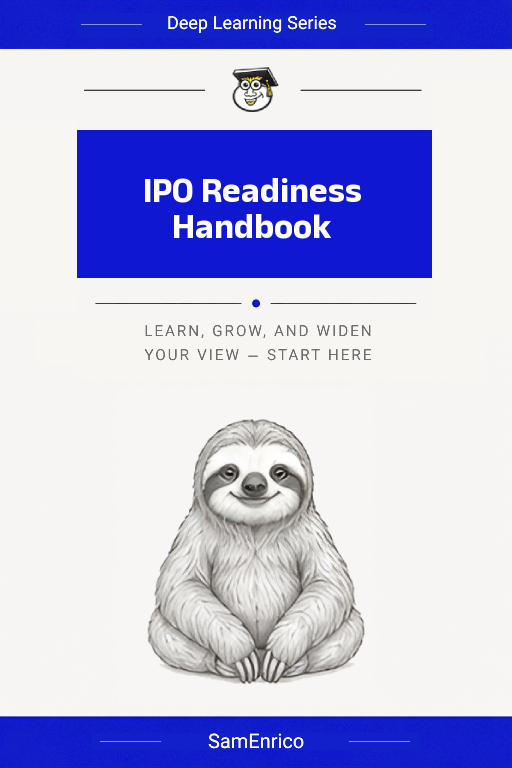
Non-FictionStartup GuidePublic Offering
IPO Readiness Handbook Audiobook
Prepare your startup for public markets within two
by Buss Winford
Prepare your startup for public markets within two years. This brief covers financial reporting and governance requirements for successful Nasdaq listings.
Formats
Free sample
Chapter 1: The Two-Year Window...--The IPO process, from the organizational meeting to the closing of the offering, typically takes five to six months. That is what the investment banks will tell you. That is what you will read in countless articles and blog posts. And it is true—if you ignore the eighteen to twenty-four months of rigorous preparatory work that must happen before that meeting even appears on your calendar.Here is the reality that separates successful public companies from the also-rans: the companies that most successfully transition to life as a public company do not start preparing when they hire underwriters. They start preparing when they still have two years of runway, when their last funding round is still fresh, when the idea of ringing the Nasdaq bell feels like a distant dream.
They start acting like a public company before they are one.This chapter is your roadmap for that two-year journey. You will learn why the timeline exists, what you must accomplish in each phase, and—most importantly—how to avoid the mistakes that have derailed hundreds of otherwise promising IPOs. By the end of this chapter, you will know exactly where you stand and what you need to do next.The Five-to-Six-Month Myth Let me be blunt: the five-to-six-month timeline for an IPO is a lie. Not a malicious lie, but a convenient omission. It describes only the active period from the organizational meeting (when you formally hire underwriters and counsel) to the closing.
It ignores everything that must happen before that meeting.Here is what actually takes time:Audited Financial Statements. To complete an IPO, you will need either two or three years of financial statements audited at the Public Company Accounting Oversight Board (PCAOB) level by an independent registered public accounting firm. The completion of these audits is often the biggest gating item for an IPO. Many companies are surprised to discover that even if they completed audits as a private company, a public company audit by a "Big 4" accounting firm (and review by the auditor's "national office") often results in significant and time-consuming accounting issues that need to be resolved prior to submitting a registration statement to the SEC. We will cover the PCAOB-level audit difference in detail in Chapter 4.Internal Control Development.
Building the internal financial reporting staff necessary to prepare financial statements, as well as closing the company's books each quarter…
This is the end of the free sample. Get the Audiobook to keep going. Buy now
About this book
Details
- Author
- Buss Winford
- Publisher
- SamEnrico
- Language
- English
- Genre
- Non-Fiction, Startup Guide, Public Offering
- Released
- 2026-05-28
- Pages (approx.)
- 137
- Available as
- eBook, Audiobook

Listen in the VoxFlicks app
Audiobooks and audio dramas wherever you go. Sign in with your SamEnrico account and press play.
More by Buss Winford
 Sandwich Evidence Diamond HeistBuss Winford$11.99
 HGH Legal Supplements GuideBuss Winford$11.99
 Retirement Assets Community PropertyBuss Winford$11.99
 Senior Memory TrainingBuss Winford$11.99
 Change Management Stress GuideBuss Winford$11.99
 Natural HGH BoostersBuss Winford$11.99
 Menstrual Equity AdvocacyBuss Winford$11.99
 Bipolar Mindfulness Practice ManualBuss Winford$11.99
 The Vanishing of the Golden Girl: The Unsolved Disappearance of Suzanne JovinBuss Winford$11.99
 The Mutiny That Shook an Empire: The Ingenious Defiance of Mangal PandeyBuss Winford$11.99
 The Rothschild Dynasty: Banking the Modern WorldBuss Winford$11.99
 Serbian Master Programs Low CostBuss Winford$12.99
You may also like
 Hong Kong Handover 1997Dunn Johnnie$11.99
 Zumba For Postnatal Recovery CourseNeal Christian$11.99
 Zumba for BeginnersLadner Nikia$11.99
 YouTube Comment Mining GuideHumes Pandora$12.99
 Worry Box MeditationCarlin Rudy$11.99
 Workplace Stress MeditationNguyen Lynn$11.99
 Workplace Stress and Sleep RepairHawley Ivory$11.99
 Workplace Perfectionism CureDelaney Jeffry$11.99
 Workplace Injustice Anger GuideWallen Isabelle$11.99
 Work Addiction and Burnout LinkGreenwood Ester$11.99
 Women in Yoga and WellnessBeattie Galina$11.99
 Women in Stand Up ComedyChun Evangeline$11.99