
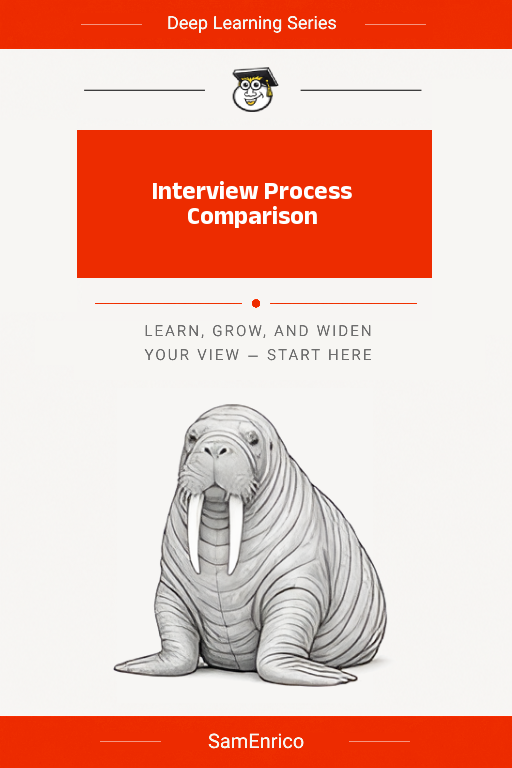
Non-FictionBusiness BriefGlobal Talent Guide
Interview Process Comparison eBook
Adapt interview processes for candidates from Keny
Adapt interview processes for candidates from Kenya, Philippines, and Poland. Cultural considerations.
Formats
Free sample
Chapter 1: The Broken Filter...--Every year, global companies lose millions of dollars not to bad products, poor strategy, or market shifts, but to a single, recurring failure: they interview the right person the wrong way, and the person walks away—or worse, they hire the wrong person because the interview taught them nothing useful.The tragedy is that both outcomes are entirely preventable. Yet most hiring teams continue to use the same standardized interview scripts, competency models, and behavioral questioning techniques regardless of whether the candidate sitting across from them grew up in Warsaw, Nairobi, or Manila. They treat cultural differences as soft skills—nice to understand but not essential to the mechanics of evaluation. This is a catastrophic error.This book exists because that error has a name: the illusion of the global standard. It is the belief that a single, universal interview process can reliably identify talent anywhere in the world.
It is the assumption that a candidate who answers STAR-format questions well in English is necessarily competent, while one who hesitates, deflects, or asks uncomfortable questions is not. It is the reason that brilliant Polish engineers are rejected for being “negative,” hardworking Kenyans are dismissed as “dishonest,” and talented Filipinos are misread as “passive” when they are anything but.The truth is that the Western behavioral interview—the model exported by Silicon Valley, taught in most MBA programs, and embedded in virtually every global HR software platform—is not a universal tool. It is a cultural artifact. It was designed in low-context, individualistic, low-power-distance societies for candidates who share those assumptions. When applied to high-context, collectivist, or high-power-distance cultures, it does not just underperform; it actively produces false negatives and false positives at rates that should terrify any organization serious about global talent.This chapter dismantles that illusion.
It explains why the internet homogenized résumés but not interpersonal dynamics, why the myth of meritocracy hides deep cultural bias, and how two real-world case studies—a rejected Polish engineer and a misjudged Kenyan applicant—reveal the urgent need for a new approach. By the end of this chapter, you will never look at a candidate from another culture the same way again.The Global Standard That Never Was In the 1990s and early 2000s, as American corporations expanded globally and Western management consulting firms spread their methodologies worldwide, a quiet consensus emerged. The behavioral interview—pioneered by industrial psychologists in the 1970s and popularized by books like Competitive Advantage and High-Output Management—became the gold standard. The logic was seductive: past behavior predicts future performance. Ask candidates to describe specific situations, the tasks they faced, the actions they took, and the results they achieved.
Score their answers against a rubric. Remove bias through structure.This approach worked reasonably well within its original context: predominantly white-collar, English-speaking, low-power-distance cultures where individuals were raised to promote their own achievements, disagree respectfully with authority, and treat an interview as a two-way evaluation rather than a test of deference. But as companies began hiring remotely across continents—first through outsourcing, then through distributed teams, and now through fully global remote work—the behavioral interview was exported wholesale, without modification, to cultures that did not share its underlying assumptions.The result was predictable but largely invisible. Hiring managers continued to score candidates using the same rubrics. Candidates from non-Western cultures consistently scored lower on “communication” and “initiative” while scoring higher on “technical skills” when those were measured objectively.
Recruiters concluded, erroneously, that their local markets lacked soft skills. The truth was the opposite: the interview itself was culturally illiterate.Consider the structure of a standard behavioral question: “Tell me about a time you led a team through a difficult project.” This question assumes that the candidate has been in a formal leadership role, that they are comfortable claiming credit for team outcomes, and that “difficult” is defined in individual rather than collective terms. In a culture like Kenya, where Harambee (pulling together) means that success is shared and individual heroism is discouraged, a candidate who answers honestly—“We solved the problem together, and I do not wish to take personal credit”—will be scored lower than an equally competent candidate from a Western culture who says “I did X, Y, and Z.” The Kenyan candidate is not less competent. The rubric is biased.Similarly, the behavioral interview prizes what psychologists call “self-enhancement”: the ability to articulate one’s own strengths without false modesty. In Filipino culture, where Hiya (shame) discourages individual boasting because it risks bringing dishonor to one’s family and community, a straightforward “Tell me about your greatest achievement” will often produce a muted, hesitant answer—not because the candidate lacks achievements, but because they were raised to believe that naming them directly is rude.
The interviewer interprets hesitation as incompetence. The candidate walks away confused and humiliated. Both lose.The global standard, in other words, is a myth. It never existed except in the minds of those who assumed their way was the only way.The Résumé Paradox: Homogenized Format, Divergent Realities One of the most deceptive trends of the past twenty years is the apparent globalization of the résumé. Linked In, Europass, and global recruitment platforms have created a surface-level uniformity.
Candidates from Nairobi, Manila, and Warsaw all upload similar documents: a professional photo (or not, depending on local norms), a list of previous employers, dates of employment, bullet points describing responsibilities, and a section for education and certifications. To the untrained eye, they look comparable.But the information contained within those similar-looking documents is processed and presented through radically different cultural lenses.A Kenyan résumé that shows a six-month gap between jobs is not automatically a red flag. In Kenya’s “hustle economy”—where formal employment is scarce and many educated young people piece together income from freelance work, small-scale trading, farming, or ride-hailing—gaps often represent periods of entrepreneurial activity that never made it into a formal job title. A candidate who lists no employment for eight months may have been running a successful mobile phone credit business from a market stall. The Western recruiter who rejects that CV for “instability” has missed a candidate with demonstrated initiative, sales skills, and risk tolerance.A Filipino résumé that lists civil status, age, number of children, and spouse’s occupation is not a violation of privacy norms—it is a reflection of a legal and cultural environment where such information is routinely shared and requested.
The Western recruiter who flags this as “inappropriate” or “too personal” reveals their own cultural parochialism. In the Philippines, these details are considered relevant context for availability, commitment, and family support structures. They are not asked to discriminate; they are asked because they are normal.A Polish résumé that demands physical copies of diplomas and written references before the first interview is not a sign of excessive bureaucracy. Poland’s historical context—decades of communist rule followed by a chaotic transition to capitalism—created a deep cultural preference for documented proof. Verbal claims carry little weight.
A candidate who insists on providing certificates is not being difficult; they are following a protocol designed to eliminate the very…
This is the end of the free sample. Get the eBook to keep going. Buy now
About this book
Details
- Author
- Bigelow Micheline
- Publisher
- SamEnrico
- Language
- English
- Genre
- Non-Fiction, Business Brief, Global Talent Guide
- Released
- 2026-05-26
- Pages (approx.)
- 158
- Available as
- eBook, Audiobook

Read better in the ZLOADR app
Your eBooks on your phone or tablet. Sign in with your SamEnrico account and start reading.
More by Bigelow Micheline
 Endometriosis and AcupunctureBigelow Micheline$11.99
 Afternoon Nap Longevity GuideBigelow Micheline$11.99
 Emfit QS Sleep GuideBigelow Micheline$11.99
 The Finnish Tuition Free GuideBigelow Micheline$11.99
 Greek Green Tax CreditsBigelow Micheline$11.99
 The Kings of the North: How Scandinavian Monarchs Shaped the Viking AgeBigelow Micheline$11.99
 Legal SecretaryBigelow Micheline$11.99
 Understanding Retinopathy Pigmentary Mental RetardationBigelow Micheline$17.99
 Business and Economics TurkeyBigelow Micheline$12.99
 How to Become a Lei SellerBigelow Micheline$11.99
You may also like
 Hong Kong Handover 1997Dunn Johnnie$11.99
 Zumba For Postnatal Recovery CourseNeal Christian$11.99
 Zumba for BeginnersLadner Nikia$11.99
 YouTube Comment Mining GuideHumes Pandora$12.99
 Worry Box MeditationCarlin Rudy$11.99
 Workplace Stress MeditationNguyen Lynn$11.99
 Workplace Stress and Sleep RepairHawley Ivory$11.99
 Workplace Perfectionism CureDelaney Jeffry$11.99
 Workplace Injustice Anger GuideWallen Isabelle$11.99
 Work Addiction and Burnout LinkGreenwood Ester$11.99
 Women in Yoga and WellnessBeattie Galina$11.99
 Women in Stand Up ComedyChun Evangeline$11.99