
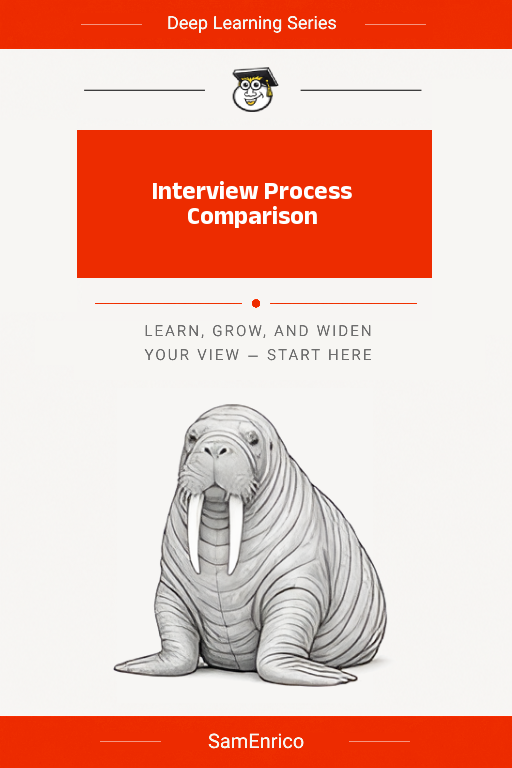
Non-FictionBusiness BriefGlobal Talent Guide
Interview Process Comparison Audiobook
Adapt interview processes for candidates from Keny
Adapt interview processes for candidates from Kenya, Philippines, and Poland. Cultural considerations.
Formats
Free sample
Chapter 1: The Broken Filter...--Every year, global companies lose millions of dollars not to bad products, poor strategy, or market shifts, but to a single, recurring failure: they interview the right person the wrong way, and the person walks away—or worse, they hire the wrong person because the interview taught them nothing useful.The tragedy is that both outcomes are entirely preventable. Yet most hiring teams continue to use the same standardized interview scripts, competency models, and behavioral questioning techniques regardless of whether the candidate sitting across from them grew up in Warsaw, Nairobi, or Manila. They treat cultural differences as soft skills—nice to understand but not essential to the mechanics of evaluation. This is a catastrophic error.This book exists because that error has a name: the illusion of the global standard. It is the belief that a single, universal interview process can reliably identify talent anywhere in the world.
It is the assumption that a candidate who answers STAR-format questions well in English is necessarily competent, while one who hesitates, deflects, or asks uncomfortable questions is not. It is the reason that brilliant Polish engineers are rejected for being “negative,” hardworking Kenyans are dismissed as “dishonest,” and talented Filipinos are misread as “passive” when they are anything but.The truth is that the Western behavioral interview—the model exported by Silicon Valley, taught in most MBA programs, and embedded in virtually every global HR software platform—is not a universal tool. It is a cultural artifact. It was designed in low-context, individualistic, low-power-distance societies for candidates who share those assumptions. When applied to high-context, collectivist, or high-power-distance cultures, it does not just underperform; it actively produces false negatives and false positives at rates that should terrify any organization serious about global talent.This chapter dismantles that illusion.
It explains why the internet homogenized résumés but not interpersonal dynamics, why the myth of meritocracy hides deep cultural bias, and how two real-world case studies—a rejected Polish engineer and a misjudged Kenyan applicant—reveal the urgent need for a new approach. By the end of this chapter, you will never look at a candidate from another culture the same way again.The Global Standard That Never Was In the 1990s and early 2000s, as American corporations expanded globally and Western management consulting firms spread their methodologies worldwide, a quiet consensus emerged. The behavioral interview—pioneered by industrial psychologists in the 1970s…
This is the end of the free sample. Get the Audiobook to keep going. Buy now
About this book
Details
- Author
- Bigelow Micheline
- Publisher
- SamEnrico
- Language
- English
- Genre
- Non-Fiction, Business Brief, Global Talent Guide
- Released
- 2026-05-26
- Pages (approx.)
- 158
- Available as
- eBook, Audiobook

Listen in the VoxFlicks app
Audiobooks and audio dramas wherever you go. Sign in with your SamEnrico account and press play.
More by Bigelow Micheline
 Endometriosis and AcupunctureBigelow Micheline$11.99
 Afternoon Nap Longevity GuideBigelow Micheline$11.99
 Emfit QS Sleep GuideBigelow Micheline$11.99
 The Finnish Tuition Free GuideBigelow Micheline$11.99
 Greek Green Tax CreditsBigelow Micheline$11.99
 The Kings of the North: How Scandinavian Monarchs Shaped the Viking AgeBigelow Micheline$11.99
 Legal SecretaryBigelow Micheline$11.99
 Understanding Retinopathy Pigmentary Mental RetardationBigelow Micheline$17.99
 Business and Economics TurkeyBigelow Micheline$12.99
 How to Become a Lei SellerBigelow Micheline$11.99
You may also like
 Hong Kong Handover 1997Dunn Johnnie$11.99
 Zumba For Postnatal Recovery CourseNeal Christian$11.99
 Zumba for BeginnersLadner Nikia$11.99
 YouTube Comment Mining GuideHumes Pandora$12.99
 Worry Box MeditationCarlin Rudy$11.99
 Workplace Stress MeditationNguyen Lynn$11.99
 Workplace Stress and Sleep RepairHawley Ivory$11.99
 Workplace Perfectionism CureDelaney Jeffry$11.99
 Workplace Injustice Anger GuideWallen Isabelle$11.99
 Work Addiction and Burnout LinkGreenwood Ester$11.99
 Women in Yoga and WellnessBeattie Galina$11.99
 Women in Stand Up ComedyChun Evangeline$11.99