
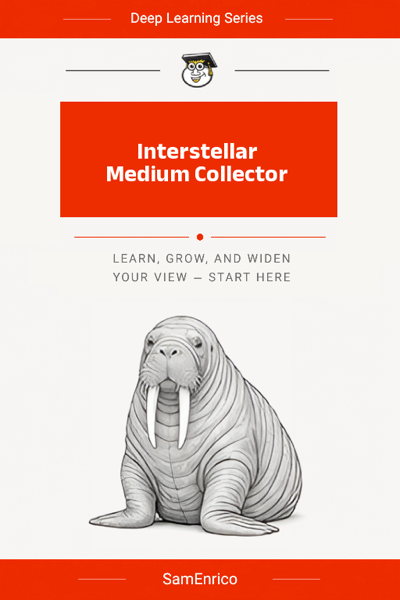
Non-FictionInformativeEducational
Interstellar Medium Collector eBook
A Coursebook on Interstellar Medium Collector
A Coursebook on Interstellar Medium Collector
Formats
Free sample
Chapter 1: The Vacuum Deception...--–- The night sky has lied to you. Every star you have ever seen is winking at you through a fog so thick that, by mass, it rivals all the stars combined. The great dark between worlds is not empty. It is a turbulent, magnetized, chemically rich fluid—a true medium—and for most of human history, we have been sailing blind through it as if it were nothing at all. This book is about learning to see that fluid, to touch it, and finally, to drink from it.The failure to recognize the interstellar medium (ISM) as a resource is not a failure of intelligence; it is a failure of intuition.
We evolved on a planet with a dense atmosphere and liquid oceans, where “empty” means a partial vacuum in a glass jar. Space, by comparison, has a density lower than any vacuum we can create on Earth. The typical density of the interstellar medium is about one hydrogen atom per cubic centimeter. One atom. In a volume the size of a sugar cube.
That sounds like nothing. And if your goal is simply to travel from one star to another, you might ignore that atom—and for most of the history of astronautics, that is exactly what we did.But that single atom per cubic centimeter is moving. It is hot. It is sometimes ionized. It carries a magnetic field.
And when you push a spacecraft through it at a significant fraction of the speed of light, that “nothing” becomes a wind. At ten percent of light speed, the interstellar medium delivers a flux of particles equivalent to a continuous, gentle sandblasting. At higher speeds, it becomes a plasma torch. The same medium that appears as a perfect vacuum to a drifting satellite becomes a dynamic, energetic environment to a fast-moving ship. The deception of the vacuum is that it is not a property of space; it is a property of your velocity relative to space.More importantly, that “nothing” contains hydrogen, helium, carbon, oxygen, iron, and silicon.
It contains water ice frozen onto dust grains. It contains organic molecules—formaldehyde, methanol, even the simple sugars that are the building blocks of life. The total mass of the interstellar medium in our galaxy is roughly ten billion times the mass of our Sun. That is not a trivial amount of stuff. It is a reservoir of fuel, propellant, shielding material, and structural elements that has been floating between the stars for billions of years, waiting for a civilization clever enough to harvest it.This book is a coursebook on how to build a machine that does exactly that: an Interstellar Medium Collector.
It is not a work of pure speculation. Every principle we will discuss is grounded in the physics of plasmas, the thermodynamics of compressible fluids, the engineering of magnetic fields, and the chemistry of cold molecular clouds. We will draw on the foundational textbooks of the interstellar medium—the works of Lyman Spitzer, Jr., who essentially invented the field; of Bruce Draine, whose comprehensive treatise on dust grains is unmatched; of James Lequeux, who mapped the phases of the ISM; and of David Williams, who catalogued its chemistry. But we will read those textbooks backwards. Where an astrophysicist asks, “What does the ISM do naturally?” we will ask, “How can we make the ISM do what we want?”The collector is not a passive sieve.
It is an active thermodynamic engine. It must reach out into space—hundreds of thousands of kilometers—with an invisible net made of magnetic fields. It must compress the thin gas it catches until that gas becomes denser than any natural interstellar cloud. It must separate that gas into its constituent elements, store some, burn others, and convert the rest into useful materials. And it must do all of this while hurtling through an environment that ranges from ten degrees above absolute zero to ten million degrees Kelvin, from nearly perfect vacuum to densities that would stop a bullet.This is not a problem for the faint of heart.
But it is a problem with a solution. And that solution begins with a single, honest admission: the vacuum is a lie.The Historical Discovery: How We Learned That Space Is Not Empty The story of the interstellar medium begins not with a telescope but with a spectroscope. In 1904, a German astronomer named Johannes Hartmann was studying the binary star system Mintaka, one of the stars in Orion’s belt. He was looking for Doppler shifts in the absorption lines of calcium—shifts that would reveal the orbital motion of the stars around each other. But he found something strange.
While most of the calcium lines shifted back and forth as expected, one particular line—the H and K lines of ionized calcium—did not move at all. It remained fixed, as if the calcium absorbing that light was not moving with the stars.Hartmann had discovered the first direct evidence of interstellar gas. The calcium was not in the stars; it was between us and them. And it was stationary relative to the Sun, or nearly so. This was the first crack in the assumption of an empty universe.Over the next two decades, other astronomers found similar stationary absorption lines—neutral sodium, ionized iron, ionized titanium.
The lines were weak, which meant the gas was thin, but they were unmistakably there. The space between the stars was not a perfect void. It was a very, very thin gas.The real revolution came in the 1930s and 1940s, with the development of radio astronomy. In 1944, the Dutch astronomer Hendrik van de Hulst predicted that neutral hydrogen—the simplest and most abundant element in the universe—should emit a radio wave at a wavelength of 21 centimeters, due to a quantum mechanical transition in the hyperfine structure of the hydrogen atom. This is an astonishingly weak transition; a given hydrogen atom will make it only once every eleven million years.
But there are so many hydrogen atoms in the galaxy that the 21-centimeter line is one of the brightest radio emissions in the sky.When astronomers finally detected the 21-centimeter line in 1951, they suddenly had a way to map the neutral hydrogen throughout the entire galaxy. They discovered that the ISM is not a uniform fog. It is structured—clumpy, filamentary, organized into giant molecular clouds, diffuse warm regions, and hot bubbles blown out by supernovae. The galaxy, seen in 21-centimeter light, looks like a turbulent ocean.The next great leap came from space-based telescopes. The Infrared Astronomical Satellite (IRAS), launched in 1983, mapped the entire sky in infrared wavelengths and revealed the glow of warm dust grains heated by starlight.
The dust, it turned out, was everywhere—not just in dense clouds but in the diffuse medium, in the halo above the galactic plane, in the spaces between the spiral arms. Later missions—the Cosmic Background Explorer (COBE), the Herschel Space Observatory, the Planck satellite—added finer resolution and more spectral bands. We now know that the ISM contains not only gas and dust but also magnetic fields, cosmic rays, and a complex chemistry that includes over two hundred distinct molecules.And…
This is the end of the free sample. Get the eBook to keep going. Buy now
About this book
Details
- Author
- Mayfield Stephenie
- Publisher
- SamEnrico
- Language
- English
- Genre
- Non-Fiction, Informative, Educational
- Released
- 2026-06-02
- Pages (approx.)
- 139
- Available as
- eBook, Audiobook

Read better in the ZLOADR app
Your eBooks on your phone or tablet. Sign in with your SamEnrico account and start reading.
More by Mayfield Stephenie
 Burnout In Creative ProfessionsMayfield Stephenie$11.99
 The Reading by FirelightMayfield Stephenie$11.99
 The Genetic Counseling Session GuideMayfield Stephenie$11.99
 The High Protein Keto GuideMayfield Stephenie$11.99
 Parent Hospice Care Companion GuideMayfield Stephenie$11.99
 The Serpent’s Curse: Nefertiti’s Lost ExileMayfield Stephenie$11.99
 The Grid That Built America: How Robert Moses Reshaped New YorkMayfield Stephenie$11.99
 How to Start a Printing of Banknotes Business (Beginners Guide)Mayfield Stephenie$11.99
 Exchange Rates ExcelMayfield Stephenie$12.99
 Discrimination Hiring Trap GuideMayfield Stephenie$12.99
 Understanding GliosarcomaMayfield Stephenie$17.99
You may also like
 Hong Kong Handover 1997Dunn Johnnie$11.99
 Zumba For Postnatal Recovery CourseNeal Christian$11.99
 Zumba for BeginnersLadner Nikia$11.99
 YouTube Comment Mining GuideHumes Pandora$12.99
 Worry Box MeditationCarlin Rudy$11.99
 Workplace Stress MeditationNguyen Lynn$11.99
 Workplace Stress and Sleep RepairHawley Ivory$11.99
 Workplace Perfectionism CureDelaney Jeffry$11.99
 Workplace Injustice Anger GuideWallen Isabelle$11.99
 Work Addiction and Burnout LinkGreenwood Ester$11.99
 Women in Yoga and WellnessBeattie Galina$11.99
 Women in Stand Up ComedyChun Evangeline$11.99