
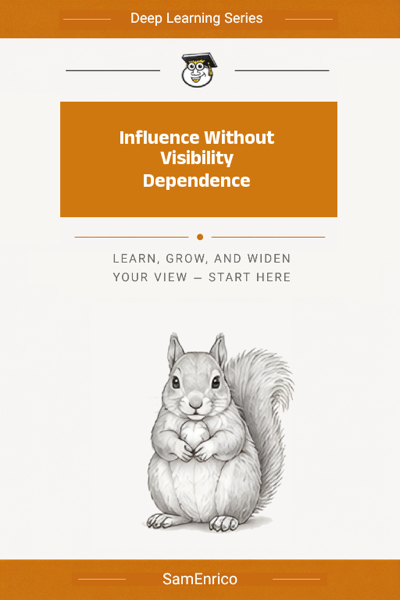
Non-FictionInformativeEducational
Influence Without Visibility Dependence eBook
A Coursebook on Influence Without Visibility Depen
A Coursebook on Influence Without Visibility Dependence
Formats
Free sample
Chapter 1: The Proximity Lie--–- Every professional has felt it at least once: the quiet, sinking realization that you are losing ground not because your work is poor, but because you are not in the right place at the right time. You have delivered the report. You have solved the problem. You have gone above and beyond. And yet, when the promotion was announced, when the high-visibility project was staffed, when the leadership meeting invitations went out—your name was absent.
Someone else got the nod. Someone who, by every objective measure, did less. But they did it closer to the decision-makers. They were seen.This is not a feeling. It is a measurable, replicable, and deeply irrational phenomenon called proximity bias.
And for decades, it has been the hidden tax on every professional who cannot—or will not—camp outside their manager’s office. This book is about ending that tax. Not by fighting proximity bias head-on—you will lose that fight—but by building a form of influence that does not depend on being seen at all.Before we can build that new form of influence, we must understand why the old form is failing. We must understand why chasing visibility is not just exhausting but counterproductive. And we must confront a truth that most workplace advice refuses to acknowledge: the professionals who are most visible are rarely the most influential.The Invention of a Broken Currency Proximity bias did not always exist.
Or rather, it existed but was irrelevant. In the era of factory floors and typing pools, work was physically tethered to a location. If you were not present, you were not working. Visibility and productivity were literally the same thing. A manager could walk through the workshop, see who was at their station, and reasonably conclude that those people were contributing.The industrial revolution hardwired this assumption into management.
Peter Drucker, the father of modern management theory, wrote extensively about “management by walking around”—the idea that leaders should be physically present to observe and guide their teams. In a world where work was manual, tangible, and location-dependent, this made perfect sense. You could not fix a broken machine from a different building. You could not inspect a product without holding it.But knowledge work is different. Knowledge work happens inside heads, not on factory floors.
A software engineer can solve a critical bug from a beach in Thailand. A strategist can design a market entry plan from a coffee shop three time zones away. A data analyst can build a forecasting model that changes the direction of a company without ever meeting the stakeholders who will use it.Management, however, has not caught up. The managers of knowledge workers are still using the mental software of factory supervisors. They still equate visibility with productivity.
They still trust what they see more than what they measure. This is not malice. It is cognitive inertia. The human brain evolved to trust visual information above all other forms of input. If a manager sees you working, their brain registers that as evidence of contribution.
If they do not see you, their brain registers absence—and absence, in the primitive calculus of survival, is dangerous.The result is a system that systematically undervalues remote, asynchronous, and low-visibility work. A 2021 study of over 10,000 employees found that those who worked in the same physical location as their manager received performance ratings that were 0.4 points higher on a five-point scale than those who did not—controlling for every measurable factor of output. A 2022 analysis of promotion data at a Fortune 500 company found that employees who worked in the same building as their skip-level manager were 2.3 times more likely to be promoted than employees with identical performance scores who worked in a different building.These numbers are not noise. They are evidence of a broken currency. And the professionals who succeed despite this broken currency are not the ones who fight it.
They are the ones who abandon it entirely.Performative Presence: The Addiction You Did Not Know You Had When most professionals realize that visibility matters, they do the obvious thing: they try to become more visible. They turn on their cameras for every meeting. They reply to Slack messages within seconds. They write “just following up” emails at 11 PM. They attend optional social calls.
They volunteer for every cross-functional project. They send “quick check-in” messages to stakeholders who did not ask for them.This constellation of behaviors has a name: Performative Presence. It is the act of appearing to work, appearing to be available, appearing to be valuable—without necessarily producing work, availability, or value. Performative Presence is the shadow of productivity. It feels like work.
It burns calories like work. But it is not work. It is theater.The tragedy of Performative Presence is that it works, at first. When you start turning on your camera, replying faster, and showing up more, people notice. You get a small bump in recognition.
Your manager mentions your name in a meeting. A stakeholder thanks you for your responsiveness. This positive reinforcement creates a dopamine loop. Your brain learns: visibility = reward.But here is the trap. The reward diminishes with repetition.
The first time you reply within thirty seconds, your manager is impressed. The tenth time, it is expected. The hundredth time, it is invisible—but your failure to reply within thirty seconds is now glaringly obvious. You have trained your colleagues to expect a level of responsiveness that is unsustainable. You have raised the bar for yourself and only for yourself.The professionals who chase visibility are like addicts who need ever larger doses to achieve the same effect.
They start with turning on their camera. Then they start speaking more in meetings. Then they start sending more emails. Then they start working later. Then they start working weekends.
The visibility treadmill has no top speed. There is always someone who can reply faster, speak more, and work later. You cannot win a war of attrition against people who have fewer boundaries than you do.But there is a deeper cost. Performative Presence does not just exhaust you. It actively undermines your influence.
Because the more visible you become, the more you are seen as someone who needs to be visible. Your colleagues begin to categorize you as high-maintenance. They learn that you require constant acknowledgment. They start giving you small, meaningless tasks to keep you occupied. They include you on email threads where your input is irrelevant.
They invite you to meetings where you will not contribute, simply because they know you will feel excluded otherwise.You have become, in their eyes, a burden. And burdens are not influential.The Noise-to-Signal Ratio Every communication has two components: noise and signal. Signal moves a decision forward, clarifies a confusion, or provides unique value. Noise wastes time, repeats known information, or serves only to make the speaker visible.The visibility-chaser is a noise generator. They send “+1” messages to threads where their agreement is irrelevant.
They write “just wanted to loop you in” emails that contain no information. They ask questions they already know the answer to, just to demonstrate engagement. They share…
This is the end of the free sample. Get the eBook to keep going. Buy now
About this book
Details
- Author
- Meza Theresia
- Publisher
- SamEnrico
- Language
- English
- Genre
- Non-Fiction, Informative, Educational
- Released
- 2026-06-02
- Pages (approx.)
- 150
- Available as
- eBook, Audiobook

Read better in the ZLOADR app
Your eBooks on your phone or tablet. Sign in with your SamEnrico account and start reading.
More by Meza Theresia
 Monthly Priority PlanningMeza Theresia$11.99
 Loving Kindness for Chronic Pain WorkbookMeza Theresia$11.99
 Beginner Mindfulness at SchoolMeza Theresia$11.99
 Stress Induced Withdrawal Recovery PlanMeza Theresia$11.99
 Self Hypnosis for Reading HabitsMeza Theresia$11.99
 From Rags to Riches: The Untold Story of How a Janitor Built a Billion-Dollar EmpireMeza Theresia$11.99
 Understanding Deafness, X Linked, DfnMeza Theresia$17.99
 Community Mobile ExperienceMeza Theresia$12.99
 Nonprofit Late Filing ReliefMeza Theresia$12.99
 Ultimate Handbook Guide to Suining : (China) Travel GuideMeza Theresia$11.99
You may also like
 Hong Kong Handover 1997Dunn Johnnie$11.99
 Zumba For Postnatal Recovery CourseNeal Christian$11.99
 Zumba for BeginnersLadner Nikia$11.99
 YouTube Comment Mining GuideHumes Pandora$12.99
 Worry Box MeditationCarlin Rudy$11.99
 Workplace Stress MeditationNguyen Lynn$11.99
 Workplace Stress and Sleep RepairHawley Ivory$11.99
 Workplace Perfectionism CureDelaney Jeffry$11.99
 Workplace Injustice Anger GuideWallen Isabelle$11.99
 Work Addiction and Burnout LinkGreenwood Ester$11.99
 Women in Yoga and WellnessBeattie Galina$11.99
 Women in Stand Up ComedyChun Evangeline$11.99