
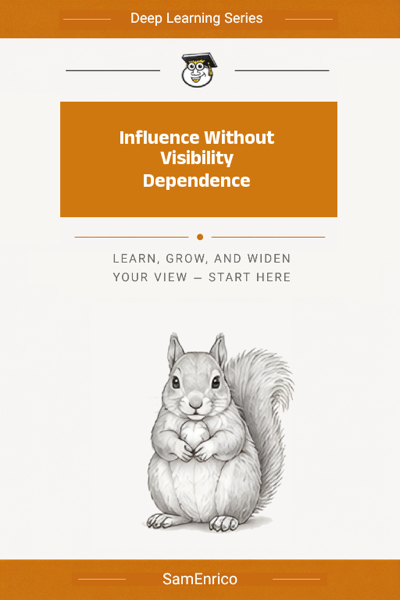
Influence Without Visibility Dependence
A Coursebook on Influence Without Visibility Depen
A Coursebook on Influence Without Visibility Dependence
Formats
About this book
Free sample
Chapter 1: The Proximity Lie--–- Every professional has felt it at least once: the quiet, sinking realization that you are losing ground not because your work is poor, but because you are not in the right place at the right time. You have delivered the report. You have solved the problem. You have gone above and beyond. And yet, when the promotion was announced, when the high-visibility project was staffed, when the leadership meeting invitations went out—your name was absent.
Someone else got the nod. Someone who, by every objective measure, did less. But they did it closer to the decision-makers. They were seen.This is not a feeling. It is a measurable, replicable, and deeply irrational phenomenon called proximity bias.
And for decades, it has been the hidden tax on every professional who cannot—or will not—camp outside their manager’s office. This book is about ending that tax. Not by fighting proximity bias head-on—you will lose that fight—but by building a form of influence that does not depend on being seen at all.Before we can build that new form of influence, we must understand why the old form is failing. We must understand why chasing visibility is not just exhausting but counterproductive. And we must confront a truth that most workplace advice refuses to acknowledge: the professionals who are most visible are rarely the most influential.The Invention of a Broken Currency Proximity bias did not always exist.
Or rather, it existed but was irrelevant. In the era of factory floors and typing pools, work was physically tethered to a location. If you were not present, you were not working. Visibility and productivity were literally the same thing. A manager could walk through the workshop, see who was at their station, and reasonably conclude that those people were contributing.The industrial revolution hardwired this assumption into management.
Peter Drucker, the father of modern management theory, wrote extensively about “management by walking around”—the idea that leaders should be physically present to observe and guide their teams. In a world where work was manual, tangible…
This is the end of the free sample. Get the eBook to keep going. Buy now
Contents
- Chapter 1
- Chapter 2
- Chapter 3
- Chapter 4
- Chapter 5
- Chapter 6
- Chapter 7
- Chapter 8
- Chapter 9
- Chapter 10
- Chapter 11
- Chapter 12
Details
- Author
- Meza Theresia
- Publisher
- SamEnrico
- Language
- English
- Genre
- Non-Fiction, Informative, Educational
- Released
- 2026-06-02
- Pages (approx.)
- 150
- Available as
- eBook, Audiobook

Read better in the ZLOADR app
Your eBooks on your phone or tablet. Sign in with your SamEnrico account and start reading.
More by Meza Theresia
 Monthly Priority PlanningMeza Theresia$11.99
 Loving Kindness for Chronic Pain WorkbookMeza Theresia$11.99
 Beginner Mindfulness at SchoolMeza Theresia$11.99
 Stress Induced Withdrawal Recovery PlanMeza Theresia$11.99
 Self Hypnosis for Reading HabitsMeza Theresia$11.99
 From Rags to Riches: The Untold Story of How a Janitor Built a Billion-Dollar EmpireMeza Theresia$11.99
 Understanding Deafness, X Linked, DfnMeza Theresia$17.99
 Community Mobile ExperienceMeza Theresia$12.99
 Nonprofit Late Filing ReliefMeza Theresia$12.99
 Ultimate Handbook Guide to Suining : (China) Travel GuideMeza Theresia$11.99