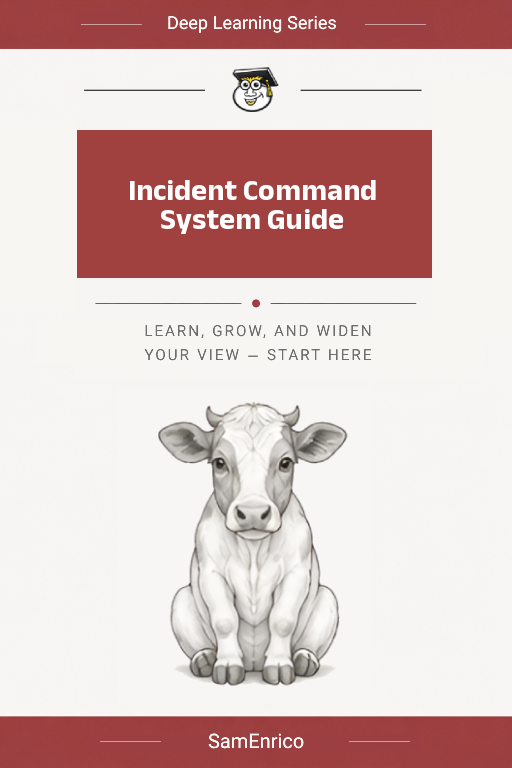
Incident Command System Guide eBook
Implement Incident Command System during terrorist
by Nobles Laine
Implement Incident Command System during terrorist attacks. Assign commander, operations, logistics, planning, and finance sections for coordinated response.
Formats
Free sample
Chapter 1: The First Sixty Seconds--–- The explosion came without warning. One moment, Sergeant Elena Vasquez was finishing her morning coffee at the firehouse kitchen table, reviewing the previous night's run reports. The next moment, the floor trembled, the windows bowed inward, and the station's automated dispatch system screamed to life with three words that every first responder dreads: "Mass casualty incident." The clock on the wall read 08:47. Within sixty seconds, she would make decisions that would determine whether dozens of people lived or died, whether evidence would convict the attackers or be trampled into dust, and whether her own crews would walk off the scene or be carried out.This chapter addresses the most dangerous window in any terrorist attack: the first minute. It is a window so narrow, so chaotic, and so information-poor that most standard Incident Command System training simply assumes it away.
Standard ICS doctrine, as taught in academies and field manuals across the country, is built for a rational world – a world where someone calls 911, a dispatcher asks the right questions, and responders arrive with at least a rough sketch of what they will face. Terrorism destroys that assumption. Terrorist attacks are designed to be ambiguous, to look like accidents until suddenly they do not, and to trap responders inside a kill zone while they are still trying to figure out what kind of incident they have walked into.The core argument of this chapter – and indeed of this entire book – is that the first sixty seconds of a suspected terrorist attack are fundamentally different from any other emergency response. In a house fire, you size up the structure and commit resources. In a car accident, you triage patients and call for extrication.
In a terrorist attack, you must simultaneously do three things that are normally sequential: rescue the living, secure the scene, and begin the criminal investigation. And you must do all three while operating under the genuine threat of a secondary attack designed specifically to kill the responders who have just arrived.This chapter provides a systematic method for navigating those first sixty seconds. It introduces the Ambiguity Protocol, a decision matrix that helps first arriving units determine whether an event is accidental or intentional before confirmation arrives. It establishes the Step-Up Protocol, the precise moment when incident command formally shifts from disaster response to counter-terrorism operation. It defines the Unified Hazard Zone Matrix, which resolves the confusion between ballistic, explosive, and chemical perimeters that has plagued real-world responses from the Boston Marathon to the Bataclan theater.
And it confronts directly what the 9/11 Commission Report called the "failure of imagination" – the human tendency to interpret ambiguous information in the most familiar, least threatening way, precisely when the opposite is required.The practical output of this chapter is a 60-Second Commander's Checklist, a single-page tool that the first arriving unit leader can use to simultaneously initiate rescue, scene security, intelligence gathering, and evidence awareness. But before we reach that checklist, we must understand the psychology of the first minute, the red flags that distinguish terror from tragedy, and the organizational shifts that must happen before the second hand completes its sweep.The Psychology of the First Minute: Why Your Brain Wants to Get It Wrong Human beings are pattern-recognition machines. We survive by quickly categorizing new information into familiar mental models. A siren means ambulance. Smoke means fire.
Screaming means injury. This neural efficiency is a gift in everyday life, but it becomes a curse in the first minute of a terrorist attack. Your brain will actively fight against the conclusion that you are witnessing an intentional act of mass violence, because that conclusion is terrifying, complicated, and socially disruptive. Instead, your brain will reach for the most benign plausible explanation: a gas explosion, a traffic accident, a fireworks mishap, a structural failure.This is not a character flaw. It is neurology.
And the first step to overcoming it is to name it. The failure of imagination is not a failure of intelligence or courage. It is a failure of the default mode network to override its own efficiency. The only known countermeasure is a deliberate, protocol-driven override – a checklist that forces you to ask the uncomfortable questions before your brain has time to smooth them over.Consider the following real-world example. In the 2008 Mumbai attacks, the first responders to the Chhatrapati Shivaji Terminus assumed they were dealing with a gang shooting or a robbery gone wrong.
They entered the station without ballistic protection, without coordination with counter-terrorism units, and without establishing secure perimeters. By the time they understood they were facing a coordinated terrorist attack with multiple shooters carrying automatic weapons and grenades, several first responders were already dead. The first sixty seconds had been wasted on normalcy bias. The cost was measured in blood.The Ambiguity Protocol: A Decision Matrix for the Unthinkable The Ambiguity Protocol is a simple, memory-assist tool that answers one question: Should I treat this event as a potential terrorist attack until proven otherwise? The protocol consists of three sequential gates.
If any gate returns a positive indicator, you immediately shift to counter-terrorism mode.Gate One: Environmental Red Flags These are physical characteristics of the scene that should trigger suspicion regardless of what anyone tells you over the radio. Ask yourself five questions in the first ten seconds:First, are there multiple points of ignition or injury? A single gas explosion creates one blast seat. A terrorist attack often creates two or more, either from multiple devices or from a shooter moving through a crowd. If you see smoke rising from two separate locations that are not connected by a single fire path, your suspicion index should spike.Second, is there evidence of pre-attack staging?
Look for backpacks left in unusual places, vehicles parked with running engines and no occupants, or ropes, ladders, or climbing equipment at the scene. Terrorists often cache weapons, secondary devices, or escape routes.Third, are there unattended items in the immediate aftermath? In the seconds after an explosion, bystanders flee and drop their belongings. Terrorists exploit this by placing devices inside bags that look like they were abandoned in panic. A single unattended bag near a mass casualty event is not necessarily a bomb, but it is a bomb until proven otherwise.Fourth, do the injuries show a pattern inconsistent with the stated cause?
Blast lung from an explosion is round and diffuse. Shrapnel wounds are linear and directional. Gunshot wounds have entrance and exit characteristics that a trained medic can identify in seconds. If the injuries do not match the narrative you are hearing, trust your clinical judgment over the radio traffic.Fifth, is there an active threat still present? This is the most unambiguous red flag of all.
If people are still being shot at, if devices are still detonating, if there is ongoing violence as you arrive, you are not at a disaster scene. You are at a battle scene.Gate Two: Behavioral Red Flags These are actions by people at the scene that should trigger suspicion. In the first twenty seconds, look for three specific behaviors.First, are there individuals who are not behaving like victims? Victims flee, hide, or seek…
This is the end of the free sample. Get the eBook to keep going. Buy now
About this book
Details
- Author
- Nobles Laine
- Publisher
- SamEnrico
- Language
- English
- Genre
- Non-Fiction, Crisis Management, ICS
- Released
- 2026-05-30
- Pages (approx.)
- 156
- Available as
- eBook, Audiobook

Read better in the ZLOADR app
Your eBooks on your phone or tablet. Sign in with your SamEnrico account and start reading.
More by Nobles Laine
 The Wrong Train StationNobles Laine$11.99
 Chef Kitchen Pressure GuideNobles Laine$11.99
 NVC For Suicidal ThoughtsNobles Laine$11.99
 Emergency Dispatcher Stress ReliefNobles Laine$11.99
 Love and Gunpowder in the Pyrenees: The Secret Affair of the Peninsular WarNobles Laine$11.99
 Web AdministratorNobles Laine$11.99
 How to Produce Billiard Cue RacksNobles Laine$11.99
 How to Become a PainterNobles Laine$11.99