
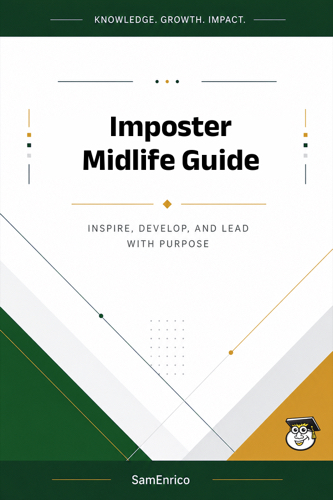
Imposter Midlife Guide eBook
Overcome career plateau doubts in middle age.
by Solis Kimber
Overcome career plateau doubts in middle age.
Formats
Free sample
Chapter 1: The Striver’s Curse--–- The phone buzzed at 11:47 on a Tuesday night. Not with an emergency. Not with a crisis. With an email from a junior colleague who had apparently decided that “urgent” meant “I’m working late and so should you.” You sighed, glanced at your laptop, and opened the message. It was fine.
It could have waited until morning. But now it was in your head, and you were already composing a response in your mind, and by 12:15 you were editing a slide deck that nobody would look at for another four days.This is not a story about burnout. This is a story about a much stranger, more insidious condition: the slow realization that the very strategies that built your career are now dismantling your peace of mind. The late nights that once felt like heroic effort now feel like quiet desperation. The perfectionism that earned you promotions now earns you resentment.
The constant forward motion that defined your twenties and thirties has somehow become a treadmill that is speeding up while going nowhere.You are not alone. You are not broken. But you have outgrown the operating system of your professional youth, and nobody gave you the upgrade manual.Welcome to the Striver’s Curse.The Paradox at the Heart of Midlife Achievement Let’s name what you are experiencing, because naming is the first form of disarming. You have spent fifteen to twenty-five years climbing. You learned the rules early: work harder than everyone else, say yes to every opportunity, polish every deliverable until it shines, never show weakness, and above all, never stop.
These rules worked. They got you into the room. They got you the promotion. They got you the title, the salary, the respect of your peers.And now, somewhere between your late thirties and early fifties, those same rules have started to backfire. The returns on your effort are diminishing.
The satisfaction that once accompanied achievement has flattened into something closer to relief—and relief is not joy, it is just the temporary absence of anxiety. You are working as hard as ever, perhaps harder, but the reward center of your brain has stopped cooperating.This is not a moral failing. It is a biological and psychological inevitability.Consider the research on hedonic adaptation—the tendency of human beings to return to a baseline level of happiness regardless of positive or negative life changes. The promotion you fought for three years ago now feels like just another Tuesday. The salary increase that felt life-changing now feels like the cost of doing business.
You have adapted to every success, and in adapting, you have drained it of its power to motivate you.But there is something deeper happening here, something beyond the familiar concept of burnout. Burnout, as conventionally understood, is exhaustion caused by excessive and prolonged stress. You know burnout. You have felt it—the bone-tired weariness that makes you want to sleep for a week. What you are feeling now may be different.
It may be something researchers have called bore-out.Burnout Versus Bore-Out: A Critical Distinction Burnout comes from too much. Too many hours, too many demands, too many competing priorities, too little control. Bore-out comes from too little—too little challenge, too little meaning, too little sense that your work matters in the way it once did. Bore-out is the peculiar exhaustion that results not from overwork but from under-stimulation. It is the fatigue of doing work that no longer engages your mind or heart.Here is the cruel irony: you can be simultaneously burned out and bored out.
You can be exhausted from the volume of your work while also being starved for the quality of meaning in it. You can spend ten hours on a Thursday answering emails, attending meetings, and putting out fires, and then drive home feeling both completely drained and completely empty. That is the Striver’s Curse. That is the plateau dressed up as productivity.Most midlife professionals mistake this experience for a personal failure. They think, “If I were smarter, I would have figured this out by now.” Or “If I were more grateful, I wouldn’t feel this way about a career that others would kill for.” Or “If I just worked a little harder, pushed a little longer, I would break through to the other side.”The last one is the most dangerous.
Because pushing harder is exactly the wrong response.The Inverted U: Why Effort Stops Paying Off Psychologists have known for decades that the relationship between effort and performance is not a straight line. It is an inverted U. At low levels of effort, performance is poor. As effort increases, performance improves—up to a point. After that point, additional effort produces diminishing returns.
Beyond that point, additional effort actually decreases performance.This is the Yerkes-Dodson Law, first described in 1908 and since validated across hundreds of studies. Moderate arousal (read: effort, stress, attention) improves performance. High arousal degrades it.Here is what the Yerkes-Dodson Law means for you, in this moment, in this plateau. The strategies that worked when you were climbing the lower slopes of your career—the relentless effort, the perfectionism, the constant vigilance—are now pushing you over the peak of the inverted U and down the other side. You are not failing because you are not trying hard enough.
You are failing because you are trying too hard in the wrong way.This is counterintuitive. Everything in your professional training has told you that more is better. More hours. More preparation. More polish.
More responsiveness. But more has become a trap. The very behaviors that signaled dedication in your twenties now signal anxiety, over-control, and a lack of strategic judgment in your forties.Consider the research on over-preparation. Studies of workplace performance consistently show that beyond a certain threshold, additional preparation time yields negligible improvement in outcomes—but significant increases in stress, procrastination, and self-doubt. The executive who spends twenty hours on a presentation that needed five is not more effective.
They are more anxious. And the anxiety is visible. And the anxiety is expensive.The Biology of Chronic Striving The Striver’s Curse is not just psychological. It is physiological. Your body is registering the mismatch between your effort and your reward, and it is sending you signals that you have learned to ignore.Cortisol, the primary stress hormone, follows a natural daily rhythm.
It peaks in the morning to help you wake up and gradually declines throughout the day. Chronic striving—the constant state of alertness, responsiveness, and self-imposed pressure—flattens and elevates this rhythm. You wake up tired because your cortisol was elevated at midnight when you checked your email. You struggle to focus because your cortisol is blunted from overuse. You feel wired and exhausted simultaneously because your sympathetic nervous system (fight or flight) has been running continuously for years.This is not a metaphor.
This is measurable biology.The research on allostatic load—the cumulative wear and tear on the body caused by repeated exposure to stress—shows that chronic strivers age faster, recover more slowly from illness, and experience higher rates of cardiovascular disease, metabolic disorders, and depression.…
This is the end of the free sample. Get the eBook to keep going. Buy now
About this book
Details
- Author
- Solis Kimber
- Publisher
- SamEnrico
- Language
- English
- Genre
- Non-Fiction, Self-Help, Midlife
- Released
- 2026-06-11
- Pages (approx.)
- 119
- Available as
- eBook, Audiobook

Read better in the ZLOADR app
Your eBooks on your phone or tablet. Sign in with your SamEnrico account and start reading.
More by Solis Kimber
 Ryan Gosling Mickey MouseSolis Kimber$11.99
 Spousal Benefit MaximizationSolis Kimber$11.99
 Reconstruction of Stranger HomicidesSolis Kimber$11.99
 Widowed Senior Over 70Solis Kimber$11.99
 Method Of Loci For Dance ChoreographySolis Kimber$11.99
 Pomodoro for FreelancersSolis Kimber$11.99
 Pacing and Pause in RecordingsSolis Kimber$11.99
 The Ghost of Medellín: Pablo Escobar’s Last HeistSolis Kimber$11.99
 How to Produce Post CardsSolis Kimber$11.99
 How to Produce Dried FlowersSolis Kimber$11.99
 Coffee: Harvesting CherriesSolis Kimber$11.99
 Research Proposal Community Engaged WorkbookSolis Kimber$12.99
You may also like
 Hong Kong Handover 1997Dunn Johnnie$11.99
 Zumba For Postnatal Recovery CourseNeal Christian$11.99
 Zumba for BeginnersLadner Nikia$11.99
 YouTube Comment Mining GuideHumes Pandora$12.99
 Worry Box MeditationCarlin Rudy$11.99
 Workplace Stress MeditationNguyen Lynn$11.99
 Workplace Stress and Sleep RepairHawley Ivory$11.99
 Workplace Perfectionism CureDelaney Jeffry$11.99
 Workplace Injustice Anger GuideWallen Isabelle$11.99
 Work Addiction and Burnout LinkGreenwood Ester$11.99
 Women in Yoga and WellnessBeattie Galina$11.99
 Women in Stand Up ComedyChun Evangeline$11.99