
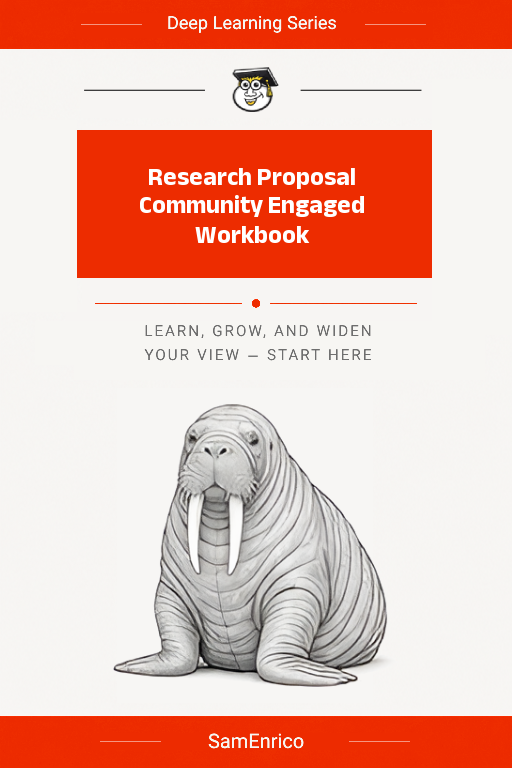
researchStudent's ShortcutCommunity Research
Research Proposal Community Engaged Workbook
Incorporate participatory methods and community pa
by Solis Kimber
Incorporate participatory methods and community partnerships while maintaining academic rigor and ethical standards.
Formats
About this book
Free sample
Chapter 1: The Mirror Test--–- Before you write a single word of your research proposal, before you identify a community partner, before you even choose a funding mechanism, you must complete one task that most academics skip entirely: you must look in the mirror. This chapter is not about methods, budgets, or IRB protocols. It is about something more fundamental and far more uncomfortable. It is about you. Your identity.
Your institutional history. Your unexamined assumptions. And the power you carry into every community space whether you acknowledge it or not.The traditional research proposal is written by an expert who knows what questions to ask, what methods to use, and what outcomes matter. That expert then seeks a community willing to be studied. The community-engaged proposal flips this script entirely.
It begins not with the expert's certainty but with the expert's humility. It starts with the recognition that you, the researcher, are not a neutral observer floating above the social world. You are situated. You have a position. And that position shapes everything you see, every question you ask, and every relationship you build.This chapter introduces the foundational shift that makes all subsequent chapters meaningful: moving from research done on communities to research done with communities.
To make that shift, you must first understand where you stand. Hence the mirror test.The Three Modes of Inquiry: A Critical Distinction Before you can write a community-engaged proposal, you must understand what makes it different from other forms of research. Most academic research falls into one of three categories, and the distinctions between them are not merely semantic. They determine who holds power, who defines problems, and who benefits from answers.Community-placed research is the most common and the least engaged. In this mode, researchers select a community as a convenient location for data collection because that community has a high prevalence of the phenomenon they wish to study.
The community provides subjects, settings, and perhaps logistical support, but it has no role in shaping the research question, interpreting the data, or determining how findings are used. Think of the…
This is the end of the free sample. Get the eBook to keep going. Buy now
Contents
- Chapter 1
- Chapter 2
- Chapter 3
- Chapter 4
- Chapter 5
- Chapter 6
- Chapter 7
- Chapter 8
- Chapter 9
- Chapter 10
- Chapter 11
- Chapter 12
Details
- Author
- Solis Kimber
- Publisher
- SamEnrico
- Language
- English
- Genre
- research, Student's Shortcut, Community Research
- Released
- 2026-06-01
- Pages (approx.)
- 157
- Available as
- eBook, Audiobook

Read better in the ZLOADR app
Your eBooks on your phone or tablet. Sign in with your SamEnrico account and start reading.
More by Solis Kimber
 Ryan Gosling Mickey MouseSolis Kimber$11.99
 Imposter Midlife GuideSolis Kimber$11.99
 Spousal Benefit MaximizationSolis Kimber$11.99
 Reconstruction of Stranger HomicidesSolis Kimber$11.99
 Widowed Senior Over 70Solis Kimber$11.99
 Method Of Loci For Dance ChoreographySolis Kimber$11.99
 Pomodoro for FreelancersSolis Kimber$11.99
 Pacing and Pause in RecordingsSolis Kimber$11.99
 The Ghost of Medellín: Pablo Escobar’s Last HeistSolis Kimber$11.99
 How to Produce Post CardsSolis Kimber$11.99
 How to Produce Dried FlowersSolis Kimber$11.99
 Coffee: Harvesting CherriesSolis Kimber$11.99
You may also like
 Scientific Research On TM GuideMartens Nathanial$11.99
 Research Proposal Methodology Section MasteryPauley Debroah$11.99
 Research Proposal Appendix CompilationRaines Tyisha$11.99
 Academic Researcher Distraction GuideFord Virgil$11.99
 TM Research and ScienceCovert Nicki$11.99
 Social Anxiety Research ReviewRoberge Cole$11.99
 Research Proposal Significance Section GuideBock Tory$12.99
 Research Proposal Reviewer PsychologyLugo Tawanda$11.99
 Research Proposal Research Questions DesignLara Robbi$11.99
 Research Proposal References and CitationsPatten Shanice$11.99
 Research Proposal Mixed Methods DesignCameron Omega$11.99
 Research Proposal Data Management PlanAnderson Roberto$12.99