
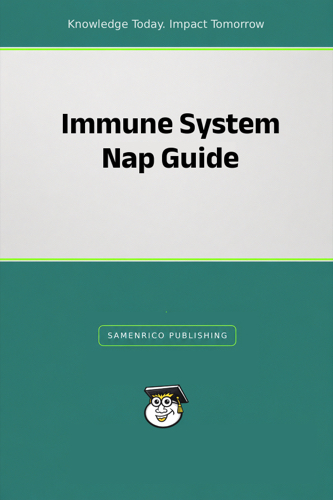
Non-FictionHealth & WellnessImmunity
Immune System Nap Guide eBook
Boost immunity with restorative daytime sleep.
Boost immunity with restorative daytime sleep.
Formats
Free sample
Chapter 1: The Exhausted Army--–- You are outnumbered. Right now, as you read this sentence, trillions of pathogens—viruses, bacteria, fungi, and parasites—are attempting to breach your borders. They ride in on the dust particles floating toward your nose. They cling to the door handle you touched thirty seconds ago. They drift across the surface of your smartphone screen, which studies show carries more bacteria than a public toilet seat.
And yet, here you are. Alive. Breathing. Not actively dying of sepsis or drowning in your own phlegm. Someone—or rather, something—is fighting for you every single millisecond of every single day.
That something is your immune system, and it is the most underappreciated, overworked, and exhausted army you will ever command.Most people never think about their immune system until it fails. They notice it only when a sore throat announces itself, when a fever takes the wheel, when fatigue pins them to the couch like a butterfly to a board. By then, the battle is already well underway—and your soldiers are running on empty. This book exists because of a single, radical idea: what if you stopped waiting for your immune system to fail, and instead started actively resupplying it? What if the most powerful immune-boosting tool wasn’t a supplement, a cold plunge, or an expensive superfood powder, but something you already do—badly, rarely, and with guilt?
Daytime sleep. Napping. And not the desperate, face-down-on-the-keyboard collapse after a sleepless night, but strategic, timed, deliberate immune napping.Before we can teach you how to nap for immunity, you need to understand what you are napping for. You need to meet the soldiers, the messengers, the killers, and the memory keepers that make up your internal defense network. You need to understand why your immune system is uniquely dependent on sleep—not just nighttime sleep, but the restorative power of daytime naps.
And you need to understand that chronic sleep debt, the kind that has become normal in modern life, does not just make you tired. It makes you sick. Not metaphorically. Literally.Let us begin with a simple fact that will change the way you think about every nap you have ever taken. Your immune system consumes an enormous amount of energy.
When it is active—fighting an infection, healing a wound, or even just maintaining surveillance—it burns through glucose, oxygen, and cellular resources at a rate that would bankrupt a smaller operation. This is why you feel exhausted when you are sick. Your body is diverting everything to the war effort. But here is the catch: your immune system never fully turns off. Even when you are healthy, even when you feel fine, a baseline level of immune activity is always running in the background, like a security camera that never blinks.
That baseline activity requires energy. And the only time your body can fully replenish that energy—clearing out metabolic waste, repairing damaged immune cells, and producing new ones—is during sleep.The Hidden Cost of Being Awake Think of it this way. Your immune system is a factory that produces weapons, ammunition, and soldiers. During the day, that factory runs at partial capacity because your brain, muscles, and organs are all competing for the same resources—glucose, oxygen, ATP, amino acids. Your brain alone consumes about 20 percent of your body’s energy despite making up only 2 percent of your mass.
Your muscles, even at rest, demand a steady supply of fuel. Your digestive system churns away, breaking down food, absorbing nutrients, and managing the constant threat of pathogens entering through your gut. By the time your immune system gets its share of the daily energy budget, it is running on leftovers.But at night, everything changes. When you fall asleep, your brain reduces its energy consumption by nearly 30 percent. Your muscles relax, lowering their demand.
Your heart rate slows. Your breathing deepens and becomes more efficient. The competition for resources fades, and your immune system gets to run the night shift at full capacity. Production lines speed up. Repairs happen.
New natural killer cells roll off the assembly line. Old, damaged immune cells are marked for destruction and replaced. Memory cells are consolidated and strengthened. This is not metaphor. This is biology, measurable in blood samples, visible under microscopes, confirmed by decades of sleep research.And if you cut your sleep short—if you rob that factory of its night shift—you wake up with fewer soldiers, older ammunition, and a commander who is already exhausted before the first shot is fired.
A single night of poor sleep, defined as five hours or less, reduces natural killer cell activity by 30 to 40 percent. One night. That is not a typo. One night of staying up late to finish a project, binge a show, or scroll through social media, and you have effectively disarmed a third of your antiviral defense force. They are still there, those natural killer cells, but they are sluggish.
They do not recognize threats as quickly. They do not kill as efficiently. They are, in the most literal sense, tired.Meeting Your Internal Military Your immune system is not one thing. It is a collection of different forces, each with its own role, its own weapons, and its own schedule. To understand how napping helps, you need to understand the difference between the two main branches: innate immunity and adaptive immunity.
(For a complete glossary of all immune terms used in this book, see the Appendix. Subsequent chapters will reference these definitions rather than redefining them, allowing us to move faster and go deeper.)Innate immunity is your rapid response team. It is the security guard at the gate, the patrol car that shows up three minutes after the alarm goes off. Innate immune cells do not need an introduction. They do not need to learn your enemy’s face.
They are pre-programmed to recognize broad categories of threat—bacteria, viruses, fungi, parasites—and destroy them immediately. The main players in innate immunity are neutrophils, macrophages, and natural killer cells.Neutrophils are the most abundant white blood cell in your body, accounting for 50 to 70 percent of all circulating immune cells. They are the infantry, the grunts, the ones who do the dirty work. When a neutrophil encounters a pathogen, it does not negotiate. It engulfs the invader whole, traps it inside a membrane-bound compartment, and floods that compartment with toxic chemicals that dissolve the pathogen into nothing.
Then the neutrophil dies, sacrificing itself to protect you. Millions of neutrophils die this way every day. Your bone marrow produces new ones at a rate of nearly 100 billion per day. That is the scale of your immune system’s daily turnover.Macrophages are the larger, slower, more intelligent cousins of neutrophils. The name comes from Greek: macro meaning large, phage meaning eater.
They wander through your tissues, not just your bloodstream, consuming not only pathogens but also dead cells, cellular debris, and anything else that does not belong. But macrophages have a second job that makes them critical to adaptive immunity. After they eat a pathogen, they break it apart and display the fragments on their surface like warning flags.…
This is the end of the free sample. Get the eBook to keep going. Buy now
About this book
Details
- Author
- Borden Arleen
- Publisher
- SamEnrico
- Language
- English
- Genre
- Non-Fiction, Health & Wellness, Immunity
- Released
- 2026-06-10
- Pages (approx.)
- 130
- Available as
- eBook, Audiobook

Read better in the ZLOADR app
Your eBooks on your phone or tablet. Sign in with your SamEnrico account and start reading.
More by Borden Arleen
 Swimming Bilateral Breathing DrillBorden Arleen$11.99
 LBO Waterfall Distribution GuideBorden Arleen$11.99
 Fingerprint Evidence ReconstructionBorden Arleen$11.99
 Anticipatory Grief In The WorkplaceBorden Arleen$11.99
 Empathy for ParentsBorden Arleen$11.99
 Memory Palace for MusiciansBorden Arleen$11.99
 Self Hypnosis for Vegetable EatingBorden Arleen$11.99
 The Velvet Underground: How Motown Almost Changed Rock ForeverBorden Arleen$11.99
 The Siege of the Pinkertons: The Kidnapping of Charlie FordBorden Arleen$11.99
 A Collector's Handbook to the Vauxhall Vx4.90 FdBorden Arleen$11.99
 How to Produce Custom Fabrication ServicesBorden Arleen$11.99
 Canadian Experience Class GuideBorden Arleen$12.99
You may also like
 Hong Kong Handover 1997Dunn Johnnie$11.99
 Zumba For Postnatal Recovery CourseNeal Christian$11.99
 Zumba for BeginnersLadner Nikia$11.99
 YouTube Comment Mining GuideHumes Pandora$12.99
 Worry Box MeditationCarlin Rudy$11.99
 Workplace Stress MeditationNguyen Lynn$11.99
 Workplace Stress and Sleep RepairHawley Ivory$11.99
 Workplace Perfectionism CureDelaney Jeffry$11.99
 Workplace Injustice Anger GuideWallen Isabelle$11.99
 Work Addiction and Burnout LinkGreenwood Ester$11.99
 Women in Yoga and WellnessBeattie Galina$11.99
 Women in Stand Up ComedyChun Evangeline$11.99