
Non-FictionSelf-HelpMusic Memory
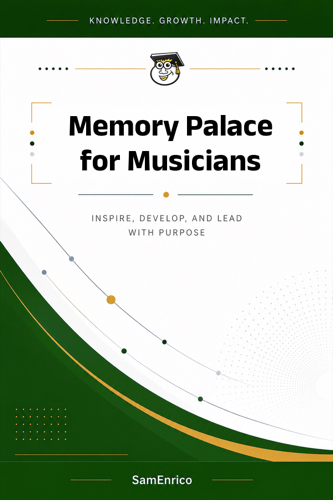
Memory Palace for Musicians
Remember scores and chord progressions using music
Remember scores and chord progressions using musical journeys.
Formats
About this book
Free sample
Chapter 1: The Red Light...--–- The first time it happened, Maria was sixteen. She had practiced Chopin's Nocturne in C-sharp minor for three hours every day for six weeks. She could play it in her sleep—and sometimes she did, her fingers twitching on the edge of the mattress at 3 a.m. On the morning of the recital, she walked onto the stage, sat at the piano, and played the first sixteen measures perfectly. Her teacher nodded from the third row.
Then, at measure seventeen, her hands stopped. Not because she didn't know the notes. Not because she hadn't practiced enough. Her hands simply... froze.
She stared at the keyboard like a traveler who has suddenly forgotten the language of the country she's been living in for years. The silence lasted four seconds—an eternity—until she skipped to the coda and stumbled through to the end. Backstage, she told herself the lie that musicians have told for centuries: "I just need to practice more."But practice wasn't the problem. The problem was that Maria had built her entire performance on a foundation of sand: muscle memory alone.The Myth of the Automatic Pilot Every musician knows the feeling. You practice a passage until your fingers know it better than your brain does.
You stop thinking about individual notes. Your hands seem to move on their own, guided by some invisible choreography that lives somewhere beneath conscious thought. This is procedural memory—the same system that lets you tie your shoes without looking, ride a bicycle after twenty years, or type on a keyboard without searching for the letters. It is fast, fluid, and gloriously unconscious.And it is dangerously unreliable.Procedural memory is what psychologists call "location-dependent" and "state-dependent." It works brilliantly when the conditions of performance exactly match the conditions of practice. Same piano?
Same room? Same level of adrenaline? Same posture? Same emotional state? If you answer yes to all of these, procedural memory will serve you like a loyal servant.
Change one variable—put a spotlight in your eyes, add three hundred people breathing in your direction, raise your heart rate…
This is the end of the free sample. Get the eBook to keep going. Buy now
Contents
- Chapter 1
- Chapter 2
- Chapter 3
- Chapter 4
- Chapter 5
- Chapter 6
- Chapter 7
- Chapter 8
- Chapter 9
- Chapter 10
- Chapter 11
- Chapter 12
Details
- Author
- Borden Arleen
- Publisher
- SamEnrico
- Language
- English
- Genre
- Non-Fiction, Self-Help, Music Memory
- Released
- 2026-06-06
- Pages (approx.)
- 132
- Available as
- eBook, Audiobook

Read better in the ZLOADR app
Your eBooks on your phone or tablet. Sign in with your SamEnrico account and start reading.
More by Borden Arleen
 Swimming Bilateral Breathing DrillBorden Arleen$11.99
 Immune System Nap GuideBorden Arleen$11.99
 LBO Waterfall Distribution GuideBorden Arleen$11.99
 Fingerprint Evidence ReconstructionBorden Arleen$11.99
 Anticipatory Grief In The WorkplaceBorden Arleen$11.99
 Empathy for ParentsBorden Arleen$11.99
 Self Hypnosis for Vegetable EatingBorden Arleen$11.99
 The Velvet Underground: How Motown Almost Changed Rock ForeverBorden Arleen$11.99
 The Siege of the Pinkertons: The Kidnapping of Charlie FordBorden Arleen$11.99
 A Collector's Handbook to the Vauxhall Vx4.90 FdBorden Arleen$11.99
 How to Produce Custom Fabrication ServicesBorden Arleen$11.99
 Canadian Experience Class GuideBorden Arleen$12.99
You may also like
 Hong Kong Handover 1997Dunn Johnnie$11.99
 Zumba For Postnatal Recovery CourseNeal Christian$11.99
 Zumba for BeginnersLadner Nikia$11.99
 YouTube Comment Mining GuideHumes Pandora$12.99
 Worry Box MeditationCarlin Rudy$11.99
 Workplace Stress MeditationNguyen Lynn$11.99
 Workplace Stress and Sleep RepairHawley Ivory$11.99
 Workplace Perfectionism CureDelaney Jeffry$11.99
 Workplace Injustice Anger GuideWallen Isabelle$11.99
 Work Addiction and Burnout LinkGreenwood Ester$11.99
 Women in Yoga and WellnessBeattie Galina$11.99
 Women in Stand Up ComedyChun Evangeline$11.99