
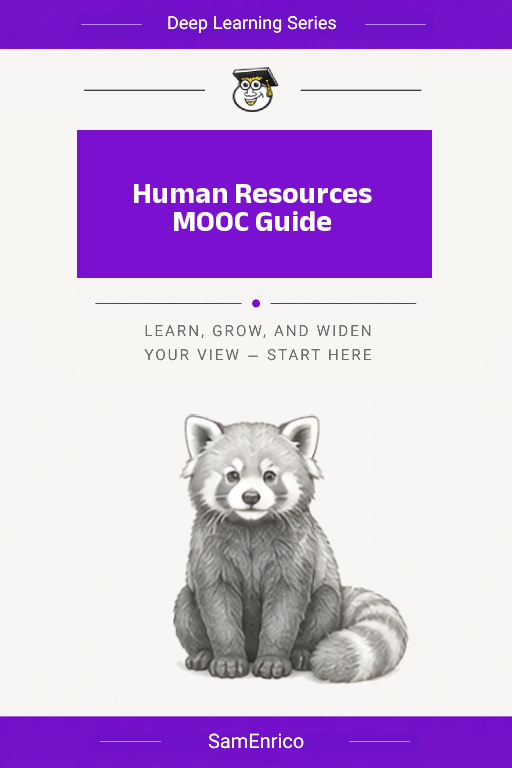
Human Resources MOOC Guide eBook
Use HR certificates from Cornell, Rutgers, and Lin
Use HR certificates from Cornell, Rutgers, and LinkedIn for recruiter and HR generalist positions with hiring data.
Formats
Free sample
Chapter 1: The $1.6 Trillion Time Bomb--–- In 2023, American families held over 1.6trillioninoutstandingstudentloandebt.Thatisnotatypo.Trillionwitha"T."Theaverageborrowergraduateswithnearly1.6 trillion in outstanding student loan debt. That is not a typo. Trillion with a "T." The average borrower graduates with nearly 1.6trillioninoutstandingstudentloandebt.Thatisnotatypo.Trillionwitha"T."Theaverageborrowergraduateswithnearly40,000 in debt, and for HR professionals carrying a four-year degree—or worse, a master's degree—the number often climbs higher. Here is what the universities do not tell you when you sign that promissory note: a traditional degree is no longer the gold standard for getting hired in Human Resources.This is not an opinion. It is a data-driven reality that has been accelerating for the past five years, and it reached a tipping point in 2025.The numbers are startling.
According to Linked In's 2025 Future of Recruiting report, 75 percent of recruiters now prioritize demonstrable skills over degrees when evaluating candidates. Skills-based job postings have jumped 35 percent year-over-year. Companies like IBM, Google, Apple, and Bank of America have explicitly dropped degree requirements for thousands of positions—including HR roles. And here is the kicker: the candidates winning those jobs are not the ones with expensive diplomas. They are the ones holding verified certificates from programs like e Cornell, Rutgers, and Linked In Learning.Welcome to the new landscape of HR hiring.
This book is your roadmap through it.The Great Unraveling: Why Degrees Lost Their Monopoly Let us rewind for a moment. For the past forty years, the formula for a stable career in Human Resources was simple: earn a bachelor's degree in HR, business, or psychology, spend a few years as a coordinator, then pursue a master's degree or a PHR/SPHR certification to break into the six-figure range. The total investment? Anywhere from 60,000to60,000 to 60,000to150,000 and four to seven years of your life.That formula is now broken.The first crack appeared in the early 2010s when companies began complaining that new graduates lacked practical skills. A four-year degree in HR management might include a semester-long course on labor laws, but it almost certainly did not teach you how to process an FMLA leave request on Day One of your first job.
It might have covered analytics in theory, but it did not teach you how to build a turnover prediction model in Excel or Tableau. And it definitely did not teach you how to use Linked In Recruiter to source passive candidates—a skill that 68 percent of hiring managers now expect new hires to possess immediately.The second crack was the pandemic. When remote work exploded, HR departments were forced to digitize every process—onboarding, compliance, performance management, recruiting. Suddenly, the ability to navigate HRIS platforms, analyze workforce data, and manage remote investigations became more valuable than the ability to write a twenty-page research paper on motivation theory.The third crack was the rise of skills-based hiring. In 2024, a coalition of major employers—including Walmart, Microsoft, and Accenture—signed the "Tear the Paper Ceiling" pledge, committing to remove degree requirements from 75 percent of their job postings.
HR roles were prominently featured on that list. Why? Because data showed that degree requirements were filtering out competent candidates while doing nothing to predict on-the-job performance.Here is what replaced the degree requirement: verified certificates. Short, intensive, practical programs that teach exactly what you need to know and then prove you know it through a digital badge that recruiters can click, verify, and trust.The Stanford/Coursera Study That Changes Everything You do not have to take my word for it. In 2024, researchers at Stanford University partnered with Coursera to analyze the job acquisition rates of over 100,000 professionals who had completed online certificates.
The results were unambiguous: professionals who displayed verified certifications on their profiles experienced a 6 percent increase in job acquisition rates compared to identical candidates who did not display certifications.Six percent does not sound enormous until you understand what it represents in a competitive job market. For an HR Generalist position receiving 250 applications, a 6 percent higher chance of being hired is the difference between being in the top fifteen candidates and being in the top seventy. It is the difference between getting a phone screen and getting a rejection form email.But the study revealed something even more important: the effect was strongest for candidates without traditional four-year degrees. In other words, certificates do not just supplement a degree—they can replace one entirely in the eyes of recruiters.Let me say that again: a 2,200certificatefrom Rutgersore Cornellcancarryasmuchweightasa2,200 certificate from Rutgers or e Cornell can carry as much weight as a 2,200certificatefrom Rutgersore Cornellcancarryasmuchweightasa60,000 bachelor's degree for entry-level and mid-level HR roles. That is not hype.
That is data.The PHR/SPHR Question: What Those Study Guides Actually Do for You At this point, some readers are thinking: "But what about the PHR? The SPHR? Aren't those the gold standard for HR credentials?"The short answer is yes and no.The PHR (Professional in Human Resources) and SPHR (Senior Professional in Human Resources) certifications, administered by HRCI, have been the dominant credentials in HR for decades. They are rigorous. They are respected.
And they are absolutely worth pursuing—if you already have the experience required to sit for the exam. The PHR requires at least two years of exempt-level HR experience. The SPHR requires four to seven years. If you are trying to break into HR or pivot from another field, you cannot even take these exams.This is the dirty secret that the PHR/SPHR study guides do not tell you. The Wiley/Sybex PHR Study Guide and the All-in-One PHR Exam Guide are excellent resources for passing the exam.
But they are nearly useless for teaching you how to actually do the job. They focus on rote memorization of laws, theories, and frameworks. They do not teach you how to navigate an FMLA interactive process. They do not teach you how to build a salary band model. They do not teach you how to use Linked In to source candidates.MOOCs—Massive Open Online Courses with verified certificates—fill exactly this gap.
They teach practical, demonstrable skills. They issue verifiable digital badges. And they do it in weeks, not years.Here is the strategy this book will teach you: use MOOCs to get the job, then use the PHR/SPHR to advance once you have the required experience. The two are not competitors. They are complements.
But if you have to choose one to break into the field, the data is clear: start with the MOOCs.The Three Certificates That Recruiters Actually Trust Not all certificates are created equal. A certificate from a random online platform with no accreditation or university backing is worse than useless—it signals to recruiters that you do not understand the credentialing landscape.Through extensive analysis of job postings, recruiter surveys, and hiring data from 2024-2025, I have identified the three certificates that consistently appear in job descriptions, generate recruiter attention, and correlate with salary increases. This book calls them the "Trinity of Trust."Cornell University (e Cornell): The HR Analytics certificate from e Cornell is the most respected analytics credential for HR professionals who do not have a master's degree. It consists of three core modules: HR Analytics, Strategic Talent Analytics…
This is the end of the free sample. Get the eBook to keep going. Buy now
About this book
Details
- Author
- Grady Maybelle
- Publisher
- SamEnrico
- Language
- English
- Genre
- Non-Fiction, Student's Shortcut
- Released
- 2026-05-30
- Pages (approx.)
- 151
- Available as
- eBook, Audiobook

Read better in the ZLOADR app
Your eBooks on your phone or tablet. Sign in with your SamEnrico account and start reading.
More by Grady Maybelle
 The Pain Medication Interaction GuideGrady Maybelle$11.99
 Daylight Saving Transition MeditationGrady Maybelle$11.99
 Daily Mindfulness PracticeGrady Maybelle$11.99
 Teresa's Autobiography StudyGrady Maybelle$11.99
 College Campus Loneliness GuideGrady Maybelle$11.99
 The Tide of Destiny: Portugal's Pathfinders to the New WorldGrady Maybelle$11.99
 How to Start a Pharmaceutical Goods Exporter (wholesale) Business (Beginners Guide)Grady Maybelle$11.99
 Analyst (Esports)Grady Maybelle$11.99
 Learn to Play the Tom-tomGrady Maybelle$11.99
 Discord Pre Launch CommunityGrady Maybelle$12.99
You may also like
 LSE Online Program LengthAgee Letisha$11.99
 Harvard Extension School for Working AdultsRoush Yer$11.99
 LSE Online Reading ListAshford Ludivina$11.99
 LSE Online Language RequirementsWhitten Daphine$11.99
 LSE Online Class SizeHughey Garret$11.99
 LSE Online Alumni MentorshipWild Lyla$11.99
 London School of Economics Alumni NetworkDutton Chantal$11.99
 Harvard Extension School Student SupportCantrell Christene$11.99
 Harvard Extension School Library AccessSantana Adah$11.99
 Harvard Extension School Degree CompletionBray Wyatt$11.99
 Harvard Extension School Course AuditingAbbott Craig$11.99
 Harvard Extension School Extension DiplomaNew Joane$11.99