
Non-FictionHealth & WellnessDrug Interactions
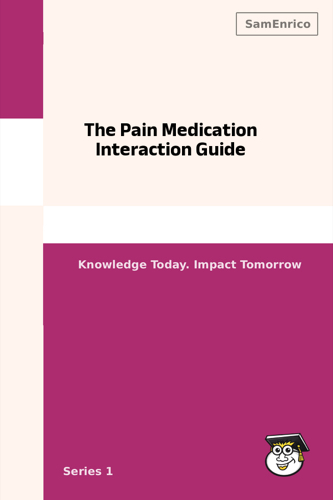
The Pain Medication Interaction Guide
Drug drug interactions in chronic pain regimens.
Drug drug interactions in chronic pain regimens.
Formats
About this book
Free sample
Chapter 1: The Eight-Bottle Visit--The patient sitting across from you is here for “refills.” She is 62 years old, has chronic low back pain, fibromyalgia, and osteoarthritis of both knees. She is pleasant, slightly overweight, and moves slowly when she stands to shake your hand. Her electronic health record shows a problem list of fifteen diagnoses, four active opioid prescriptions, and a note from last month stating “pain well controlled.” She hands you a plastic grocery bag. Inside are eight orange prescription bottles, three over-the-counter pain relievers, and two supplement bottles she bought online. She does not know what most of them are for.
She takes them because “the other doctors said to.”This is the eight-bottle visit. It happens in primary care clinics, pain management centers, and rheumatology offices every day. And it is the single most dangerous moment in chronic pain medicine—not because the patient is difficult, not because her pain is untreatable, but because no one has ever stopped to ask the question that will save her life: What happens when all eight of these drugs are taken together?The answer, more often than clinicians want to admit, is harm. Not the intended harm of disease, but the iatrogenic harm of medicines colliding inside a human body that was never designed to process eight simultaneous chemical signals. The average chronic pain patient in the United States now takes between four and seven prescription medications daily.
Among patients seen in academic pain centers, nearly forty percent take six or more. Each additional drug beyond four does not add a linear increase in risk. It adds an exponential one. The mathematics of drug interactions is not addition; it is multiplication. Two drugs have one possible pair.
Three drugs have three pairs. Four drugs have six pairs. Eight drugs have twenty-eight possible interactions, and that is before accounting for over-the-counter products, supplements, and the patient’s own genetic variability in drug metabolism.This chapter is not about any single interaction. It is about the forest before the trees. Before we can understand why a specific combination of oxycodone and gabapentin suppresses respiration more…
This is the end of the free sample. Get the eBook to keep going. Buy now
Contents
- Chapter 1
- Chapter 2
- Chapter 3
- Chapter 4
- Chapter 5
- Chapter 6
- Chapter 7
- Chapter 8
- Chapter 9
- Chapter 10
- Chapter 11
- Chapter 12
Details
- Author
- Grady Maybelle
- Publisher
- SamEnrico
- Language
- English
- Genre
- Non-Fiction, Health & Wellness, Drug Interactions
- Released
- 2026-06-11
- Pages (approx.)
- 149
- Available as
- eBook, Audiobook

Read better in the ZLOADR app
Your eBooks on your phone or tablet. Sign in with your SamEnrico account and start reading.
More by Grady Maybelle
 Daylight Saving Transition MeditationGrady Maybelle$11.99
 Daily Mindfulness PracticeGrady Maybelle$11.99
 Teresa's Autobiography StudyGrady Maybelle$11.99
 College Campus Loneliness GuideGrady Maybelle$11.99
 The Tide of Destiny: Portugal's Pathfinders to the New WorldGrady Maybelle$11.99
 How to Start a Pharmaceutical Goods Exporter (wholesale) Business (Beginners Guide)Grady Maybelle$11.99
 Analyst (Esports)Grady Maybelle$11.99
 Learn to Play the Tom-tomGrady Maybelle$11.99
 Human Resources MOOC GuideGrady Maybelle$12.99
 Discord Pre Launch CommunityGrady Maybelle$12.99
You may also like
 Hong Kong Handover 1997Dunn Johnnie$11.99
 Zumba For Postnatal Recovery CourseNeal Christian$11.99
 Zumba for BeginnersLadner Nikia$11.99
 YouTube Comment Mining GuideHumes Pandora$12.99
 Worry Box MeditationCarlin Rudy$11.99
 Workplace Stress MeditationNguyen Lynn$11.99
 Workplace Stress and Sleep RepairHawley Ivory$11.99
 Workplace Perfectionism CureDelaney Jeffry$11.99
 Workplace Injustice Anger GuideWallen Isabelle$11.99
 Work Addiction and Burnout LinkGreenwood Ester$11.99
 Women in Yoga and WellnessBeattie Galina$11.99
 Women in Stand Up ComedyChun Evangeline$11.99