
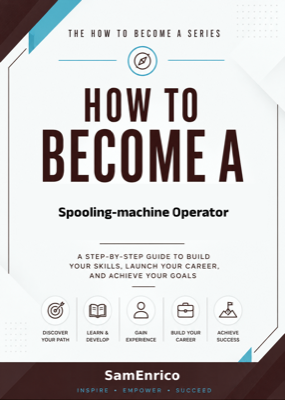
Non-FictionInformativeEducational
How to Become a Spooling-machine Operator Paperback
How to Become a Spooling-machine Operator
How to Become a Spooling-machine Operator
Formats
Free sample
Chapter 1: The Invisible Backbone--–- Every mile of wire in your car, every thread in the shirt on your back, every fiber optic cable carrying this sentence from a server to your screen—all of it was wound onto a spool by someone who mastered a craft most people do not even know exists. Spooling-machine operators are the invisible backbone of modern manufacturing, yet they work in the shadows of more glamorous trades like welding or CNC machining. This invisibility is strange, because without these precision technicians, assembly lines would stop, construction projects would freeze, and the global supply chain would snap like an over-tensioned thread. You have probably walked past spooled products thousands of times without ever considering the human skill that made them usable.This chapter exists to pull back the curtain. You are about to learn what a spooling-machine operator actually does, why the role demands more intelligence and dexterity than most college graduates possess, and how entering this trade can transform your financial future without requiring a single student loan payment.
By the time you finish reading, you will understand not just the mechanics of winding, but the economic and industrial forces that make this job one of the most secure blue-collar careers available today.The Unspoken Definition Let me start with a precise definition that cuts through corporate jargon. A spooling-machine operator is a manufacturing professional who sets up, monitors, adjusts, and maintains machines that wind flexible linear material onto cores, reels, bobbins, or spools according to exact customer specifications. That material can be textile thread, copper wire, aluminum wire, fiber optic filament, plastic tubing, rubber cord, or industrial strapping. The machine pulls material from a larger supply spool—called the pay-off—passes it through tensioners and guides, and winds it onto a smaller or differently configured take-up spool.But definitions are dry. Let me give you an image instead.
Imagine you have a giant roll of wrapping paper that weighs fifty pounds. You need to rewind that entire roll onto a cardboard tube the size of a toilet paper core, without any wrinkles, tears, or uneven edges. You must do this at five hundred feet per minute, while standing on a concrete floor for eight hours, and the finished product must have exactly 2,450 feet on it, plus or minus less than one percent. Now imagine the material is not forgiving gift wrap but brittle copper wire that stretches permanently if you pull too hard. Or glass fiber thinner than a human hair that shatters if you bend it too sharply.
Or nylon thread that builds up static electricity and clings to every surface. That is spooling. That is the invisible skill.The operator’s job breaks down into five core functions, and you will master each one as you progress through this book. First, setup: loading the supply spool, threading the material through up to fifteen different guides and rollers, and programming the machine for target length, speed, tension, and stop position. Second, monitoring: watching the winding process continuously, listening for pitch changes in the motor, and feeling the finished spool’s surface tension with your thumb.
Third, quality control: measuring finished spools with calipers and micrometers, inspecting for cross-overs or nesting, and documenting every defect. Fourth, troubleshooting: diagnosing why a thread keeps breaking or why a spool edge is telescoping, then fixing it without calling maintenance. Fifth, maintenance and safety: cleaning tension discs, lubricating traverse bars, and following lockout/tagout procedures before any repair. A good operator does all five every single shift, often while running two to four machines simultaneously.The Four Industrial Pillars…
This is the end of the free sample. Get the Paperback to keep going. Buy now
About this book
Details
- Author
- Beckham Camelia
- Publisher
- SamEnrico
- Language
- English
- ISBN
- 9781506057804
- Genre
- Non-Fiction, Informative, Educational
- Released
- 2026-05-04
- Pages (approx.)
- 128
- Available as
- eBook, Paperback, Audiobook

Read better in the ZLOADR app
Your eBooks on your phone or tablet. Sign in with your SamEnrico account and start reading.
More by Beckham Camelia
 TM For Caregivers Burnout GuideBeckham Camelia$11.99
 The Joy of RoutineBeckham Camelia$11.99
 Utility Shutoff SeasonsBeckham Camelia$11.99
 Self Esteem for Partners in RecoveryBeckham Camelia$11.99
 EQ for First RespondersBeckham Camelia$11.99
 The Klondike Code: How a Forgotten Gold Rush Math Formula Made MillionsBeckham Camelia$11.99
 Ads ManagerBeckham Camelia$11.99
 Understanding Myelofibrosis-osteosclerosisBeckham Camelia$17.99
 Financial Statement Formula WorkbookBeckham Camelia$12.99
 Micron SWOT GuideBeckham Camelia$12.99
You may also like
 Hong Kong Handover 1997Dunn Johnnie$11.99
 Zumba For Postnatal Recovery CourseNeal Christian$11.99
 Zumba for BeginnersLadner Nikia$11.99
 YouTube Comment Mining GuideHumes Pandora$12.99
 Worry Box MeditationCarlin Rudy$11.99
 Workplace Stress MeditationNguyen Lynn$11.99
 Workplace Stress and Sleep RepairHawley Ivory$11.99
 Workplace Perfectionism CureDelaney Jeffry$11.99
 Workplace Injustice Anger GuideWallen Isabelle$11.99
 Work Addiction and Burnout LinkGreenwood Ester$11.99
 Women in Yoga and WellnessBeattie Galina$11.99
 Women in Stand Up ComedyChun Evangeline$11.99