
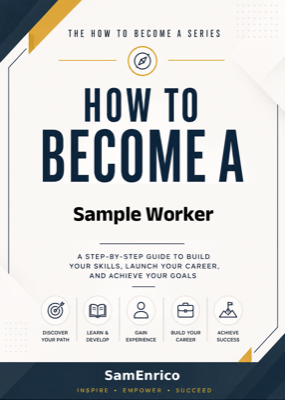
How to Become a Sample Worker eBook
How to Become a Sample Worker
How to Become a Sample Worker
Formats
Free sample
Chapter 1: The Invisible Architect...--The first time a sewing needle broke on an industrial machine, I was twenty-two years old, working in a sample room that smelled of fabric dust and coffee, and I had just ruined a $400 piece of Italian wool. The needle shattered at 4,000 stitches per minute, the machine seized, and the fabric tore from the needle plate to the selvage. My supervisor, a woman named Rosa who had been making samples for thirty years, walked over, looked at the damage, and said something I have never forgotten: "Now you know what the job really is. It is not sewing. It is building the first one.
And the first one always fights back."That is the difference between a sample maker and everyone else who works with fabric. A production stitcher sews the five hundredth unit, following a rhythm that has been perfected by someone else. A home hobbyist sews for pleasure, with no deadline and no one waiting. But a sample maker builds the very first version of a new design, with no instructions, no proven techniques, and no guarantee that the pattern will even fit the body. You are not following a path.
You are blazing one. And every mistake you make is a mistake that five thousand future garments would have repeated if you had not caught it first.This book is not a sewing manual. There are hundreds of those, and many of them are excellent. This book is a career blueprint for becoming the person that designers, production managers, and brand owners call when they have an idea that needs to become real. It is for the sewer who is tired of following patterns and wants to create them.
It is for the fashion graduate who can sketch beautiful garments but has no idea how to make them stand up on a body. It is for the factory worker who knows they can do more than run the same seam eight hours a day. And it is for the entrepreneur who wants to start a clothing line but cannot afford to hire a sample maker, so they must become one.Before we go any further, we need to clear up a fundamental confusion. The term "sample maker" means different things in different industries, and if you search for jobs or training under this title without understanding the distinctions, you will waste weeks of your life. In the fashion and apparel industry, which is the focus of this entire book, a sample maker is the skilled craftsperson who sews the first physical version of a designer's sketch, working from a technical package that specifies measurements, materials, and construction methods.
In the medical device industry, a sample maker might prepare tissue samples for pathology. In the food industry, a sample maker might blend ingredients for a new product's first test batch. In aerospace, a sample maker might machine the first prototype of a bracket. All of these are valid careers, but they require completely different skills, tools, and training. This book is about fashion sample making because it is the most accessible entry point, the most portable skill set, and the career path with the clearest progression from beginner to master.So what exactly does a fashion sample maker do?
Let me give you a concrete answer. A designer hands you a sketch, a tech pack, and a bundle of fabric. The sketch shows what the garment should look like. The tech pack tells you the measurements and construction details. The fabric is what you have to work with.
Your job is to produce a finished, wearable, correctly fitting garment that matches the sketch, meets the measurements, and can be reproduced by a factory five thousand times. You will cut the fabric, sew the seams, set the zippers, attach the buttons, press the garment, and then stand in a fitting room while the designer points at every flaw. Then you will go back to your machine, rip out the seams that did not work, recut the pieces that were wrong, sew it again, press it again, and bring it back to the fitting room. You will do this anywhere from two to eight times per sample, depending on the complexity of the design and the pickiness of the designer. Then, when the sample is finally approved, you will hand it to a factory, and the factory will copy your sample exactly to make thousands of units.
If you made a mistake that you did not catch, every single unit will have that same mistake. That weight of responsibility is what separates sample makers from everyone else.Let me tell you about the three types of people who think they want to be sample makers, and why only one of them succeeds.The first type is the hobbyist. She has been sewing since she was twelve. She made her own prom dress, her Halloween costumes, and curtains for her entire apartment. She can follow a commercial pattern from Simplicity or Mc Call's with her eyes closed.
She thinks sample making is just sewing for money. She is wrong. Commercial patterns are designed to be foolproof. They have been tested, graded, and rewritten based on thousands of home sewers making mistakes. The seam allowances are printed on the pattern pieces.
The notches match perfectly. The instructions tell you exactly which piece to sew to which piece in which order. A sample maker gets none of that. The tech pack might have missing measurements. The pattern might have been drafted by a designer who does not understand how fabric behaves.
The notches might not line up because the pattern was digitized incorrectly. The hobbyist who cannot solve problems without instructions will fail within the first month.The second type is the production stitcher. He has worked in a factory for five years. He can sew a single-needle lockstitch at forty stitches per inch. He can set a sleeve in eighteen seconds.
He can topstitch a mile of denim without veering an eighth of an inch. He thinks sample making is just the first step before production. He is also wrong. A production stitcher repeats the same operation hundreds of times per day, on the same fabric, with the same thread, on the same machine, with the tension already set by someone else. The pattern pieces come to him pre-cut, pre-marked, and pre-sorted.
His job is speed and consistency. A sample maker's job is problem-solving and adaptation. The production stitcher who cannot think beyond the next seam will struggle when the pattern does not work, the fabric is unfamiliar, and the designer is watching.The third type is the problem-solver. She might have come from sewing, or from pattern drafting, or from costume design, or from a completely different field like engineering or carpentry. She does not care about following instructions perfectly.
She cares about understanding why a garment works or fails. When a seam puckers, she does not just re-sew it. She asks: was the tension wrong? Was the seam allowance inconsistent? Was the fabric cut off-grain?
Was the pattern designed with the wrong ease? She can look at a sketch and anticipate where the fitting problems will…
This is the end of the free sample. Get the eBook to keep going. Buy now
About this book
Details
- Author
- Haller Sherita
- Publisher
- SamEnrico
- Language
- English
- ISBN
- 9781506048963
- Genre
- Non-Fiction, Informative, Educational
- Released
- 2026-04-25
- Pages (approx.)
- 128
- Available as
- eBook, Paperback, Audiobook

Read better in the ZLOADR app
Your eBooks on your phone or tablet. Sign in with your SamEnrico account and start reading.
More by Haller Sherita
 Creative Imposter Syndrome FixHaller Sherita$11.99
 Contract Abstraction Accuracy MetricsHaller Sherita$11.99
 The Ninety Five Theses ImpactHaller Sherita$11.99
 Nigeria NDE Grant ApplicationHaller Sherita$11.99
 Back Pain RelaxationHaller Sherita$11.99
 Anti Diarrheal MedicationsHaller Sherita$11.99
 Moon Lodge Spiritual LeadershipHaller Sherita$11.99
 Rewiring Adoption Search FearHaller Sherita$11.99
 Listening Without AdvisingHaller Sherita$11.99
 The Day the Sky Turned Yellow: The Great London Smog of 1952Haller Sherita$11.99
 The Habsburgs' Golden Age: Court, Culture, and ConquestHaller Sherita$11.99
 The Celestial Codebreakers of Timbuktu: Africa's Forgotten MathematiciansHaller Sherita$11.99