
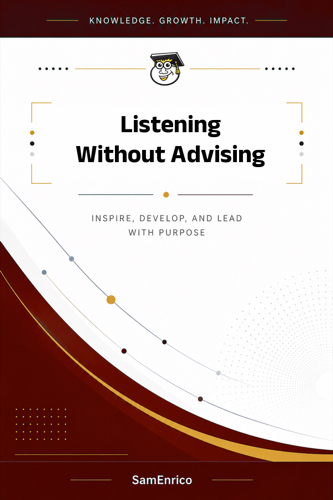
Non-FictionSelf-HelpNon-Advising
Listening Without Advising
Resists problem-solving when the speaker just want
Resists problem-solving when the speaker just wants to vent.
Formats
About this book
Free sample
Chapter 1: The Fixer’s Fallacy--It begins, as it always does, with good intentions.You are standing in your kitchen. The dishes from dinner are still in the sink. Your partner walks through the door, drops their bag on the floor with a thud that sounds heavier than the bag itself, and says five words: “I can’t believe what happened today.”Before those five words have fully landed—before you know who said what, before you understand the context, before you have even heard the ending of the first sentence—your mouth opens. And out comes a solution.“Did you talk to your manager about it?”“You should send an email.”“Why don’t you just take a day off?”You mean well. You genuinely want to help.
You would never intentionally hurt this person. And yet, something shifts in the room. Your partner’s shoulders, which were already slumped, slump further. Their eyes, which were looking to you for connection, drop to the floor. They mutter “never mind” and walk toward the bedroom.
You are left standing in the kitchen, dishwater cooling on your hands, wondering what just happened.You were trying to help. So why does it feel like you made everything worse?This is the Fixer’s Fallacy. And until you understand it, you will keep walking into this exact kitchen scene for the rest of your life, wondering why your good intentions keep backfiring.The Biology of Broken Fixing To understand why we fix when we should listen, we have to go back about two hundred thousand years. The human brain evolved in an environment where threats were immediate and physical. A rustle in the grass could be a predator.
A change in the weather could mean starvation. The brain that survived was the brain that acted quickly—that identified a problem, generated a solution, and executed it before the predator struck.This is the origin of what psychologists call the problem-solving imperative. When we perceive a problem, our brain releases a small amount of cortisol, the stress hormone. That cortisol creates a feeling of discomfort. When we…
This is the end of the free sample. Get the eBook to keep going. Buy now
Contents
- Chapter 1
- Chapter 2
- Chapter 3
- Chapter 4
- Chapter 5
- Chapter 6
- Chapter 7
- Chapter 8
- Chapter 9
- Chapter 10
- Chapter 11
- Chapter 12
Details
- Author
- Haller Sherita
- Publisher
- SamEnrico
- Language
- English
- Genre
- Non-Fiction, Self-Help, Non-Advising
- Released
- 2026-06-06
- Pages (approx.)
- 150
- Available as
- eBook, Audiobook

Read better in the ZLOADR app
Your eBooks on your phone or tablet. Sign in with your SamEnrico account and start reading.
More by Haller Sherita
 Creative Imposter Syndrome FixHaller Sherita$11.99
 Contract Abstraction Accuracy MetricsHaller Sherita$11.99
 The Ninety Five Theses ImpactHaller Sherita$11.99
 Nigeria NDE Grant ApplicationHaller Sherita$11.99
 Back Pain RelaxationHaller Sherita$11.99
 Anti Diarrheal MedicationsHaller Sherita$11.99
 Moon Lodge Spiritual LeadershipHaller Sherita$11.99
 Rewiring Adoption Search FearHaller Sherita$11.99
 The Day the Sky Turned Yellow: The Great London Smog of 1952Haller Sherita$11.99
 The Habsburgs' Golden Age: Court, Culture, and ConquestHaller Sherita$11.99
 The Celestial Codebreakers of Timbuktu: Africa's Forgotten MathematiciansHaller Sherita$11.99
 Brand Deal Outreach ScriptHaller Sherita$12.99
You may also like
 Hong Kong Handover 1997Dunn Johnnie$11.99
 Zumba For Postnatal Recovery CourseNeal Christian$11.99
 Zumba for BeginnersLadner Nikia$11.99
 YouTube Comment Mining GuideHumes Pandora$12.99
 Worry Box MeditationCarlin Rudy$11.99
 Workplace Stress MeditationNguyen Lynn$11.99
 Workplace Stress and Sleep RepairHawley Ivory$11.99
 Workplace Perfectionism CureDelaney Jeffry$11.99
 Workplace Injustice Anger GuideWallen Isabelle$11.99
 Work Addiction and Burnout LinkGreenwood Ester$11.99
 Women in Yoga and WellnessBeattie Galina$11.99
 Women in Stand Up ComedyChun Evangeline$11.99