
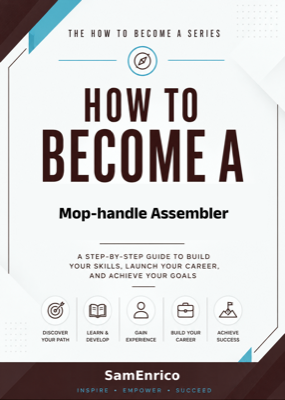
How to Become a Mop-handle Assembler Paperback
How to Become a Mop-handle Assembler
by Slocum Jona
How to Become a Mop-handle Assembler
Formats
Free sample
Chapter 1: The Plastic Graveyard--–- The first thing you need to understand about becoming a mop-handle assembler is that you will spend your career surrounded by failure. Not your own failure—though there will be plenty of that in the beginning—but the failure of things that should have held together and did not. Every stripped screw, every cracked plastic boss, every handle that separates from its head mid-sweep is a small tragedy of physics ignored. And somewhere, in a warehouse or a returns processing center or a landfill the size of a small country, there is a pile of these tragedies. I call it the Plastic Graveyard.I did not start my career intending to become an expert in broken things.
Like most people, I assumed that a mop was a mop. You buy it, you wet it, you push it around, and eventually it breaks. The breaking part seemed like an act of God or poor manufacturing karma—nothing to do with me. Then I spent three months working the returns desk at a national hardware retailer, and I saw the truth. They came back by the pallet: mops with handles sheared clean off at the neck, mops with screw heads buried so deep in cracked plastic that you could not remove them without a drill, mops that had never been used at all but fell apart in the box.
The common thread was not the brand or the price point. The common thread was assembly. Someone—a human being, usually paid by the piece—had connected the parts incorrectly, or with the wrong force, or without understanding what the parts were asking for. And that someone had probably never been told there was a right way and a wrong way. They had simply been handed a screwdriver and a bin of parts and told to go fast.This book is the opposite of that.
This chapter is where we stop assuming that a mop is simple. A mop handle under load is a cantilever beam. A plastic socket under screw tension is a pressure vessel. A snap-fit connection that feels solid but is misaligned by two millimeters is a failure waiting for a date on the calendar. If you want to become a mop-handle assembler—not a button-pusher, not a parts-jammer, but a true assembler who understands the physics of what you hold—you must first understand why things break.
Not in a theoretical, textbook way. In a visceral, I-have-held-the-broken-pieces-in-my-hands way.The Transition Zone: Where Handles Go to Die Take any mop that has ever failed catastrophically—the kind where the user was pushing hard to clean a stubborn spot and suddenly the handle snapped, sending them stumbling forward with a useless stub in their hands. Look at the fracture surface. In ninety percent of cases, the break did not happen in the middle of the handle. It did not happen at the very tip.
It happened exactly at the point where the handle entered the plastic socket. This is the transition zone, and it is the most dangerous place in any assembled tool.Why does the transition zone fail? Two reasons, one obvious and one hidden. The obvious reason is that the handle material changes geometry at that point. A round handle inserted into a socket creates a natural stress concentration—a point where the forces of bending, pushing, and twisting all converge.
The hidden reason is that the assembler almost certainly created microscopic damage during assembly that no one ever saw. A scratch on the handle surface, a barb that did not fully seat, a…
This is the end of the free sample. Get the Paperback to keep going. Buy now
About this book
Details
- Author
- Slocum Jona
- Publisher
- SamEnrico
- Language
- English
- ISBN
- 9781505746471
- Genre
- Non-Fiction, Informative, Educational
- Released
- 2026-04-25
- Pages (approx.)
- 149
- Available as
- eBook, Paperback, Audiobook

Read better in the ZLOADR app
Your eBooks on your phone or tablet. Sign in with your SamEnrico account and start reading.
More by Slocum Jona
 Shift Work Exercise Timing GuideSlocum Jona$11.99
 Self Esteem for Introverts WorkbookSlocum Jona$11.99
 Leading Hybrid Operations TeamsSlocum Jona$11.99
 Decluttering for Downsize ProfitSlocum Jona$11.99
 Gaslighting Recovery Self EsteemSlocum Jona$11.99
 The Sapphire Serpent: A Heist of Myth and MayhemSlocum Jona$11.99
 The Great London Zoo Panic of 1962: When Lions Roamed Regent’s ParkSlocum Jona$11.99
 Remote LinkedIn CoachSlocum Jona$12.99
 Mentoring Non Verbal DifferencesSlocum Jona$12.99
 Machine Learning Software EngineerSlocum Jona$11.99
 Understanding Erythrokeratodermia AtaxiaSlocum Jona$17.99