
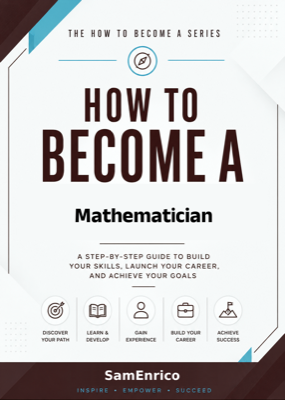
How to Become a Mathematician eBook
How to Become a Mathematician
by Joyner Jere
How to Become a Mathematician
Formats
Free sample
Chapter 1: Beyond Lone Geniuses– Mathematicians are often portrayed as solitary figures, scribbling indecipherable symbols by candlelight, struck by sudden genius during moments of isolation. This image, while romantic, is largely fiction. The reality is far more interesting: mathematicians are pattern-seekers, logical architects, and frequently, collaborative team members who build on centuries of collective insight. If you picked up this book, you likely carry some version of the lone-genius myth in your head—perhaps without even realizing it. Let us dismantle that myth together in the first few pages, because understanding what mathematicians actually do is the first and most essential step toward becoming one.The Myth of the Lonely Calculator Walk into any bookstore, and you will find popular accounts of mathematicians as eccentric hermits: John Nash seeing conspiracies in newspaper clippings, Grigori Perelman refusing a million-dollar prize and retreating to a Russian forest, Alan Turing single-handedly breaking the Enigma code.
These stories make for compelling biographies, but they distort the everyday reality of mathematical work. The vast majority of mathematicians do not work in isolation. They attend seminars, co-author papers, argue over coffee about topological invariants, and run computer experiments with colleagues across continents.Consider the landmark proof of Fermat’s Last Theorem by Andrew Wiles. Popular accounts often present Wiles as a lone genius working in secrecy for seven years. But this narrative omits the crucial role of his former student Richard Taylor, who helped fix a fatal flaw in the original argument.
It also ignores centuries of prior work by mathematicians like Sophie Germain, Ernst Kummer, and Yves Hellegouarch, without whom Wiles could not have begun. Even the most celebrated “solitary” achievements rest on enormous collaborative foundations.What do mathematicians actually spend their time doing? Not primarily calculation, contrary to common belief. Professional mathematicians rarely compute long arithmetic by hand; they delegate that to computers or students. Instead, their core activities include:Reading and understanding proofs written by others, often from different subfields Asking precise questions about why certain patterns hold or fail Constructing counterexamples to test the boundaries of conjectures Writing rigorous arguments that leave no logical gaps Teaching and explaining concepts to students, colleagues, and the public Programming to explore numerical patterns or simulate mathematical models If you are drawn to mathematics because you love solving puzzles, constructing logical arguments, or finding hidden structure in seemingly chaotic systems, you already share common ground with working mathematicians.
You do not need to be the fastest calculator in the room, and you do not need to work alone.Intrinsic and Extrinsic Motivation: Why It Matters Before investing years of your life in mastering mathematics, it is worth examining why you want to do it. Motivation research distinguishes between two types that interact in complex ways.Intrinsic motivation comes from within: the sheer pleasure of understanding something new, the aesthetic satisfaction of an elegant proof, the intellectual thrill of solving a problem that has resisted you for weeks. Intrinsic motivation is the engine that sustains mathematicians through dry periods, rejected papers, and failed conjectures. When you see a mathematician’s eyes light up while explaining a beautiful result, you are witnessing intrinsic motivation in action.Extrinsic motivation comes from external rewards: salary, job titles, publications, prizes, tenure, or the admiration of peers. Extrinsic motivators are real and powerful.
They pay rent, open doors to research positions, and provide objective validation of your work. However, they are fragile. Relying solely on extrinsic rewards leads to burnout when the rewards stop coming—and in mathematics, they often stop for long stretches.The most resilient mathematicians cultivate both. They pursue interesting problems because the problems fascinate them, while also strategically attending to the career structures that reward that fascination. A healthy mathematical life balances the intrinsic joy of discovery with the extrinsic realities of professional advancement.Consider the mathematician who works for years on a difficult problem, only to see another researcher publish the solution first.
If her motivation was purely extrinsic—the prize, the fame, the citation count—she might despair. If her motivation was primarily intrinsic—the love of the chase, the satisfaction of understanding the problem deeply—she can still take pride in her parallel journey and pivot to the next interesting question.Take a few minutes to reflect honestly: what keeps you coming back to mathematics? Is it the “aha” moment when a proof clicks? The desire for a stable, well-paying career? The abstract beauty of pure structures?
The feeling of competence and mastery? There is no wrong answer, but knowing yours will guide every subsequent decision in this book.Careers Beyond Academia: Where Mathematicians Really Work If you ask someone to name a mathematician’s job, they will likely say “university professor” or “high school teacher.” These are common paths, but they represent only a fraction of the opportunities. The twenty-first century has created an explosion of careers that reward deep mathematical training outside traditional academic settings.Data Science and Machine Learning Data scientists extract insights from massive, messy datasets. At the core of this field lie linear algebra (for dimensionality reduction), probability theory (for modeling uncertainty), optimization (for fitting models), and statistics (for inference). A mathematician trained in abstract structures and rigorous proof adapts naturally to data science, though you will need to supplement your toolkit with programming (especially Python and SQL).
Companies like Google, Netflix, and Palantir employ mathematicians as data scientists, as do hospitals, logistics firms, and political campaigns.Cryptography Cryptography is the mathematics of secure communication. It draws heavily on number theory (modular arithmetic, prime factorization, discrete logarithms), abstract algebra (finite fields, elliptic curves), and complexity theory. The cryptographic systems that protect online banking, messaging apps, and government secrets were designed and analyzed by mathematicians. The National Security Agency, academic research groups, and technology companies like IBM and Apple actively recruit mathematicians for cryptographic roles. Unlike some other applied fields, cryptography requires genuine mathematical depth—not just programming skill.Quantitative Finance Quantitative analysts, or “quants,” use stochastic calculus, partial differential equations, probability, and optimization to price financial derivatives, manage risk, and discover trading signals.
Investment banks (Goldman Sachs, Morgan Stanley), hedge funds (Renaissance Technologies, Two Sigma), and proprietary trading firms hire mathematicians with strong backgrounds in probability and analysis. The pay can be exceptionally high, but the problems are hard, the hours can be long, and the work carries ethical considerations about market impact and wealth inequality.Artificial Intelligence and Operations Research AI research increasingly relies on mathematical foundations: optimization (gradient descent, convex optimization), linear algebra (neural network architectures), probability (Bayesian inference, reinforcement learning), and information theory (entropy, mutual information). Operations researchers optimize supply chains, airline scheduling, and logistics using linear programming, integer programming, and network flow theory. Both fields reward mathematicians who understand the underlying theory rather than just calling pre-built libraries.Actuarial Science Actuaries assess long-term financial risks for insurance companies and pension funds. The work involves probability, statistics, financial mathematics, and specialized exams leading to professional credentials.
Actuarial roles are stable, well-compensated, and require deep mathematical fluency without requiring a Ph.D.Government and National Laboratories Institutions like the National Institute of Standards and Technology (NIST), Los Alamos National Laboratory, and the Institute for Defense Analyses employ mathematicians to work on…
This is the end of the free sample. Get the eBook to keep going. Buy now
About this book
Details
- Author
- Joyner Jere
- Publisher
- SamEnrico
- Language
- English
- ISBN
- 9781505772661
- Genre
- Non-Fiction, Informative, Educational
- Released
- 2026-05-02
- Pages (approx.)
- 132
- Available as
- eBook, Paperback, Audiobook

Read better in the ZLOADR app
Your eBooks on your phone or tablet. Sign in with your SamEnrico account and start reading.
More by Joyner Jere
 The Career Change Difficult TalkJoyner Jere$11.99
 Parenting Coach Anger GuideJoyner Jere$11.99
 The Leptin Resistance FixJoyner Jere$11.99
 Carson Bird Migration StudiesJoyner Jere$11.99
 Bipolar And Psychosis GuideJoyner Jere$11.99
 Improv for Remote MeetingsJoyner Jere$11.99
 Gratitude for FutureJoyner Jere$11.99
 Public Speaking for Funeral EulogiesJoyner Jere$11.99
 The Gold Train Heist: Argentina's Great Coin Robbery of 1854Joyner Jere$11.99
 The Silk and Gold Dynasty: The Fashion Revolution of the Kingdom of KongoJoyner Jere$11.99
 Bison: Plains & Woodland BisonJoyner Jere$11.99
 A Collector's Handbook to the Talbot 105 SpeedJoyner Jere$11.99