
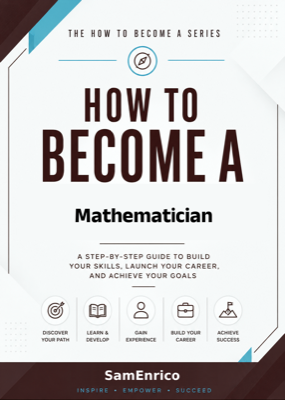
How to Become a Mathematician Audiobook
How to Become a Mathematician
by Joyner Jere
How to Become a Mathematician
Formats
Free sample
Chapter 1: Beyond Lone Geniuses– Mathematicians are often portrayed as solitary figures, scribbling indecipherable symbols by candlelight, struck by sudden genius during moments of isolation. This image, while romantic, is largely fiction. The reality is far more interesting: mathematicians are pattern-seekers, logical architects, and frequently, collaborative team members who build on centuries of collective insight. If you picked up this book, you likely carry some version of the lone-genius myth in your head—perhaps without even realizing it. Let us dismantle that myth together in the first few pages, because understanding what mathematicians actually do is the first and most essential step toward becoming one.The Myth of the Lonely Calculator Walk into any bookstore, and you will find popular accounts of mathematicians as eccentric hermits: John Nash seeing conspiracies in newspaper clippings, Grigori Perelman refusing a million-dollar prize and retreating to a Russian forest, Alan Turing single-handedly breaking the Enigma code.
These stories make for compelling biographies, but they distort the everyday reality of mathematical work. The vast majority of mathematicians do not work in isolation. They attend seminars, co-author papers, argue over coffee about topological invariants, and run computer experiments with colleagues across continents.Consider the landmark proof of Fermat’s Last Theorem by Andrew Wiles. Popular accounts often present Wiles as a lone genius working in secrecy for seven years. But this narrative omits the crucial role of his former student Richard Taylor, who helped fix a fatal flaw in the original argument.
It also ignores centuries of prior work by mathematicians like Sophie Germain, Ernst Kummer, and Yves Hellegouarch, without whom Wiles could not have begun. Even the most celebrated “solitary” achievements rest on enormous collaborative foundations.What do mathematicians actually spend their time doing? Not primarily calculation, contrary to common belief. Professional mathematicians rarely compute long arithmetic by hand; they delegate that to computers or students. Instead, their core activities include:Reading and understanding proofs written by others, often from different subfields Asking precise questions about why certain patterns hold or fail Constructing counterexamples to test the boundaries of conjectures Writing rigorous arguments that leave no logical gaps Teaching and explaining concepts to students, colleagues, and the public Programming to explore numerical patterns or simulate mathematical models If you are drawn to mathematics because you love solving puzzles, constructing logical arguments, or finding hidden structure in seemingly chaotic systems, you already share common ground with working mathematicians.…
This is the end of the free sample. Get the Audiobook to keep going. Buy now
About this book
Details
- Author
- Joyner Jere
- Publisher
- SamEnrico
- Language
- English
- ISBN
- 9781505772661
- Genre
- Non-Fiction, Informative, Educational
- Released
- 2026-05-02
- Pages (approx.)
- 132
- Available as
- eBook, Paperback, Audiobook

Listen in the VoxFlicks app
Audiobooks and audio dramas wherever you go. Sign in with your SamEnrico account and press play.
More by Joyner Jere
 The Career Change Difficult TalkJoyner Jere$11.99
 Parenting Coach Anger GuideJoyner Jere$11.99
 The Leptin Resistance FixJoyner Jere$11.99
 Carson Bird Migration StudiesJoyner Jere$11.99
 Bipolar And Psychosis GuideJoyner Jere$11.99
 Improv for Remote MeetingsJoyner Jere$11.99
 Gratitude for FutureJoyner Jere$11.99
 Public Speaking for Funeral EulogiesJoyner Jere$11.99
 The Gold Train Heist: Argentina's Great Coin Robbery of 1854Joyner Jere$11.99
 The Silk and Gold Dynasty: The Fashion Revolution of the Kingdom of KongoJoyner Jere$11.99
 Bison: Plains & Woodland BisonJoyner Jere$11.99
 A Collector's Handbook to the Talbot 105 SpeedJoyner Jere$11.99