
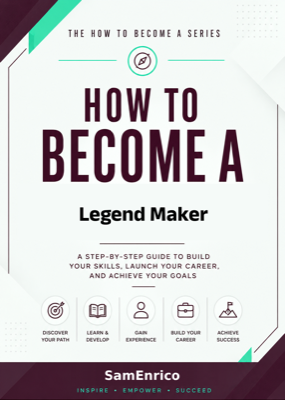
How to Become a Legend Maker Paperback
How to Become a Legend Maker
How to Become a Legend Maker
Formats
Free sample
Chapter 1: The Mirror’s Edge...--– Before you can make a single legend, you must first survive an encounter with the person who has ruined more potential than any other. That person is staring back at you from the nearest reflective surface.Let me tell you about David.David was a brilliant software engineer who had risen to CTO of a mid-sized tech company by age thirty-four. He was kind, driven, and genuinely loved mentoring his junior developers. Every Friday afternoon, he held “office hours” where anyone could bring problems. His calendar was always full.
His team adored him. And when David left the company after five years, not a single person he had mentored ever became a team lead. Not one. Most of them plateaued. Several quit the industry entirely.David was not a bad person.
He was a bad Legend Maker. Worse, he never knew it.When I interviewed David’s former protégés, a pattern emerged. They all said the same thing in different words: “David always had the answer. I never had to figure anything out myself.” He was a crutch disguised as a coach. He gave fish every day and called it teaching.This chapter is about ensuring you are not David.
It is a mirror, not a medal. And the reflection may be uncomfortable.The Uncomfortable Truth About Mentorship Here is a sentence that will anger some readers: Most mentors make their protégés weaker.I do not mean intentionally. I mean structurally. The default mode of human assistance is to solve problems. When someone comes to us with a struggle, our evolutionary wiring screams, “Fix it.
Relieve the pain. Restore equilibrium.” This is why medical doctors are respected and why firefighter heros exist. But in the realm of talent development, the fixer is not a hero. The fixer is a thief.Every time you hand a protégé an answer, you steal from them the opportunity to build a mental model. Every time you jump in before they have struggled, you train them to wait for you.
Every time you feel proud of how quickly you solved their problem, you are celebrating your own ego at the expense of their independence.The research is clear. A 2018 study published in the Academy of Management Learning & Education followed 247 formal mentoring relationships over two years. The protégés of “highly directive” mentors (those who frequently gave solutions) reported higher satisfaction in the first three months but lower competence, lower promotion rates, and higher dependency scores at twelve and twenty-four months. The protégés of “highly enabling” mentors (those who asked questions and resisted giving answers) reported initial frustration but significantly higher outcomes across every long-term metric.In short: If you make yourself essential, you have failed. If you make yourself unnecessary, you have succeeded.This is the first law of Legend Making: Your value is inversely proportional to your indispensability.But here is the trap.
Your ego will fight this law. Your ego wants to be needed. Your ego wants the late-night phone call, the desperate email, the tearful “I could not have done it without you.” Your ego wants to be the hero of someone else’s story. The Legend Maker, by contrast, wants to be the invisible architect. The one whose name never appears in the headline but whose fingerprints are on every achievement.So before we talk about how to spot talent, build belief, or design pressure tests, we must talk about the person who will sabotage all of it: you.The Mirror Test Defined The Mirror Test is a simple but…
This is the end of the free sample. Get the Paperback to keep going. Buy now
About this book
Details
- Author
- Ferraro Reynalda
- Publisher
- SamEnrico
- Language
- English
- ISBN
- 9781505759501
- Genre
- Non-Fiction, Informative, Educational
- Released
- 2026-05-02
- Pages (approx.)
- 138
- Available as
- eBook, Paperback, Audiobook

Read better in the ZLOADR app
Your eBooks on your phone or tablet. Sign in with your SamEnrico account and start reading.
More by Ferraro Reynalda
 The Self Metta WorkbookFerraro Reynalda$11.99
 Sibling Loss Infant Death WorkbookFerraro Reynalda$11.99
 Stress and Sweating DisordersFerraro Reynalda$11.99
 The Parental Neglect ForgivenessFerraro Reynalda$11.99
 Anger Management for Scrum MastersFerraro Reynalda$11.99
 The Desert’s Crucible: Rommel’s Mirage and the Collapse of Axis AfricaFerraro Reynalda$11.99
 Persimmon HarvestingFerraro Reynalda$11.99
 SA Asset Finance Credit GuideFerraro Reynalda$12.99
 Week Four First Sales GuideFerraro Reynalda$12.99
 Understanding Sapho SyndromeFerraro Reynalda$17.99