
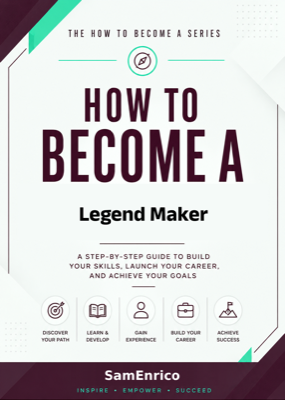
How to Become a Legend Maker eBook
How to Become a Legend Maker
How to Become a Legend Maker
Formats
Free sample
Chapter 1: The Mirror’s Edge...--– Before you can make a single legend, you must first survive an encounter with the person who has ruined more potential than any other. That person is staring back at you from the nearest reflective surface.Let me tell you about David.David was a brilliant software engineer who had risen to CTO of a mid-sized tech company by age thirty-four. He was kind, driven, and genuinely loved mentoring his junior developers. Every Friday afternoon, he held “office hours” where anyone could bring problems. His calendar was always full.
His team adored him. And when David left the company after five years, not a single person he had mentored ever became a team lead. Not one. Most of them plateaued. Several quit the industry entirely.David was not a bad person.
He was a bad Legend Maker. Worse, he never knew it.When I interviewed David’s former protégés, a pattern emerged. They all said the same thing in different words: “David always had the answer. I never had to figure anything out myself.” He was a crutch disguised as a coach. He gave fish every day and called it teaching.This chapter is about ensuring you are not David.
It is a mirror, not a medal. And the reflection may be uncomfortable.The Uncomfortable Truth About Mentorship Here is a sentence that will anger some readers: Most mentors make their protégés weaker.I do not mean intentionally. I mean structurally. The default mode of human assistance is to solve problems. When someone comes to us with a struggle, our evolutionary wiring screams, “Fix it.
Relieve the pain. Restore equilibrium.” This is why medical doctors are respected and why firefighter heros exist. But in the realm of talent development, the fixer is not a hero. The fixer is a thief.Every time you hand a protégé an answer, you steal from them the opportunity to build a mental model. Every time you jump in before they have struggled, you train them to wait for you.
Every time you feel proud of how quickly you solved their problem, you are celebrating your own ego at the expense of their independence.The research is clear. A 2018 study published in the Academy of Management Learning & Education followed 247 formal mentoring relationships over two years. The protégés of “highly directive” mentors (those who frequently gave solutions) reported higher satisfaction in the first three months but lower competence, lower promotion rates, and higher dependency scores at twelve and twenty-four months. The protégés of “highly enabling” mentors (those who asked questions and resisted giving answers) reported initial frustration but significantly higher outcomes across every long-term metric.In short: If you make yourself essential, you have failed. If you make yourself unnecessary, you have succeeded.This is the first law of Legend Making: Your value is inversely proportional to your indispensability.But here is the trap.
Your ego will fight this law. Your ego wants to be needed. Your ego wants the late-night phone call, the desperate email, the tearful “I could not have done it without you.” Your ego wants to be the hero of someone else’s story. The Legend Maker, by contrast, wants to be the invisible architect. The one whose name never appears in the headline but whose fingerprints are on every achievement.So before we talk about how to spot talent, build belief, or design pressure tests, we must talk about the person who will sabotage all of it: you.The Mirror Test Defined The Mirror Test is a simple but brutal protocol.
You stand in front of a mirror and ask yourself three questions. You are not allowed to look away until you have answered each one honestly. Most people cannot complete this exercise in under thirty minutes. Some cannot complete it at all.Question One: Do I have a consistent personal practice of discipline that my protégé could observe and copy?Not a practice you intend to start. Not a practice you had in college.
A practice that exists today, this week, this morning. Do you have a routine for your own skill development? Do you have a system for reviewing your own failures? Do you have a visible architecture of self-improvement that someone else could witness and adopt?If the answer is no, you are not ready. You can still read this book.
You can take notes. But you cannot begin the work of making legends until you have built the scaffolding of your own making. Because here is the mechanical reality: Protégés do not listen to what you say. They copy what you do. If you are undisciplined, they will become undisciplined.
If you are anxious, they will absorb your anxiety. If you are a fame-seeker, they will learn to perform for applause rather than for mastery. You are not a transmitter of information. You are a transmitter of patterns.Question Two: Have I transformed my three biggest failures into explicit teaching tools?Everyone has failures. That is not impressive.
What is rare is the ability to articulate those failures as curriculum. Can you tell the story of your worst professional mistake in ninety seconds, with a clear arc (this is what happened, this is what I learned, this is what I do differently now), without self-pity or self-aggrandizement? Can you teach from your scars rather than your medals?Legend Makers do not hide their failures. They weaponize them. A protégé who only sees your successes will feel inadequate.
A protégé who sees how you rebuilt from rubble will feel possible. But this requires that you have actually done the work of processing those failures. Not just surviving them. Processing them.Question Three: Am I willing to become irrelevant to my protégé within twelve months?This is the hardest question. Most people say yes reflexively because it sounds noble.
But watch what they do. They hoard contacts. They insist on being cc’ed on emails. They check in too frequently. They feel a twinge of pain when the protégé stops asking for advice.
The Mirror Test reveals not your stated intentions but your unconscious attachments.If you feel threatened by the idea of a protégé outgrowing you, stop now. This work is not for you. Legend Making is not a career path to fame. It is a discipline of vanishing.Once you have answered these three questions honestly, you have two possible paths forward:Path A (The Accelerated Track): If you answered “yes” to all three questions, or “yes” to at least two with a credible plan to address the third within thirty days, you may proceed directly to Chapter 2. You are ready enough.
Not perfect. Ready enough.Path B (The Preparation Track): If you answered “no” to two or more questions, or if any answer was accompanied by defensiveness, stop here. Do not read Chapter 2. Do not select a protégé. Do not pass go.
Instead, complete the thirty-day Mirror Test Protocol outlined below. This is not punishment. This is preservation. You cannot give what you do not have.The Thirty-Day Mirror Test Protocol For the…
This is the end of the free sample. Get the eBook to keep going. Buy now
About this book
Details
- Author
- Ferraro Reynalda
- Publisher
- SamEnrico
- Language
- English
- ISBN
- 9781505759501
- Genre
- Non-Fiction, Informative, Educational
- Released
- 2026-05-02
- Pages (approx.)
- 138
- Available as
- eBook, Paperback, Audiobook

Read better in the ZLOADR app
Your eBooks on your phone or tablet. Sign in with your SamEnrico account and start reading.
More by Ferraro Reynalda
 The Self Metta WorkbookFerraro Reynalda$11.99
 Sibling Loss Infant Death WorkbookFerraro Reynalda$11.99
 Stress and Sweating DisordersFerraro Reynalda$11.99
 The Parental Neglect ForgivenessFerraro Reynalda$11.99
 Anger Management for Scrum MastersFerraro Reynalda$11.99
 The Desert’s Crucible: Rommel’s Mirage and the Collapse of Axis AfricaFerraro Reynalda$11.99
 Persimmon HarvestingFerraro Reynalda$11.99
 SA Asset Finance Credit GuideFerraro Reynalda$12.99
 Week Four First Sales GuideFerraro Reynalda$12.99
 Understanding Sapho SyndromeFerraro Reynalda$17.99