
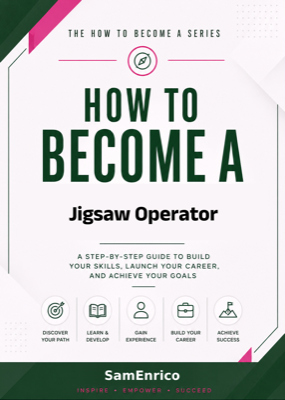
How to Become a Jigsaw Operator
How to Become a Jigsaw Operator
How to Become a Jigsaw Operator
Formats
About this book
Free sample
Chapter 1: The Unseen Blade--– The first time I watched a professional jigsaw operator work, I felt embarrassed. Embarrassed because I had been using the same tool for nearly a decade, and I had no idea what it could actually do. The operator was a woman named Carla, fifty-three years old, with calloused hands and safety glasses fogged from the humidity of a Florida cabinet shop. She was cutting a curved countertop insert for a luxury yacht galley. The material was 1.5-inch-thick solid surface—Corian, dense as stone, expensive as a used car.
She didn't measure. She didn't hesitate. She placed her jigsaw against the edge, pulled the trigger, and moved through the material like a paintbrush through water. The blade turned, dipped, and carved a perfect arc. No chatter.
No burning. No second cut. She set the saw down, wiped the dust off her glasses, and said, "That's the seventh one today. They're all the same." They were. I checked.
Seven pieces, stacked and cut simultaneously, each one a mirror of the last. That moment changed how I thought about tools. It wasn't the saw that impressed me. It was Carla. She had made a 150handheldtoolperformlikea150 handheld tool perform like a 150handheldtoolperformlikea50,000 CNC machine.
She was not a machine operator. She was a craftsperson. And the only thing separating her from every other person holding a jigsaw was knowledge—specific, repeatable, teachable knowledge.This book exists to give you that knowledge. But before we talk about blades, speeds, and career paths, we need to talk about what a jigsaw actually is. Not the dictionary definition.
The real one. The one that explains why this tool has survived for seventy-five years while countless other power tools have been rendered obsolete by lasers, routers, and robots.The Machine That Refuses to Die The portable jigsaw—originally called the "saber saw" when it was introduced by Scintilla (later Bosch) in 1947—was never supposed to last this long. It was a compromise tool, designed for rough construction work, not precision craftsmanship. The earliest models weighed nearly eight pounds, vibrated like a jackhammer, and required a hex…
This is the end of the free sample. Get the eBook to keep going. Buy now
Contents
- Chapter 1
- Chapter 2
- Chapter 3
- Chapter 4
- Chapter 5
- Chapter 6
- Chapter 7
- Chapter 8
- Chapter 9
- Chapter 10
- Chapter 11
- Chapter 12
Details
- Author
- Conley Lawanda
- Publisher
- SamEnrico
- Language
- English
- ISBN
- 9781505748703
- Genre
- Non-Fiction, Informative, Educational
- Released
- 2026-05-02
- Pages (approx.)
- 152
- Available as
- eBook, Paperback, Audiobook

Read better in the ZLOADR app
Your eBooks on your phone or tablet. Sign in with your SamEnrico account and start reading.
More by Conley Lawanda
 John Newcombe The EntertainerConley Lawanda$11.99
 Emotional Binge Eating GuideConley Lawanda$11.99
 Equifax Shareholder LawsuitConley Lawanda$11.99
 EQ Imposter Syndrome GuideConley Lawanda$11.99
 SAS Sniper Medal WinnerConley Lawanda$11.99
 The Asura Conspiracy: Shadows of the MahabharataConley Lawanda$11.99
 Frozen Equations: The Calculus That Conquered the ArcticConley Lawanda$11.99
 Data Management AnalystConley Lawanda$11.99
 Young Professionals Program GuideConley Lawanda$12.99
 Cruise Industry RecoveryConley Lawanda$12.99
 Understanding Gastrointestinal NeoplasmConley Lawanda$17.99