
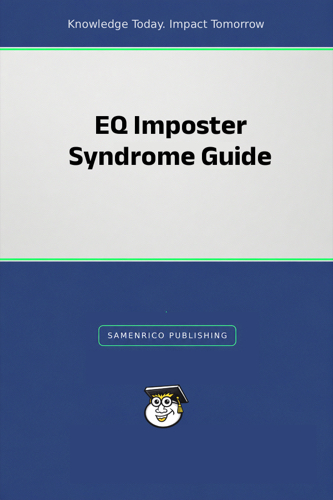
Non-FictionSelf-HelpImposter Syndrome
EQ Imposter Syndrome Guide
Recognize and manage feelings of fraudulence using
Recognize and manage feelings of fraudulence using emotional intelligence strategies.
Formats
About this book
Free sample
Chapter 1: The Fraud Factory--–- You have accomplished something real. A promotion. A degree. A public success. An award.
A moment of genuine recognition from people you respect. And yet, instead of feeling pride, you feel a quiet, creeping dread. Any moment now, someone will discover the truth: you have been faking it. You do not belong. You got lucky.
You tricked them. Any moment now, the floor will open and swallow you whole.If this feeling has a familiar shape, you are not broken. You are not uniquely insecure. You are not an impostor. You are experiencing a predictable, well-documented, and highly treatable psychological pattern known as Imposter Syndrome.
And the fact that you feel this way—especially if you are accomplished, ambitious, and successful—does not mean you are failing. It means you are human.This chapter opens by dismantling the most common misconception about Imposter Syndrome: that it is a rare, shameful secret reserved for the truly incompetent. In truth, an estimated 70 percent of high-achievers experience Imposter Syndrome at some point in their careers. That statistic includes Nobel laureates, Pulitzer Prize winners, Fortune 500 CEOs, celebrated artists, and tenured professors. Maya Angelou once confessed that after writing eleven books, she still worried someone would discover she was a fraud.
Tom Hanks has said that no matter what he accomplishes, a voice follows him around whispering, “They’re going to find me out.” Michelle Obama has admitted that even as First Lady of the United States, she occasionally felt like she did not belong in the rooms where she found herself.These are not insecure people. These are people who have been objectively validated by the highest standards of their fields. And yet, the feeling persists. That is the first thing you need to understand: Imposter Syndrome is not a reflection of your actual competence. It is a reflection of how your brain processes—or more accurately, mismanages—emotional data.The key distinction is between occasional nervousness and chronic Imposter Syndrome.
Occasional nervousness is normal, situational, temporary, and even useful. It is the flutter you feel before a job interview, the…
This is the end of the free sample. Get the eBook to keep going. Buy now
Contents
- Chapter 1
- Chapter 2
- Chapter 3
- Chapter 4
- Chapter 5
- Chapter 6
- Chapter 7
- Chapter 8
- Chapter 9
- Chapter 10
- Chapter 11
- Chapter 12
Details
- Author
- Conley Lawanda
- Publisher
- SamEnrico
- Language
- English
- Genre
- Non-Fiction, Self-Help, Imposter Syndrome
- Released
- 2026-06-07
- Pages (approx.)
- 144
- Available as
- eBook, Audiobook

Read better in the ZLOADR app
Your eBooks on your phone or tablet. Sign in with your SamEnrico account and start reading.
More by Conley Lawanda
 John Newcombe The EntertainerConley Lawanda$11.99
 Emotional Binge Eating GuideConley Lawanda$11.99
 Equifax Shareholder LawsuitConley Lawanda$11.99
 SAS Sniper Medal WinnerConley Lawanda$11.99
 The Asura Conspiracy: Shadows of the MahabharataConley Lawanda$11.99
 Frozen Equations: The Calculus That Conquered the ArcticConley Lawanda$11.99
 Data Management AnalystConley Lawanda$11.99
 Young Professionals Program GuideConley Lawanda$12.99
 Cruise Industry RecoveryConley Lawanda$12.99
 Understanding Gastrointestinal NeoplasmConley Lawanda$17.99
 How to Become a Jigsaw OperatorConley Lawanda$11.99
You may also like
 Hong Kong Handover 1997Dunn Johnnie$11.99
 Zumba For Postnatal Recovery CourseNeal Christian$11.99
 Zumba for BeginnersLadner Nikia$11.99
 YouTube Comment Mining GuideHumes Pandora$12.99
 Worry Box MeditationCarlin Rudy$11.99
 Workplace Stress MeditationNguyen Lynn$11.99
 Workplace Stress and Sleep RepairHawley Ivory$11.99
 Workplace Perfectionism CureDelaney Jeffry$11.99
 Workplace Injustice Anger GuideWallen Isabelle$11.99
 Work Addiction and Burnout LinkGreenwood Ester$11.99
 Women in Yoga and WellnessBeattie Galina$11.99
 Women in Stand Up ComedyChun Evangeline$11.99