
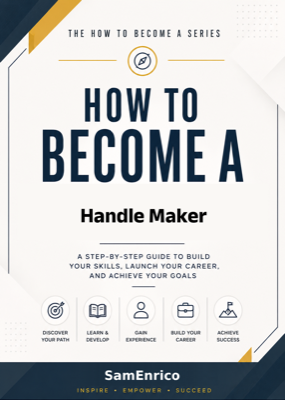
How to Become a Handle Maker Paperback
How to Become a Handle Maker
by Smyth Alba
How to Become a Handle Maker
Formats
Free sample
Chapter 1: The Bone-Handled Knife--It was a bone-handled hunting knife, and my grandfather had carried it for forty-seven years. The blade had been sharpened so many times that it had lost a quarter-inch of its original width. The leather sheath was cracked and stained. But the handle — the handle was smooth as river glass, dark amber where his palm had rested for decades, perfectly shaped to the negative space of his grip. When I held it as a boy, it felt wrong in my small hands.
When I held it as a man, after he was gone, it felt like shaking hands with a ghost.That knife taught me something that took me another fifteen years to fully understand: a handle is not a part of an object. A handle is the conversation between an object and a human body. And most people — including most craftspeople — are having the wrong conversation.If you have picked up this book, you already sense that something is missing from your work. Perhaps you are a potter who has watched a beautiful mug sit unsold because the handle felt awkward in the customer's hand. Perhaps you are a knife maker who has mastered heat treatment and blade geometry, only to watch a $400 chef's knife get returned because "it just doesn't feel right." Perhaps you are a woodworker who has built a flawless tool chest, but the drawer pulls — those afterthoughts you added at the end — look like exactly what they are: afterthoughts.Or perhaps you are none of these things yet.
Perhaps you are a beginner who has never touched clay or wood, but you have noticed that every tool you own has a handle that could be better. The hammer that gives you blisters after an hour. The kitchen knife that makes your wrist ache. The coffee mug that forces you to bend your hand at an uncomfortable angle. You have wondered: Why doesn't anyone make this right?Here is the answer: because making handles properly is hard.
It requires knowledge of anatomy, physics, material science, and aesthetics. It requires patience and a willingness to fail. Most craftspeople never master it because they treat handles as the last thing they do — an afterthought, a necessary evil, a finishing touch.That is where you come in.This book exists because a small number of craftspeople have discovered a secret that the rest of the world hasn't figured out yet: you can build an entire career making only handles. Not mugs. Not knives.
Not furniture. Handles. Because handles are the single point of failure for almost every functional object. A blade can be perfect, but if the handle breaks or causes discomfort, the tool is worthless. A mug can be thrown to perfection, but if the handle snaps or pours poorly, the customer will never use it twice.I have written this book for three kinds of people.
First, the potter, knife maker, or woodworker who wants to finally master the one skill that has always eluded them. Second, the aspiring craftsperson who wants to skip the decade of trial and error and go straight to professional results. Third, the entrepreneur who sees an opportunity in a niche that almost nobody is filling — the handle specialist, the person other makers hire to do the work they hate.By the time you finish this book, you will understand why a handle that is two percent too heavy can cause measurable wrist fatigue. You will know why vinegar makes clay handles stick better. You will be able to look at a raw block of wood or a lump…
This is the end of the free sample. Get the Paperback to keep going. Buy now
About this book
Details
- Author
- Smyth Alba
- Publisher
- SamEnrico
- Language
- English
- ISBN
- 9781505773095
- Genre
- Non-Fiction, Informative, Educational
- Released
- 2026-05-02
- Pages (approx.)
- 129
- Available as
- eBook, Paperback, Audiobook

Read better in the ZLOADR app
Your eBooks on your phone or tablet. Sign in with your SamEnrico account and start reading.
More by Smyth Alba
 Alcoholism and Trauma ConnectionSmyth Alba$11.99
 Helplessness AngerSmyth Alba$11.99
 The Death of a ParentSmyth Alba$11.99
 Art Supply Toxin GuideSmyth Alba$11.99
 The Lion of Carrhae: Surena's Last Stand Against RomeSmyth Alba$11.99
 How to Produce Clarinet ReedsSmyth Alba$11.99
 US Address for Non Resident BankingSmyth Alba$12.99
 Skijoring With HorsesSmyth Alba$11.99