
Non-FictionInformativeEducational
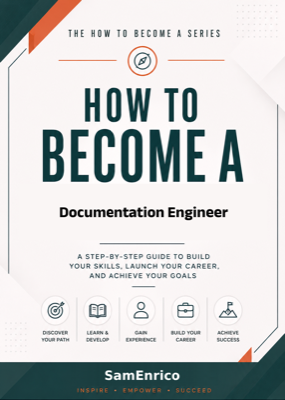
How to Become a Documentation Engineer eBook
How to Become a Documentation Engineer
How to Become a Documentation Engineer
Formats
Free sample
Chapter 1: The Invisible Career–– In the summer of 2019, a senior technical writer named Priya sat in a crowded conference room at a mid-sized Saa S company, watching yet another product launch meeting unfold without her. The engineers talked about API rate limits, database migrations, and breaking changes. The product manager sketched user flows on a whiteboard. The developer advocate planned sample apps and hackathons. Priya raised her hand and asked, “Who is updating the documentation for the new authentication endpoint?” Silence.
Then the engineering lead said, “We’ll get to it after launch. Can you just clean up the old docs in the meantime?” Priya smiled, nodded, and took notes. Six weeks after launch, support tickets had tripled. Users could not figure out how to authenticate. The company lost an estimated four hundred thousand dollars in wasted developer hours and churned customers.
Priya had warned them. No one had listened. She quit three months later—not because she was bitter, but because she had discovered a new role at a different company. The title was “Documentation Engineer.” Her salary increased by sixty-two percent. And at her first sprint planning meeting, when she asked about documentation, the engineering manager said, “You tell us what you need.
You own the docs pipeline.”This chapter is for everyone who has ever felt like Priya—invisible, underappreciated, and fighting uphill for basic respect. It is also for the developer who secretly enjoys writing clear explanations, the support engineer who is tired of answering the same question fifty times, and the technical writer who learned Git last weekend just to keep up. This chapter defines what a documentation engineer actually does, why the role exists, and how it differs from everything that came before. By the end, you will know whether this career path fits you—and you will have a clear self-assessment to guide your next steps.The Problem That Created the Role To understand the documentation engineer, you must first understand the failure of traditional documentation models. For decades, technical writing followed a simple pattern: subject matter experts (usually engineers) wrote down what they knew, a technical writer edited for clarity and consistency, and the final output was published as a PDF, a help file, or a static website.
This model worked reasonably well for shrink-wrapped software with annual release cycles and dedicated documentation teams. But modern software development broke that model in at least four ways.First, release cycles compressed from years to weeks or even days. Continuous deployment means code changes multiple times per day. Traditional documentation, updated quarterly, cannot keep pace. By the time a PDF is printed, the API it describes is already obsolete.
Second, software became orders of magnitude more complex. A single modern application might include a REST API, a Graph QL endpoint, a Web Socket server, a command-line interface, a mobile SDK, and a webhook system. No single technical writer can master all these domains. Third, users changed their behavior. No one reads documentation cover to cover anymore.
They arrive via search engines, click a link from Stack Overflow, or land on a page directly from a chat conversation. Every page must stand alone. Fourth, and most critically, documentation became a competitive differentiator. Stripe, Twilio, and other developer-first companies proved that excellent documentation could be a moat. Developers choose APIs based on documentation quality.
Bad documentation loses customers. Good documentation retains them.The traditional technical writer was never equipped to solve these problems. Technical writing as a discipline focuses on prose, user psychology, and instructional design—all valuable skills, but insufficient for the scale and speed of modern software. The documentation engineer emerged as a hybrid role, combining the technical depth of a software engineer with the user empathy of a writer and the systems thinking of an information architect. This is not a writer who knows a little Git.
This is a professional who can design, build, test, deploy, and measure documentation as a first-class product.What a Documentation Engineer Actually Does Let us be precise about the day-to-day responsibilities of a documentation engineer. The title varies across companies—some call this role “Developer Experience Engineer,” others “Technical Content Engineer,” and a few simply “Senior Technical Writer with a focus on tooling.” But the core activities are remarkably consistent.A documentation engineers builds and maintains the documentation pipeline. This includes selecting and configuring static site generators (like Docusaurus, Mk Docs, or Hugo), setting up continuous integration workflows that test documentation on every commit, and ensuring that deployment is a single command rather than a manual ritual. When the pipeline breaks—and it will break—the documentation engineer fixes it.A documentation engineers designs information architecture at scale. This means creating content models that allow reuse without duplication, designing navigation systems that work for both beginners and experts, and implementing search that actually returns useful results.
When a product manager asks for a new section, the documentation engineer knows whether to create a new page, extend an existing one, or reference content from elsewhere.A documentation engineers writes and reviews technical content. Despite the engineering title, writing remains central to the role. But the writing is different. Documentation engineers write API reference documentation from Open API specifications, error messages that guide users toward solutions, UI microcopy that reduces confusion, and runbooks that help on-call engineers debug production issues. They also review contributions from other engineers, ensuring that code examples compile, terminology remains consistent, and explanations match the intended audience.A documentation engineers tests everything.
Link checkers run automatically to catch 404s. Code snippets execute in CI to confirm they still work. Style guides are enforced through linters. Screenshots are validated against the live application. When a test fails, the documentation engineer treats it as a bug—with a ticket, a severity rating, and a fix.A documentation engineers measures and analyzes.
They instrument documentation with analytics to understand what users search for, where they click, and when they give up. They build dashboards that show documentation health over time. They use data to prioritize rewrites, not gut feelings.A documentation engineers collaborates across disciplines. They attend sprint planning to identify documentation requirements before coding begins. They participate in design reviews to catch missing error messages.
They review pull requests for documentation impact and block merges when documentation is missing for user-facing changes. They negotiate with product managers for documentation capacity and with engineers for accurate examples.This is not a support role. This is not an afterthought. This is a core engineering function with the same weight as backend, frontend, or infrastructure.The Myth of the “Natural Writer”A dangerous myth pervades the technology industry: the belief that good writers are born, not trained. This myth harms documentation engineers in two ways.
First, it discourages people who do not see themselves as “natural writers” from pursuing the role. Second, it allows organizations to underinvest in documentation by assuming that anyone with a humanities degree can handle it.The truth is that effective technical documentation is a learnable skill, not an innate talent. The most successful documentation engineers I have worked with came from diverse backgrounds: former QA engineers who learned to write, former support technicians who learned…
This is the end of the free sample. Get the eBook to keep going. Buy now
About this book
Details
- Author
- Ainsworth Mariko
- Publisher
- SamEnrico
- Language
- English
- ISBN
- 9781505751031
- Genre
- Non-Fiction, Informative, Educational
- Released
- 2026-05-06
- Pages (approx.)
- 156
- Available as
- eBook, Paperback, Audiobook

Read better in the ZLOADR app
Your eBooks on your phone or tablet. Sign in with your SamEnrico account and start reading.
More by Ainsworth Mariko
 Senior Media Esteem GuideAinsworth Mariko$11.99
 Gratitude for the BodyAinsworth Mariko$11.99
 Childcare Cost CrisisAinsworth Mariko$11.99
 Assertiveness Training for MenAinsworth Mariko$11.99
 Mindfulness for Stress Reduction BasicsAinsworth Mariko$11.99
 The Unseen War: How a Forgotten Conflict Shaped the Modern WorldAinsworth Mariko$11.99
 Behavior AnalystAinsworth Mariko$11.99
 Netflix SWOT Analysis Library GuideAinsworth Mariko$12.99
 Accounting Formulas for Excel MasteryAinsworth Mariko$12.99
 Understanding Myoclonic Progressive Familial EpilepsyAinsworth Mariko$17.99
You may also like
 Hong Kong Handover 1997Dunn Johnnie$11.99
 Zumba For Postnatal Recovery CourseNeal Christian$11.99
 Zumba for BeginnersLadner Nikia$11.99
 YouTube Comment Mining GuideHumes Pandora$12.99
 Worry Box MeditationCarlin Rudy$11.99
 Workplace Stress MeditationNguyen Lynn$11.99
 Workplace Stress and Sleep RepairHawley Ivory$11.99
 Workplace Perfectionism CureDelaney Jeffry$11.99
 Workplace Injustice Anger GuideWallen Isabelle$11.99
 Work Addiction and Burnout LinkGreenwood Ester$11.99
 Women in Yoga and WellnessBeattie Galina$11.99
 Women in Stand Up ComedyChun Evangeline$11.99